Books & the Arts / The Genius of Ella Fitzgerald She remade the American songbook in her image, uprooting the very meaning of musical performance.
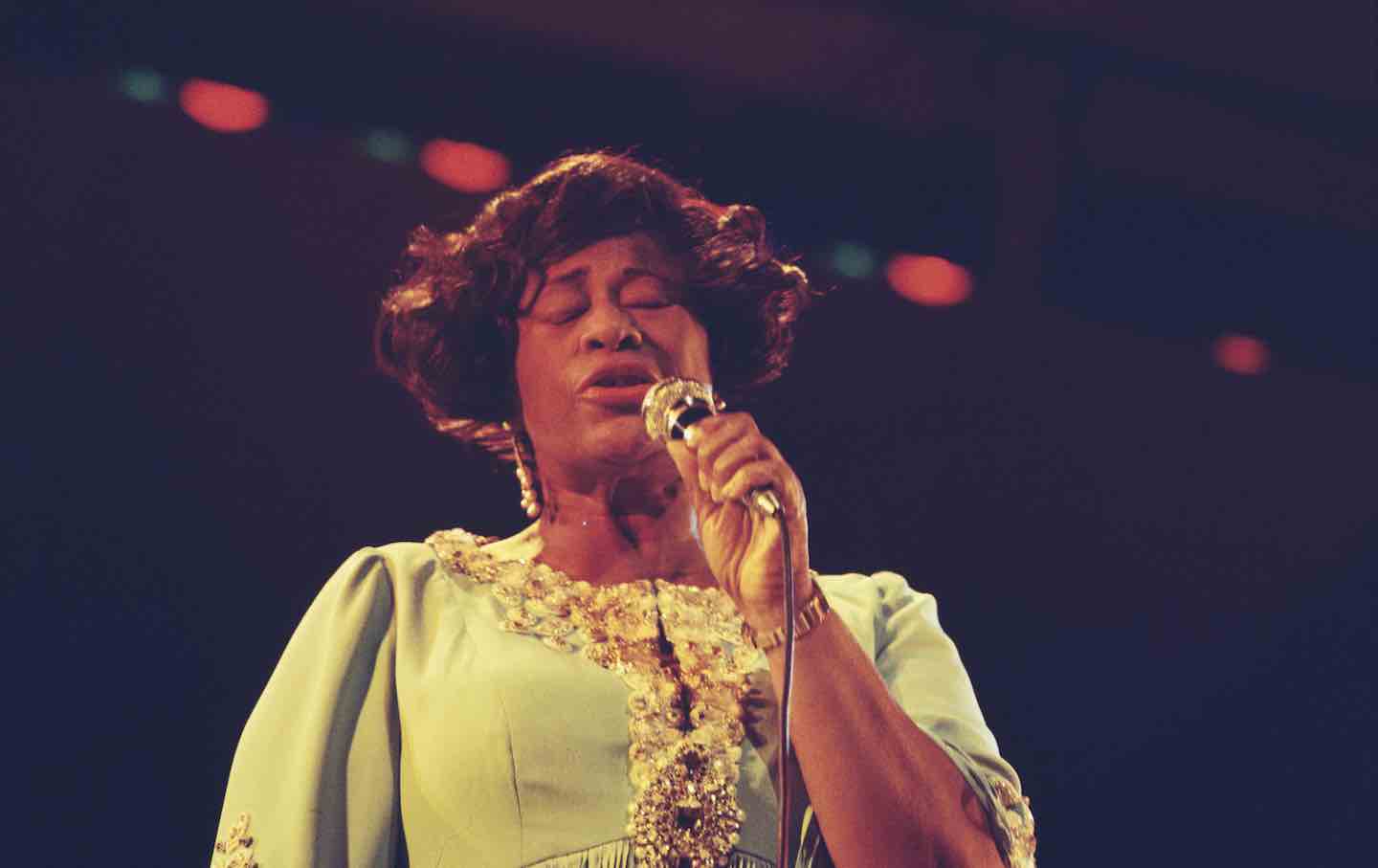
Ella Fitzgerald at the Newport Jazz Festival in Newport, Rhode Island, 1970.
(Photo by David Redfern / Redferns)
Ella Fitzgerald made singing feel like thinking. Her interpretations of the Great American Songbook—taken as a whole, still its most ambitious rendering to date—are full of harmonic risk and expressive lucidity. Her exhaustive approach to improvisation, exemplified in the revelations of scat, made her a moving “music laboratory,” in Margo Jefferson’s phrase: a musician whose experiments seemed to alter the possibilities of performance.
Books in review Becoming Ella Fitzgerald: The Jazz Singer Who Transformed American Song Buy this book
Fitzgerald was also, observers in her lifetime mused, a “lamb,” a “pretty bird,” “an innocent with the musical capacity of a sweet wizard.” She “too often sounds like a child,” the jazz critic Nat Hentoff wrote. Perhaps even more than her peers, an obsession with Fitzgerald’s appearance defined her reception. In an interview near the start of her career, a reporter for Baltimore’s Afro-American plied her about her eating habits before noting that she’d recently gained 30 pounds. Fitzgerald understood that perceptions could make or break careers. “When a girl comes up and she looks like me,” she told the same reporter, “she just can’t get a chance.”
A further line of criticism cut directly at her music: The songbook, that old American theater fare, was simply “outside Ella’s understanding.” Another critic admitted that he “sometimes wondered if she knew what the words meant.” A third agreed that she had never been a “profound interpreter of lyrics.” And a fourth: “Whatever praiseworthy [things] one may say about Miss Fitzgerald, intelligence is certainly the one quality to which her voice could never lay claim.”
The scope of this particular disparagement emerges fully in Becoming Ella Fitzgerald, a recent biography by the musicologist Judith Tick. Tick captures the breadth of Fitzgerald’s treatment by the press, particularly in Black newspapers, where she gave some of her most revealing interviews; from it emerges a portrait of the condescension Fitzgerald endured. The existence of the criticism is not new or surprising, and these floggings never derailed her career. But Tick’s book raises a range of possible answers to a question that helps register both the cultural force of Fitzgerald’s music and our evolving apprehension of her life: Why did critics fixate on her depth?
Ella Fitzgerald was born in 1917 in Virginia, though she spent her childhood in Yonkers, New York, where Black and immigrant residents of the industrialized neighborhoods were partitioned from the white Manhattan commuter class. Before she became a singer, she was a formidable teenage dancer, a practitioner of the fad moves of the late 1920s and early ’30s—the Lindy Hop, the Charleston, the Shim Sham Shimmy, the Big Apple, the Scrontch—that set the pace at Harlem’s Savoy Ballroom.
After a stint in youth detention for skipping school, Fitzgerald earned a chance to sing for the drummer Chick Webb, an inventive bandleader with whom she would spend the first four years of her professional career. Webb was an ideal collaborator, because his group was the house band at the Savoy; his rhythms shaped and took shape from popular social dance. Perhaps more than ever again in its history, jazz’s function at the time was to help dancers move, and its keenest practitioners—the dance bands who played not just jazz but Latin music, waltzes, and more—paid close attention to their counterparts. Webb had “such command of his audiences at the Savoy ballroom,” Duke Ellington later wrote, “because he was always in communication with the dancers.”
Fitzgerald became a star with Webb, writing and performing hits like “A-Tisket, A-Tasket.” She played her first gigs with him at age 17, and her rhythmic versatility won her quick acclaim. Fitzgerald was the only woman in the band: Scatting—the technique for which she became famous—was born from her desire (encouraged by Webb) to participate in the group’s after-hours jam sessions. “I felt out of place until Chick suggested I improvise on my voice,” she told an interviewer. Those four years with Webb turned out to be the last four of his short life. At the drummer’s funeral, Fitzgerald sang “My Buddy” while the rest of the band wept.
Fitzgerald led the group under her own name for several more years, trying to find her footing. In 1941, at age 24, she married a man nicknamed “Cigaret” while on the road in St. Louis. The marriage was annulled a year later. The war proved something of a slump for her career, which was managed during its first decades by Savoy Records cofounder Moe Gale and then—more famously, starting in the mid-1950s—by the impresario Norman Granz.
Granz was a force whose ends were neither merely musical nor managerial. He was the same age as Fitzgerald, and their adolescence (his in Los Angeles, hers in Harlem) saw musicians ally with the Popular Front. The labor historian Archie Green, a childhood friend of Granz’s, recalled their shared youthful enjoyment of “New Deal culture”: WPA theater, Hall Johnson’s gospel choir, reading The Nation and The Atlantic Monthly at the public library. Swing became “the preeminent musical expression of the New Deal,” as the historian David Stowe wrote in a 1994 book. The Chick Webb Orchestra played at Daily Worker–sponsored events in the late 1930s, and Fitzgerald lent her time to an artists’ committee that helped elect the Black communist Benjamin Davis to the New York City Council.