Objectives
To evaluate the efficacy of eye exercises in preventing and controlling myopia.
Methods
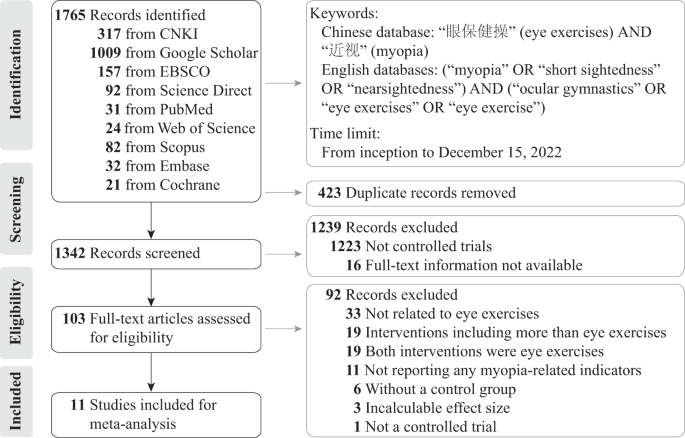
We searched studies on eye exercises from nine Chinese and English databases from their inception to December 15, 2022. Using random-effect models and sensitivity/subgroup analyses, we estimated the effects of eye exercises compared to control on changes in three measures: visual acuity, refractive error (both quantified using standardized mean differences, SMDs), and protective/mitigating effects (assessed through risk ratios, RRs).
Results
Eleven studies were included in the meta-analysis, with 921 participants. Nine studies had some concerns of bias in at least two domains, and two studies had a high risk of bias in two domains. Seven studies used visual acuity to measure myopia; visual acuity declined after eye-exercise interventions (SMD = −0.67, 95% CI −1.28 to −0.07, Z = 2.17, P = 0.03) and the effect was not better than control (SMD = −0.50, 95% CI −1.16 to 0.16, Z = 1.49, P = 0.14). Two studies used refractive error to measure myopia; the effect of eye-exercise interventions did not differ from control (SMD = −1.74, 95% CI −6.27 to 2.79, Z = 0.75, P = 0.45). Seven studies reported on protective/mitigating effects; eye exercises exhibited a greater protective/mitigating effect than control (RR = 0.40, 95% CI 0.23–0.71, Z = 3.13, P < 0.01).
Conclusions
Overall, the results suggest that eye exercises have limited to no efficacy in preventing or controlling myopia progression. Until robust evidence supports their efficacy, available evidence suggests retiring the eye-exercise policy.