Books & the Arts / The Uses and Misuses of Spinoza The beguiling Dutch philosopher’s life and work is prone to misunderstandings and misreadings. A recent biography goes so far as to recruit him into the culture war.
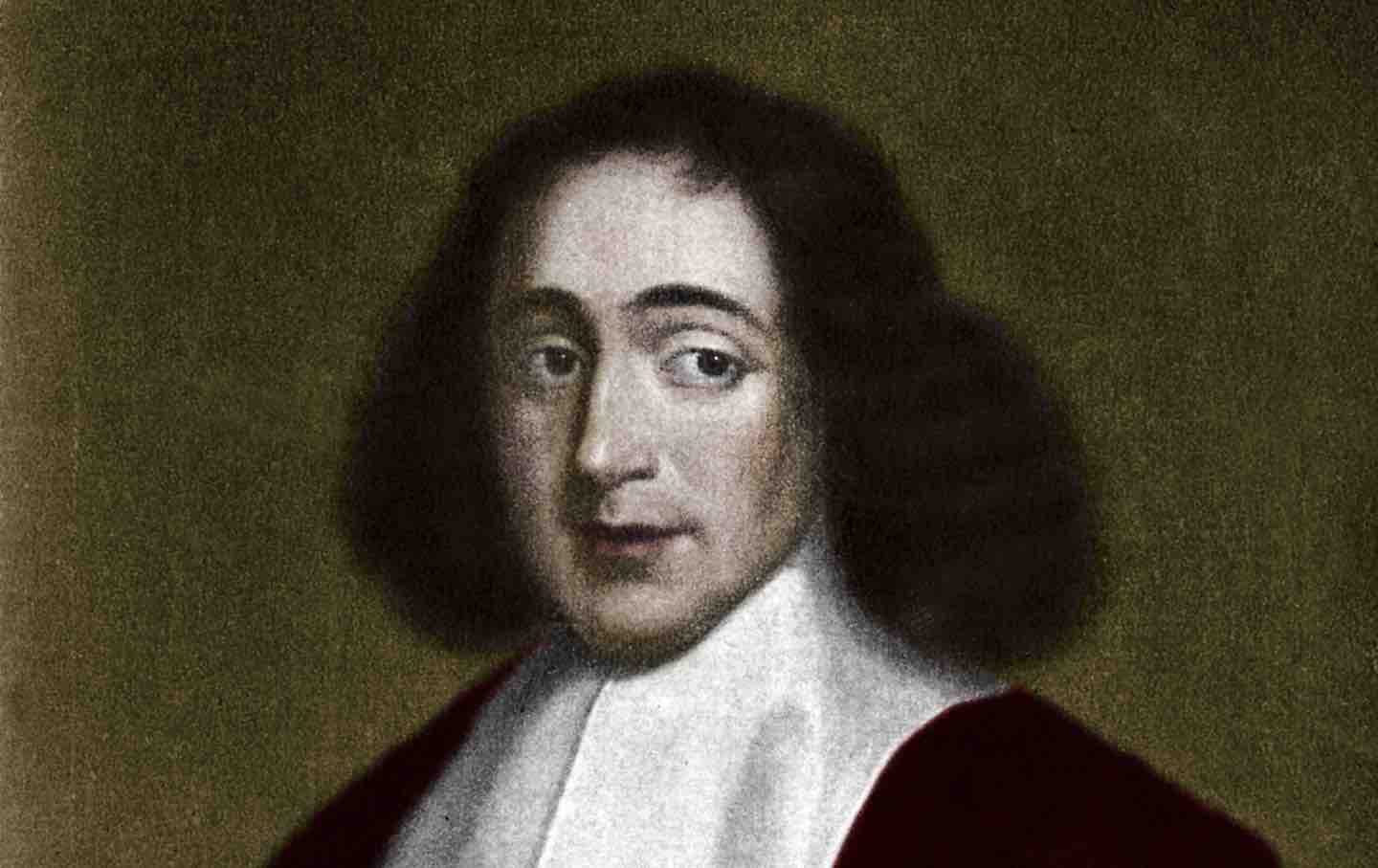
A portrait of Benedict (Baruch) Spinoza, 1754. (Photo by Bridgeman via Getty Images)
Born in Amsterdam in 1632, Baruch Spinoza was the most original thinker of the European Enlightenment. Three and a half centuries later, his philosophy retains a sense of strangeness and novelty long exhausted in Descartes, Locke, or Voltaire. So distinctive was his thought that at a young age, before he had published a word, rumors circulated through the republic of letters about the Jew who was not a Jew but possessed an encyclopedic knowledge of the Bible along with a radical new method for reading it, and who had solved many of the metaphysical problems left behind by Descartes. At Spinoza’s country home in Rijsenburg, just outside of Leiden, and later in The Hague, figures like Christiaan Huygens, Henry Oldenburg, and G.W. Leibniz called on him to discuss his experiments in optics or to try and catch a glimpse of the long-rumored manuscript of his Ethics.
Books in review Spinoza: Freedom’s Messiah Buy this book
With the publication of the Tractatus Theologico-Politicus (1670), Spinoza’s quiet fame among scientists and philosophers turned into a vehement, Europe-wide notoriety and near-universal condemnation. A relentless, unprecedented assault on the tenets of the Abrahamic religions and on religious institutions more generally, the Tractatus was universally banned and reviled. Less incendiary but no less widely censored, the posthumous Ethics reimagined God as infinity itself, constructing an immanent univocal ontology (“monism”) in place of Descartes’s increasingly paradigmatic substantial dualism. Declaring that good and evil are nothing but judgments in the mind and that “virtue” is merely each individual’s sustained, rational pursuit of their own well-being, Spinoza espoused an ethical philosophy that was widely but falsely decried as atheistic and hedonistic.
“No philosopher was ever more worthy,” wrote Gilles Deleuze, the 20th century’s foremost exponent and interpreter of Spinoza, “but neither was any philosopher more maligned and hated.” Notorious throughout Europe by the end of his short life, in death the philosopher assumed mythic proportions and his biography became a conundrum, for every report and witness testimony agreed that this man, whose blasphemous ideas brought him an infamy normally reserved for tyrants and heresiarchs, was unimpeachably virtuous, living a modest, frugal, and kindly existence. No other philosopher since Socrates has been so persistently regarded as a paragon of the philosophical life.
For an intellectual of his era and reputation, little is known about Spinoza’s life. He left no diary; only one of his works, the unfinished “Treatise on the Emendation of the Intellect,” contains any biographical information. Like most of his peers, he maintained regular correspondences by letter, but only a fraction have survived; anything the generally circumspect philosopher did not destroy himself was carefully pruned by his literary executors, who preserved only “philosophical” epistles. A few defining events form the core of every account of him: his birth in Amsterdam’s Jewish community and his banishment from it; his retreat to the countryside, where he drafted the Ethics while grinding glass lenses; his extensive association with fringe Dutch Protestant groups. But there are entire years about which we know nothing.
Jonathan Israel’s Radical Enlightenment and its sequels (including a weighty biography of Spinoza published at the end of last year) showed that Spinoza’s books had wide distribution despite being banned, and that a surprising number of European thinkers who were not supposed to have copies of the books engaged quite deeply with their contents: Leibniz, Hume, and Kant are just a few of the major figures who attacked Spinoza while bearing the obvious marks of his influence. For most readers, however, knowledge of Spinoza came secondhand, from vituperative reports written by furious clergy and indignant professors, and from biographies that were popular but significantly unreliable.
Every early account of Spinoza’s life and thought presents the Jewish community he was exiled from as benighted, superstitious, and medieval in comparison with its mostly Dutch Calvinist surroundings, which existed on the cusp of the Enlightenment in a de facto state of “toleration.” The assumption that the encounter with gentile philosophy spurred him on his path of apostasy neatly explains the otherwise difficult problem of Spinoza’s banishment: In this story, it was rationality itself that made the Jews of Amsterdam tremble in fear and loathing as much as any particular dogma Spinoza may have espoused. In Pierre Bayle’s account, “the rabbis” feared Spinoza enough to send hired daggers after him post-banishment—an unlikely story. (My own best guess is that the great philosopher probably just got mugged.) This image of Spinoza, and of his relationships both with Judaism and with his post-exilic Christian environment, remained consistent and dominant well into the 20th century; as late as 1935, Paul Hazard described Spinoza as “a Jew, but a Jew despised by the Ghetto.” The narrative of the philosopher’s banishment proved irresistible to later Protestant thinkers. Spinoza was permitted his place in the canon of the Enlightenment not least because he offered proof that both Catholicism (through the Inquisition) and Judaism (through banishment) would chew up and spit out those who offered the promise of rationality and free thought.
In 1899, Jakob Freudenthal published the first critical biography of Spinoza, collecting every available historical document and initiating a scholarly and archival renaissance. Extensive and previously unknown information about the philosopher’s family, education, and finances, as well as a copy of his writ of banishment, were found in the Amsterdam archives in the following decades. In the 1940s, Israel Revah found previously unknown reports about Spinoza and his circle written by Spanish visitors to Amsterdam shortly after the philosopher’s banishment. Along with a great influx of new research on the history of Spanish and Dutch Judaism, these developments not only gave us valuable new biographical details but also significantly transformed our understanding of the philosopher’s origins and youthful context.
Hardly a “Ghetto,” the Sephardic community of 17th-century Amsterdam was a dynamic and generally prosperous group of recently reconverted Jews who served as a crucial cog in the rapidly expanding economic machinery of the Dutch Golden Age. Spinoza’s milieu was the first generation born in the United Provinces, and like most of his peers he grew up well-educated and multilingual. Neither resistant to new ideas nor trapped in medieval superstition, Spinoza’s community offered advanced Talmudic study for its most promising pupils but also a range of study and discussion groups. Spinoza’s own father probably paid for his Latin tutor.
We also know now that Spinoza acquired significant skill in philosophy before he left the Jewish community, and probably long before he read Descartes. In early accounts and in quite a few today, “Jewish thought” means rabbinical Talmud study (halakha) and sometimes Kabbalah. The existence of a separate Jewish Aristotelian tradition, a tradition often directly hostile to Kabbalah, was largely unknown, and it was easy to assume that Spinoza’s strange and unprecedented system was simply Cartesian philosophy filtered through an unspecified Jewish lens. This position is exemplified by Hegel, who was both obsessed with Spinoza and highly critical of him; in the lecture on Spinoza in his Lectures on the History of Philosophy, Hegel writes that “the dualism present in the Cartesian system is decisively abolished by Spinoza—as a Jew.” The idea that Spinoza was a strange offshoot in an emerging European movement and not the acme of a long and rich pan-Mediterranean tradition goes hand in hand with the centuries-long disavowal on the part of Western scholars of the profound and sustained influence of Muslim and Jewish philosophy on European thought in the medieval and early modern periods.
Carefully and slowly, to a significant degree through the work of Jewish scholars, centuries of myth and prejudice around Spinoza’s life, thought, and environment have been unpeeled. And now comes Ian Buruma’s new biography, Spinoza: Freedom’s Messiah, determined to undo a century of progress in Spinoza studies and rebuild some of the most tired myths around the philosopher and his ideas, valiantly reiterating these retrograde perspectives in the face of much new evidence to the contrary.