The MIT AI Lab, with a PDP-10 at its heart, was hugely important in computer history, with many 'firsts' on its record. Over the past decade, a group of enthusiasts did a full reconstruction of the Lab's hardware and software as it stood in the 1970s. The PiDP-10 gives a physical shape to this project , we regard it as a 'computer history capsule'. A self-contained, compact replica that gives an experience as close as possible to the real machine and the AI Lab. But now at home, perhaps even in the living room. Our goal is not to show computer history, but to keep hands-on experience of it alive. The PiDP-10 lets you operate highlights of the AI Lab hardware, the ITS operating system, and hundreds of applications as they evolved during the late 1960s and 70s. One particular example is Shrdlu : the first demonstration of AI that in the 70s, triggered the first massive wave of interest in the field.
Background Story
In 1968, the PDP-10, model KA10, brought DEC into the world of mainframe-class machines. The PDP-6 had already defined the architecture four years earlier: a 36 bits CPU with a rich, very complex instruction set that feels completely esoteric today. Alas, the PDP-6 was notoriously unreliable. It took the PDP-10 before DEC got it right.
The fact that it was designed for real-time multiprocessing set it apart from other mainframes: this was the Big Iron that you used interactively on a terminal. No batch processing with punch cards. Thus, hackable. Its TOPS-10 operating system was groundbreaking, starting the lineage of RT-11 (PDP-11), OS/8 (PDP-8), CP/M and in the end of the line, MS-DOS. But TOPS-10 was much more powerful than the microcomputer OSes it inspired, properly multi-user, multi-tasking.
The PDP-10 at the LCM in Seattle, where we could verify our front panel's exact behaviour
Famous from computer lore, the PDP-10 was also the breeding ground for the early Hacker Culture at MIT, made famous by Levy’s book Hackers. At the Artifical Intelligence Lab, the Ten was at the heart of a large collection of connected hardware, and its ITS operating system became a playground for computer scientists and hackers alike. MacLisp, emacs, the earliest AI demos, they were born on ITS. An operating system so esoteric that the debugger doubled as the command line, and although massively multi-user, connected to the early internet, open for all to visit – it had no password or security. Anyone from anywhere could join for a game of multi-user Mazewar on it – or crash the whole system. Which nobody seemed to do as it was just too easy to be cool.
The original MIT PDP-10 console, a bit worse for wear after a decade of hackers' gefingerpoken
Free software was born here, Stallman was one of the ITS hackers. But, funny enough, Microsoft as well: Bill Gates and Paul Allen wrote Micro Soft Basic on a PDP-10 at Harvard, running their homebrew 8080 emulator. Allen’s love for the PDP-10 drove him to a full restoration of a KA10 in the 2010s. And in fact, when that restored machine came to life, it gave us the one and only opportunity to check our our replica against a live real machine. Sadly, Allen passed away just before the restoration was completed, and the future of The Last KA10 looks dim now. Making us even more grateful for that tiny time slot in which we could perfect the replica's behaviour.
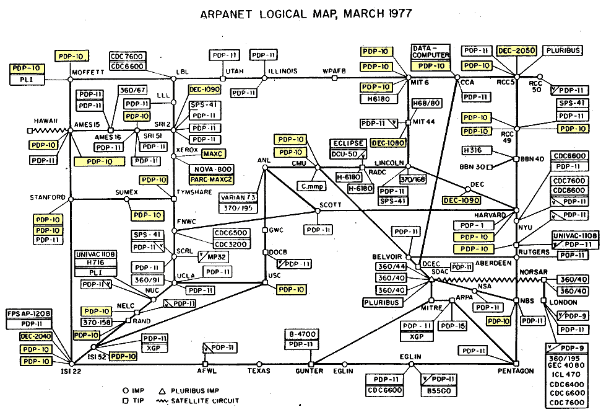
The Ten also played a key role in early networking. MIT had its own Chaosnet running early on, and soon, with the Interface Message Processor (IMP), it connected to the ARPANET, that would evolve into the modern-day internet. All the PDP-10s in this chart of the ARPANET in March 1977 are marked in yellow. As the IMP is included in the PiDP-10 simulator, plans are afoot to recreate this early ARPANET snapshot with a group of PiDP-10 and -11s.