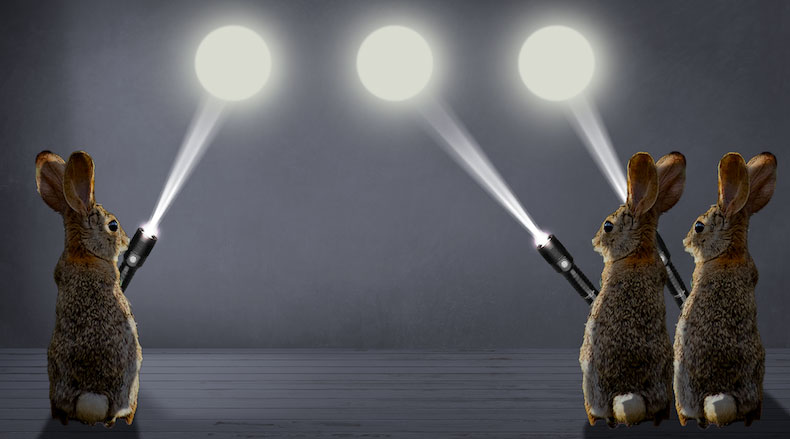
Their findings indicate that participants misperceived the second flash, placing it near the midpoint between the first and last flash. This illusion occurred regardless of whether the second flash was at the same location as the third or even further to the right of the third flash. “It's like a rabbit hopping back to the middle after the brain processes it,” comments Sheryl Anne Manaligod de Jesus, the first author of the study and a doctoral student at Kyushu University's Graduate School of Design.
Additionally, the researchers found that the flashes do not need to be presented in a line for the illusion to happen. Even when the second flash appeared above or below the midpoint, its perceived location still tended to be near the center. This happens because when our visual system receives flashes in rapid succession, the brain processes them as a whole, leading to a perceptual reorganization of the flashes into a simpler, more coherent pattern.
One way to further investigate the visual saltation illusion's mechanisms is by providing the experimental results to artificial intelligence. Comparing human and AI responses could indicate whether our visual pathways are simpler or more complex than we imagine.
What we “see” is not solely dependent on our vision, it is often a construction of our brain, influenced by attention and memory. This questions the reliability of eyewitness testimony. “Our brain sometimes uses future events to interpret the past,” says de Jesus, “This is called postdiction, meaning that how we perceive a past event, like the second flash, is influenced by what happens afterward. This results in the fascinating illusion of the flash appearing in a place, where it never really was.”
As the study suggests, our peripheral vision, especially with fast-moving objects, is not completely reliable. Further research into visual saltation illusions is needed to help us better understand visual processing and potentially improve our peripheral vision. After studying how position changes affected the perceived “rabbit,” the team’s next step is to explore how attention impacts the illusion.
Where hops the rabbit? Or do we see a rabbit or a duck? How much does our brain mislead our sense of the visual world? Despite needing more research to fully understand these illusions, their power to enrich our lives with unique and enjoyable experiences is clear. As Professor Hiroyuki Ito, the supervisor of de Jesus and the second author from Kyushu University's Faculty of Design, remarks, “The most important thing is to enjoy the illusions.”