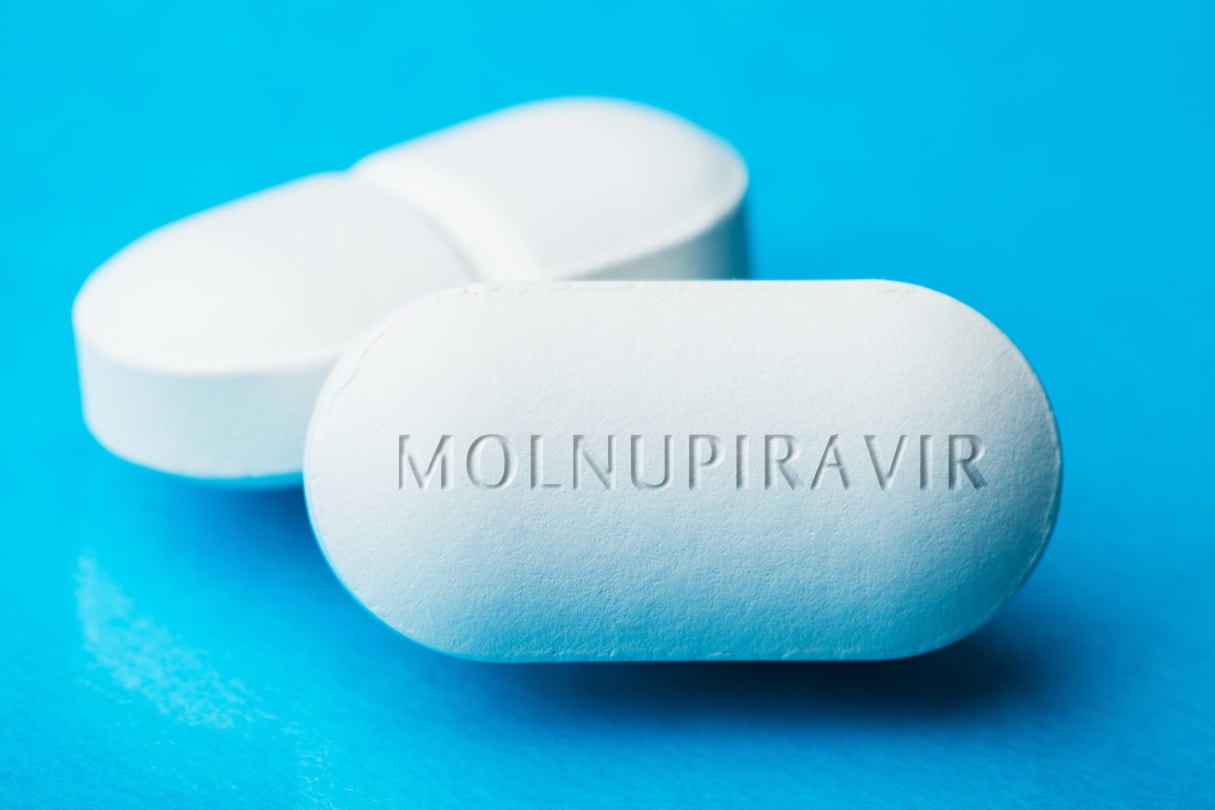
Over the past year, discussions—sometimes heated ones—about ending the COVID-19 pandemic have largely focused on the availability, effectiveness, and safety of vaccines. But in early October, Merck reported on a promising new drug treatment that could be given as a pill in the days after COVID-19 symptoms arise to prevent severe disease. This news, which many are hailing as a potential game-changer, is already starting to change the conversation.
Merck has applied to the Food and Drug Administration (FDA) for emergency use authorization (EUA) of the pill, called molnupiravir. While an authorization could become available in a matter of weeks, it’s not yet clear who would get it. But what we do know is that the company says it performed so well in a clinical trial that it halted the trial early, so it could move quickly to apply for the EUA. A company press release reports that the drug cut the risk of hospitalization and death by half in patients who had mild-to-moderate disease.
“It certainly has the potential to be a really important advance,” says Albert Shaw, MD, PhD, a Yale Medicine infectious diseases specialist. “Other COVID-19 treatments, such as remdesivir or monoclonal antibodies against the SARS-CoV-2 virus causing COVID-19, are given intravenously. This is a pill your physician could write a prescription for, that you could pick up in a drugstore.”
We asked Dr. Shaw and other infectious disease experts to answer commonly asked questions about Merck’s new COVID pill.