Your support helps us to tell the story Read more Support Now From reproductive rights to climate change to Big Tech, The Independent is on the ground when the story is developing. Whether it's investigating the financials of Elon Musk's pro-Trump PAC or producing our latest documentary, 'The A Word', which shines a light on the American women fighting for reproductive rights, we know how important it is to parse out the facts from the messaging. At such a critical moment in US history, we need reporters on the ground. Your donation allows us to keep sending journalists to speak to both sides of the story. The Independent is trusted by Americans across the entire political spectrum. And unlike many other quality news outlets, we choose not to lock Americans out of our reporting and analysis with paywalls. We believe quality journalism should be available to everyone, paid for by those who can afford it. Your support makes all the difference. Read more
Oil prices held above $100 a barrel on Thursday as Iran seized two container ships in the Strait of Hormuz and peace talks with the United States remained deadlocked, even as Asian stock markets tracked Wall Street to record highs on strong corporate earnings.
Brent crude fell 15 cents to $101.76 a barrel after settling above $100 for the first time in more than two weeks on Wednesday, when both benchmarks closed more than $3 higher following larger-than-expected draws in US gasoline and distillate stocks and a lack of progress on negotiations. West Texas Intermediate slipped 14 cents to $92.82.
Iran seized two container ships seeking to exit the Gulf via the strait on Wednesday, tightening its grip on the waterway through which around a fifth of daily global oil and liquefied natural gas supplies flowed before the war began in late February.
Donald Trump extended the ceasefire on Tuesday following a request from Pakistani mediators but has maintained the US Navy blockade of Iran's ports, and Iranian parliament speaker and top negotiator Mohammad Baqer Qalibaf said a full ceasefire only made sense if the blockade was lifted.
The US military has also intercepted at least three Iranian-flagged tankers in Asian waters and is redirecting them away from positions near India, Malaysia and Sri Lanka, shipping and security sources told Reuters.
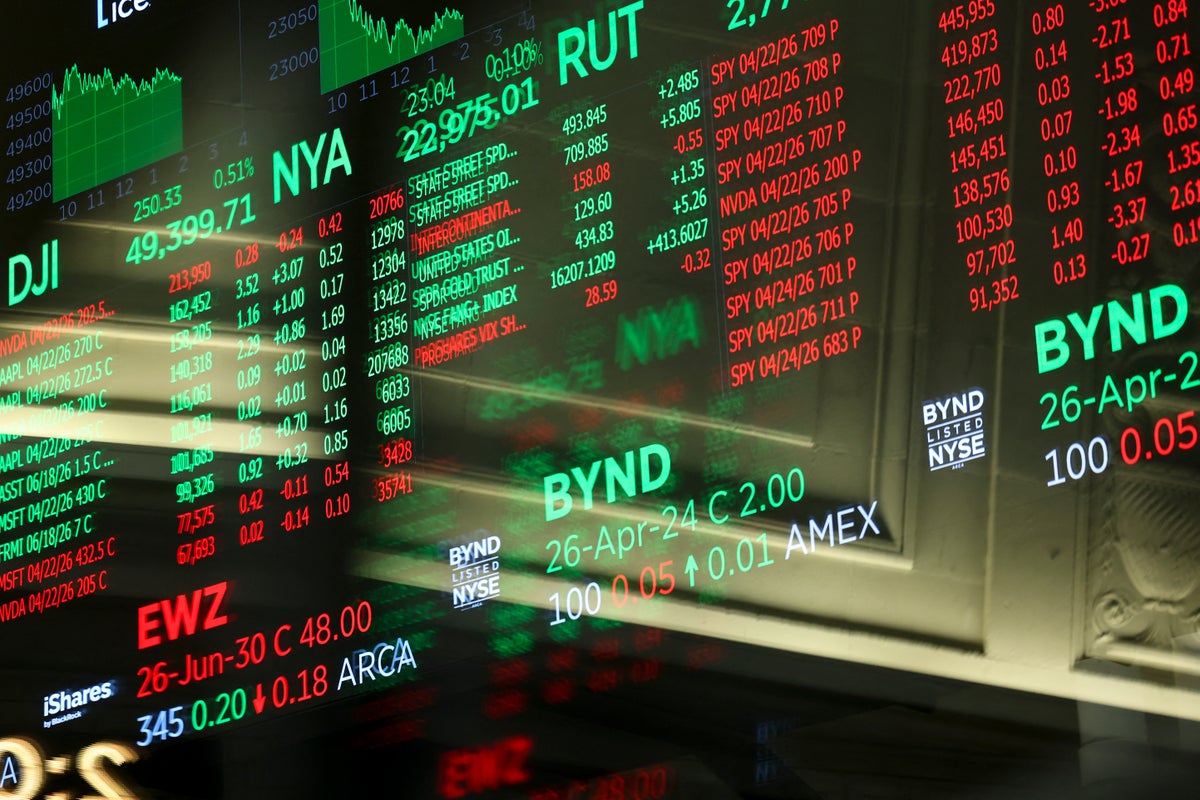
Despite the worsening energy picture, equity markets pushed higher. The S&P 500 climbed 1 per cent, and the Nasdaq jumped 1.6 per cent overnight to close at record highs, lifted by a strong start to earnings season.
( Getty )
On Thursday morning, Japan's Nikkei crossed 60,000 points for the first time, while South Korean and Taiwanese stocks also vaulted to records for a second consecutive day. MSCI's broadest index of Asia-Pacific shares outside Japan rallied 1 per cent to a record high. China's blue chips rose 0.3 per cent while Hong Kong's Hang Seng slipped 0.3 per cent.
Some analysts warned the disconnect between rising markets and rising risks was unsustainable. "Markets have been remarkably effective at looking through risks — and may continue to be. But the list of risks is growing as resolutions remain elusive," Laura Cooper, global investment strategist at financial services organisation Nuveen told Reuters.
"The dissonance cannot hold indefinitely. At some point, the weight of what is being ignored could become the only one that matters."
Skye Masters, head of markets research at the National Australia Bank, said it was "questionable whether financial markets are correctly pricing the reality that supply constraints will remain an issue for some time."
On the earnings front, GE Vernova surged 13.75 per cent after raising its annual revenue forecast on the back of AI-driven demand for power equipment, and Boeing advanced more than 5 per cent after reporting a smaller-than-expected quarterly loss.
Tesla reported a surprise positive free cash flow in the first quarter but its plans for sharply higher spending on AI and robotics drew scepticism from investors, with its shares falling around 2 per cent after the bell.
US oil exports climbed to a record 12.88 million barrels per day as Asian and European countries bought up supplies to replace disrupted Middle East flows, the Energy Information Administration said. Crude inventories rose by 1.9 million barrels, while gasoline stocks fell by 4.6 million barrels and distillate stockpiles dropped 3.4 million barrels — both larger than expected draws that signal strong domestic demand.
Wall Street futures slipped slightly in Asian trading, with Nasdaq futures off 0.2 per cent and S&P 500 futures down 0.3 per cent. The dollar held small overnight gains, with the euro steady at $1.1709. The two-year US Treasury yield held at 3.8064 per cent and the ten-year yield edged up 1 basis point to 4.3094 per cent.