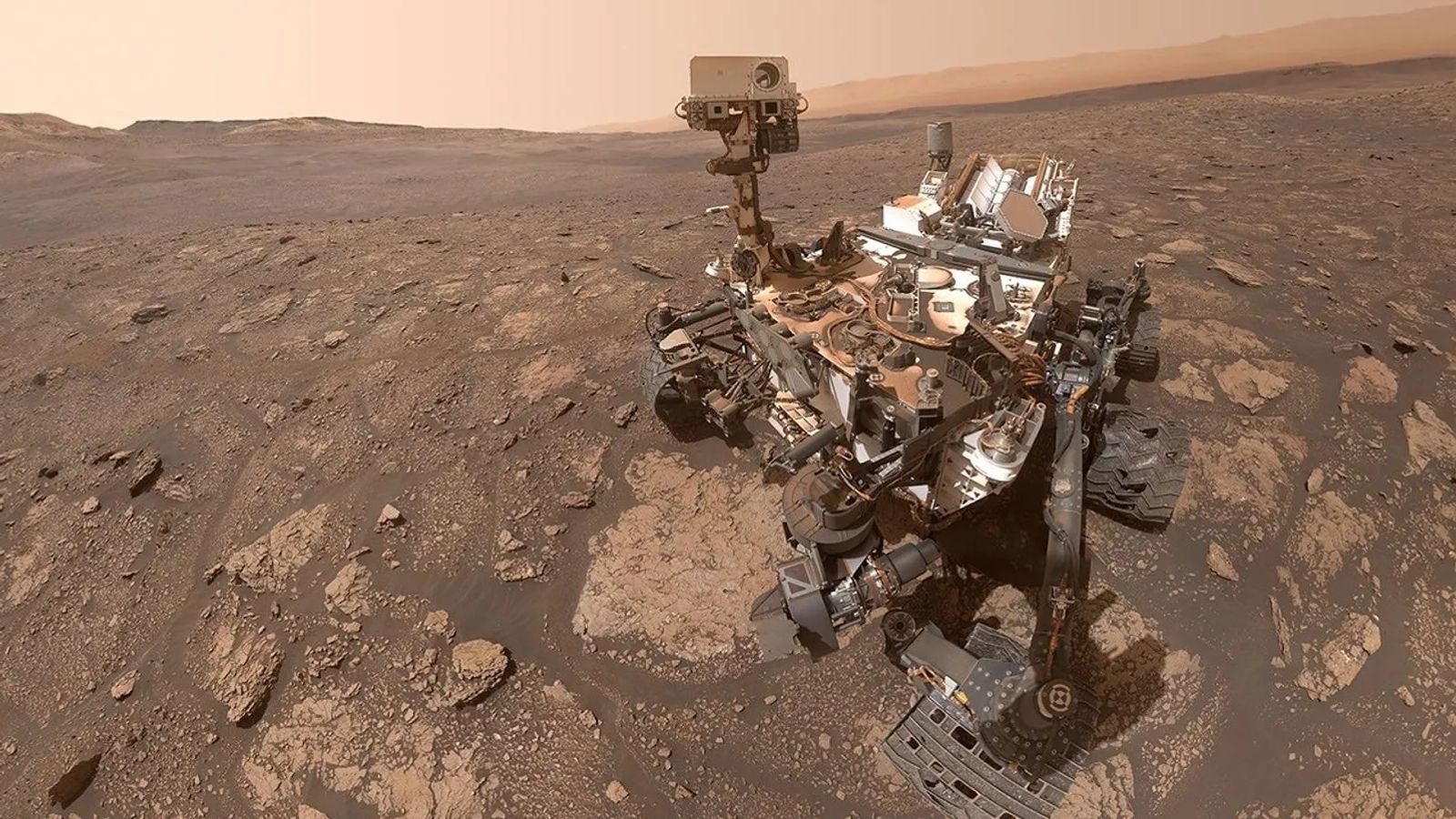
NASA's Curiosity rover has found organic molecules on Mars that have never been detected before - hinting at the possibility there was once life on the Red Planet.
After years of lab work, a rock that the rover drilled and analysed in 2020 has been confirmed to include organic molecules.
Among them is a nitrogen heterocycle. Its molecular structure - a ring of carbon atoms including nitrogen - is considered a predecessor to RNA and DNA.
But scientists have no way of knowing if these molecules were created by biologic or geologic processes - either path is possible, the space agency says.
You need javascript enabled to view this content 0:37 Enable javascript to share Share The footage was released by one of the astronauts on the mission, Reid Wiseman
However, their discovery provided further confirmation that ancient Mars had the right chemistry to support life.
The news comes soon after the success of the Artemis II mission, in which four astronauts travelled further from Earth than any human had ever been.
Image: Curiosity captured this mosaic of a region on Mount Sharp in 2019. Pic: NASA/JPL-Caltech/MSSS
"This collection of organic molecules once again increases the prospect that Mars offered a home for life in the ancient past," mission project scientist Ashwin Vasavada said.
"This is Curiosity and our team at their best. It took dozens of scientists and engineers to locate this site, drill the sample, and make these discoveries with our awesome robot."
Read more:
'Leopard spots' are sign life once existed on Mars
The rock sample was nicknamed Mary Anning 3 after an English paleontologist and was found on part of the planet's Mount Sharp - a region that was covered by lakes and streams billions of years ago.
Detecting DNA predecessors is "pretty profound because these structures can be chemical precursors to more complex nitrogen-bearing molecules," said the paper's lead author, Amy Williams of the University of Florida in Gainesville.
"Nitrogen heterocycles have never been found before on the Martian surface or confirmed in Martian meteorites."
Image: An annotated close-up of three holes NASA’s Curiosity drilled into Martian rock at a location nicknamed 'Mary Anning'. Pic: NASA/JPL-Caltech/MSSS
Also discovered was benzothiophene, which has previously been found in meteorites.
These meteorites, along with the organic molecules within them, are believed by some scientists to have seeded prebiotic chemistry across the early solar system.