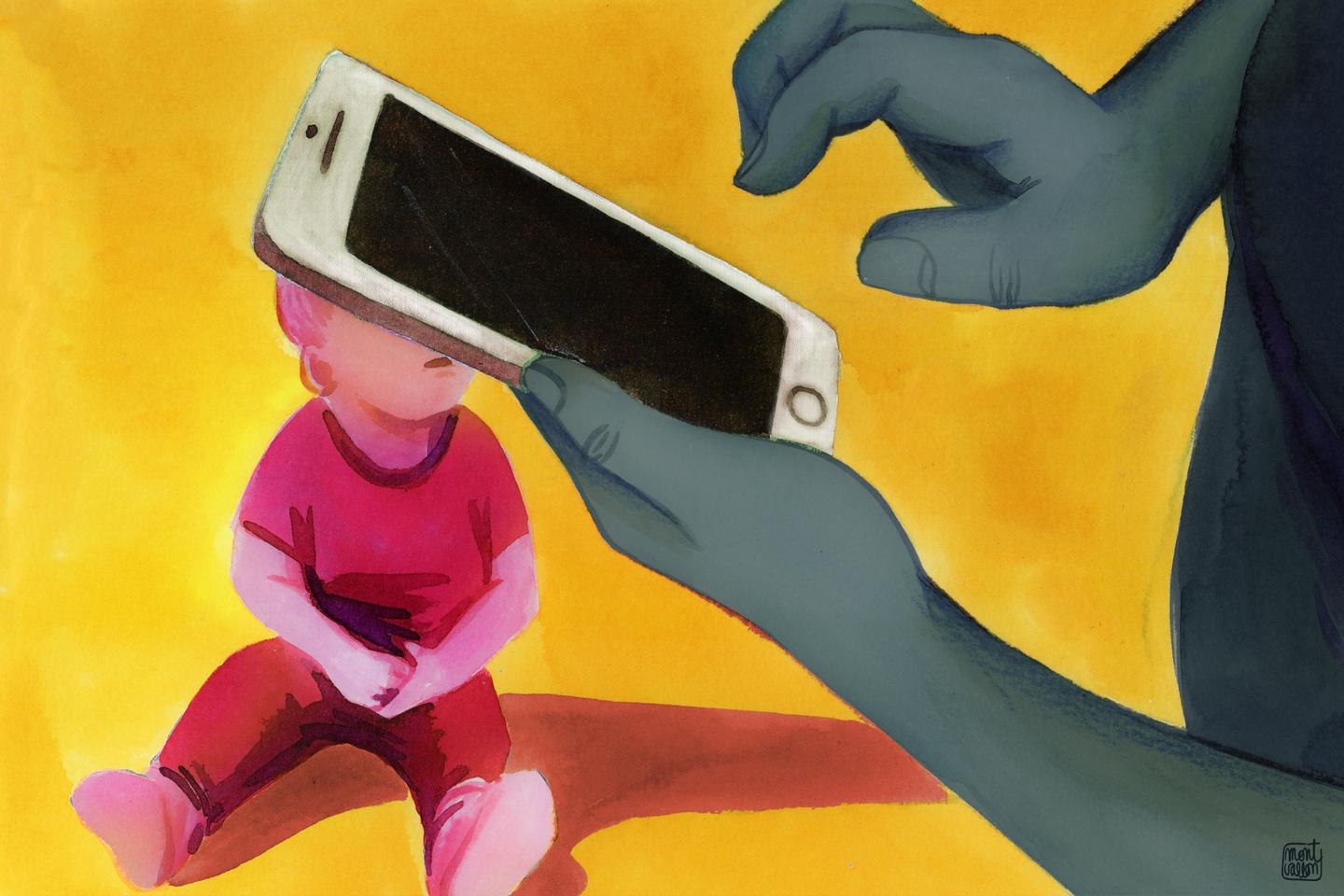
Reading text messages while bottle-feeding, answering emails at the dinner table, interrupting playtime to check a notification, or pausing a bedtime story to reply to a message: To what extent do these digital activities and distractions of daily life weigh on family interactions? And how do they affect exchanges between parents and their young children, which experts say are essential for building attachment bonds, as well as for the development of emotional regulation and even language?
To try to answer these questions, at a time when exposure to screens among very young children has become a public health issue, a new term has emerged among researchers and healthcare professionals: "technoference," a blend of technology and interference. It is imported from the United States, where experts like family psychology researcher Brandon McDaniel and pediatrician Jenny Radesky began studying, in the mid-2010s, the effects of parental distraction due to new technologies and digital devices (smartphones, tablets, etc.) on their young children. The concept has also become the subject of research in France, with teams at the Université de Nanterre, the Université de Lille and the Université d'Aix-Marseille.
Column Subscribers only 'Never have we communicated so much without actually speaking to one another'
"The alarm was raised by field professionals in the early 2020s, just after Covid," explained Maya Gratier, professor of developmental psychology at Université Paris-Nanterre. "Pediatricians, psychiatrists and psychologists told us they were seeing more and more parents every day who were 'glued' to their phones and 'missing out' on their babies. Those were their words."
Together with her colleague Rana Esseily, also a psychology researcher, Gratier set up a long-term observation project for the university's Ethology, Cognition and Development Laboratory and master's students, in a maternal and child health center in Nanterre (north of Paris) and in a child mental health center specializing in early childhood in Bourg-la-Reine, south of the city. The behaviors of 91 parent-baby pairs (average age: 10.74 months) were closely observed in two waiting rooms "with quite different social backgrounds, but similar behaviors," she explained.
You have 47.68% of this article left to read. The rest is for subscribers only.