Your support helps us to tell the story Read more Support Now From reproductive rights to climate change to Big Tech, The Independent is on the ground when the story is developing. Whether it's investigating the financials of Elon Musk's pro-Trump PAC or producing our latest documentary, 'The A Word', which shines a light on the American women fighting for reproductive rights, we know how important it is to parse out the facts from the messaging. At such a critical moment in US history, we need reporters on the ground. Your donation allows us to keep sending journalists to speak to both sides of the story. The Independent is trusted by Americans across the entire political spectrum. And unlike many other quality news outlets, we choose not to lock Americans out of our reporting and analysis with paywalls. We believe quality journalism should be available to everyone, paid for by those who can afford it. Your support makes all the difference. Read more
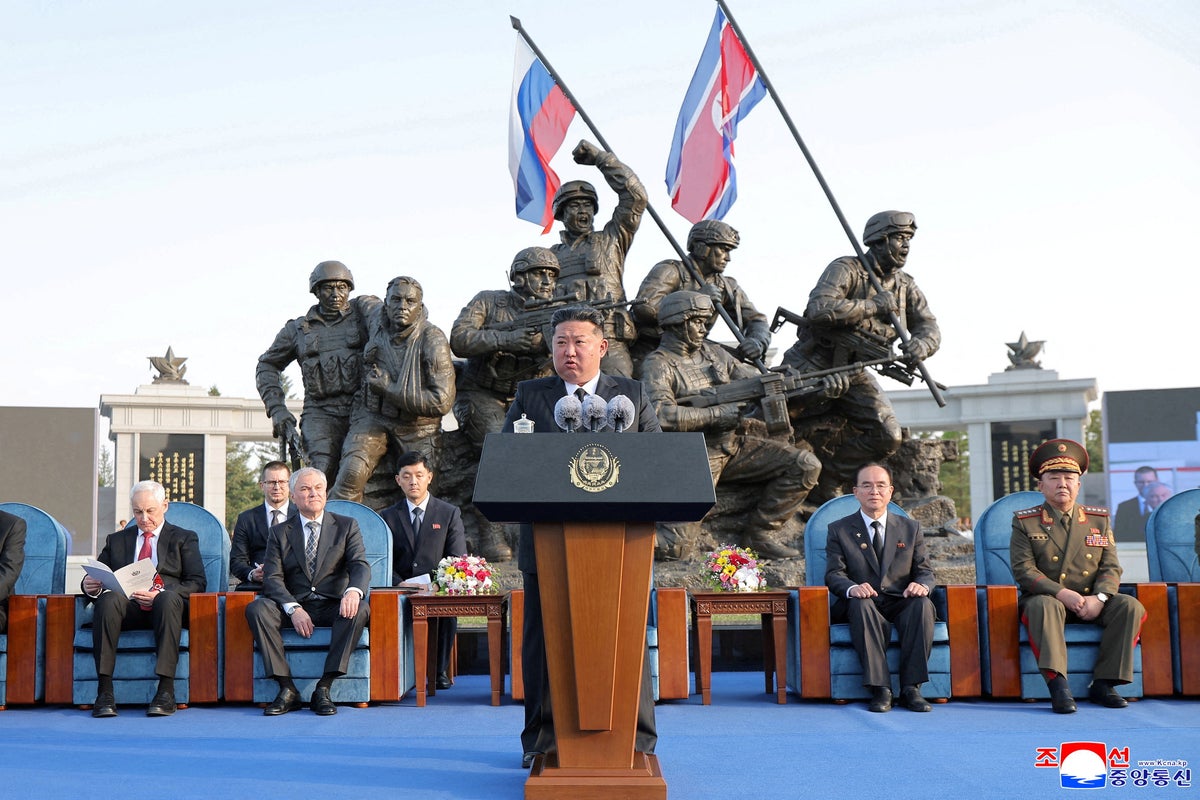
North Korea has opened a memorial museum for its soldiers killed while fighting for Russia against Ukraine, with top leaders of North Korea and Russia pledging a push for greater cooperation.
In April 2025, North Korea and Russia announced that their soldiers fought together to repel a Ukraine incursion into Russia’s Kursk border region. The two countries haven’t disclosed how many North Koreans soldiers were deployed, but South Korea’s intelligence service estimated North Korea sent about 15,000 troops and 2,000 of them were killed.
The North’s Korean Central News Agency reported Monday the museum’s inaugural ceremony was held in Pyongyang on Sunday to mark the one-year anniversary of the end of an operation to liberate the Kursk region. KCNA said leader Kim Jong Un attended the ceremony along with top visiting Russian officials including Vyacheslav Volodin, speaker of the State Duma, and Defense Minister Andrei Beloussov.
open image in gallery ( Reuters )
During the ceremony, Kim threw dirt over the remains of one dead soldier and laid flowers before others whose bodies were already placed in a mortuary, before he and Volodin and Beloussov left messages on the guest book, according to KCNA.
In a speech, Kim said the spirits of dead North Korean soldiers will remain as “a symbol of “the North Korean people’s heroism” and support “a victorious march by the Korean and Russian people.” He praised the North Korean and Russian forces for thwarting what he called a U.S.-led Western “hegemonic plot and military adventurism” on the Russian-Ukraine front.
Meeting with Beloussov separately, Kim said North Korea will fully support the Russian policy of defending its sovereignty and security interests, KCNA reported. Russia’s state news agency, Tass, cited Belousov as telling Kim that Russia was ready to sign a Russian-North Korean military cooperation plan for the 2027-2031 period.
open image in gallery ( Reuters )
In a letter to Kim read by Volodin during the ceremony, Russian President Vladimir Putin said the museum “will undoubtedly be a clear symbol of the friendship and solidarity” between the two countries. Putin said he was convinced that the two countries would continue to strengthen their comprehensive strategic partnership, according to KCNA.
open image in gallery ( Reuters )
Since Russia’s invasion of Ukraine, Kim has made Moscow the priority of his foreign policy by supplying troops and conventional weapons. In return, North Korea was believed to have received economic and other assistance from Russia. South Korea, the U.S. and their partners worry Russia may transfer high-tech technologies that can enhance North Korea’s nuclear and missile programs.
open image in gallery ( Reuters )
Experts say North Korean troops sent to the war earlier became easy targets for drone and artillery attacks due to their lack of combat experience and unfamiliarity with the terrain. But Ukrainian military and intelligence officials have assessed that the North Koreans were gaining crucial battlefield experience and were key to Russia’s strategy of overwhelming Ukraine by throwing large numbers of soldiers into the battle for Kursk.