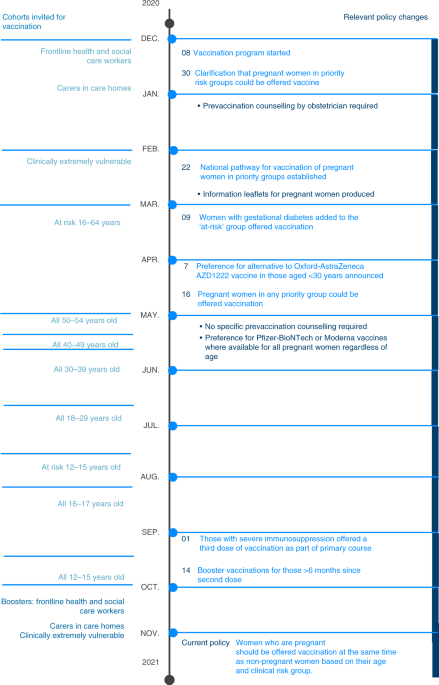
Cohort
We used the COPS database linked to records of COVID-19 vaccinations delivered and SARS-CoV-2 infections diagnosed up to and including 31 October 2021. This included data on a total of 145,424 pregnancies in 131,751 women. Overall, 144,548 (99.4%) of these pregnancy records (and 130,875, 99.3% of the women) had an associated unique community health index (CHI) number used for data linkage. Pregnancy records with no associated CHI number are likely to relate to duplicate records so were excluded from this analysis. Figure 2 describes the participants in the cohort. Overall, 117,190 pregnancies were complete, with 13,933 ending in early pregnancy loss (miscarriage, molar or ectopic pregnancy), 20,480 resulting in termination of pregnancy, 79,148 resulting in delivery and 3,629 having an unknown outcome. The deliveries resulted in 273 stillbirths and 80,183 live births, of which 179 resulted in neonatal death. Overall, 27,358 pregnancies were ongoing on 31 October 2021.
Fig. 2: Summary of participants in the COVID-19 in Pregnancy in Scotland cohort. Flow chart summarizing participants in the COPS cohort. Counts for molar pregnancies, ectopic pregnancies, miscarriages, terminations and deliveries are numbers of pregnancies. Live births, stillbirths and neonatal deaths are numbers of babies. Full size image
Pregnancy data were linked with national data on confirmed SARS-CoV-2 infection and COVID-19 vaccination using CHI number. Overall, 99% of all the PCR with reverse transcription (RT−PCR) samples within the national testing database since the start of the pandemic, and 99.8% of all records for vaccinations given from the start of the program, have an associated CHI number.
Infection and vaccination in pregnancy was defined as infection diagnosed or vaccination given at any point from the date of conception (2 + 0 weeks gestation) to the date the pregnancy ends inclusive. The date of first positive viral RT−PCR sample collection was taken as the date of onset of the first episode of COVID-19. Subsequent episodes were recorded if a positive viral RT−PCR sample was taken ≥90 d after a first positive sample.
To explore the impact of vaccination status on SARS-CoV-2 infection, women were grouped as follows: unvaccinated (no previous COVID-19 vaccination before the date of onset of COVID-19 or with one dose of vaccination ≤21 d before the date of onset); partially vaccinated (one dose of vaccination >21 d before the date of onset of COVID-19 or two doses of vaccination with the second dose administered ≤14 d before the date of onset); or fully vaccinated (two doses of vaccination with the second dose >14 d before the date of onset of COVID-19). We also report the number of third or booster doses given, but have not included these in definitions of vaccination status, as third and booster doses in Scotland were only recommended from 14 and 20 September 2021, respectively.
COVID-19 vaccine coverage and uptake in pregnancy
From 1 December 2020 to 31 October 2021 a total of 25,917 COVID-19 vaccinations (12,518 (48%) first doses, 12,194 (47%) second doses and 1,205 (5%) third or booster doses) had been given in 18,399 pregnancies. A total of 9,905 (38.2%; 95% CI 37.6−38.8) vaccinations were given in the first trimester of pregnancy (at 2 + 0 to 13 + 6 weeks gestation); 9,317 (35.9%; 95% CI 35.4−36.5) in the second trimester (at 14 + 0 to 27 + 6 weeks gestation); and 6,695 (25.8%; 95% CI 25.3−26.4) in the third trimester (at 28 + 0 weeks gestation or over). Of the vaccinations given, 20,572 (79.4%; 95% CI 78.9−79.9) were Pfizer-BioNTech BNT162b2 messenger RNA vaccine; 3,224 (12.4%; 95% CI 12.0−12.8) were Moderna mRNA-1273 mRNA vaccine; and 2,121 (8.2%; 95% CI 7.9−8.5) were Oxford-AstraZeneca AZD1222 viral vector vaccine (given mainly early in the vaccine program to pregnant women with a clinical risk factor indicating vaccination).
We used two different metrics to describe vaccination in pregnancy, monthly uptake in women who were pregnant during the month and coverage (the proportion of women who, at the time of giving birth, had been vaccinated, whether vaccination was before or during pregnancy). Uptake and coverage data in the general female population of reproductive age (18−44 years) were provided for context, generated from data collected by Public Health Scotland26.
COVID-19 vaccine uptake among pregnant women each month was consistently lower than that in the general female population of reproductive age (Fig. 3a). Vaccine uptake was consistently lowest in younger (≤20 years) pregnant women and those living in the most deprived areas of Scotland (Fig. 3b,c).
Fig. 3: COVID-19 vaccination uptake and coverage. a, Monthly uptake of COVID-19 vaccination in all women 18−44 years and in pregnant women. b, Monthly uptake of COVID-19 vaccination in pregnant women by age group. c, Monthly uptake of COVID-19 vaccination in pregnant women by SIMD quintile. SIMD, Scottish Index Multiple Deprivation, with SIMD 5 being least deprived and 1 being most deprived. d, Vaccine coverage in the general female population in women age 18−44 years (purple) and percentage of pregnant women vaccinated before the time of birth (green). Numbers of women 18−44 years were derived from 2020 mid-year population estimates26. Full size image
COVID-19 vaccine coverage increased over time, but has consistently been substantially lower among pregnant women than in the general female population of reproductive age (Fig. 3d). In October 2021, 4,064 women gave birth, of whom 1,738 (42.8%; 95% CI 41.2−44.3) had received any COVID-19 vaccination before delivery, with 1,311 (32.3%; 95% CI 30.8−33.7) of the women having received two primary doses of vaccination and 36 women (0.9%; 95% CI 0.6−1.2) having received a third or booster dose of vaccination. In contrast, by 31 October 2021, 84.7% (803,241 out of 947,984; 95% CI 84.7−84.8) of women aged 18–44 years in the general population had received any vaccination, 77.4% had received two doses (733,942 out of 947,984; 95% CI 77.3−77.5) and 7.0% had received a third dose or booster dose (66,001 out of 947,984; 95% CI 6.9−7.0).
SARS-CoV-2 outcomes in vaccinated and unvaccinated pregnant women
Between 1 March 2020 and 31 October 2021, there were 5,653 confirmed SARS-CoV-2 infections in pregnancy. Overall, rates of SARS-CoV-2 infection in pregnancy showed similar patterns to those in the general female population of reproductive age, with peaks of infection in October 2020, January 2021 and September 2021 (Fig. 4a). SARS-CoV-2 infection rates have been consistently highest in pregnant women living in the most deprived areas and in younger, compared to older, pregnant women (Fig. 4b,c).
Fig. 4: SARS-CoV-2 in pregnancy and outcomes by vaccination status. a, SARS-CoV-2 in all women 18−44 years per 100,000 women and in pregnant women. b, Monthly rates of SARS-CoV-2 per 100,000 pregnant women by age group c, Monthly rates of SARS-CoV-2 per 100,000 pregnant women by SIMD. d, Percentage of cases of SARS-CoV-2 infection in pregnancy occurring 1 December 2020 to 31 October 2021 inclusive, cases with associated hospital admission and cases with associated critical care admission, by vaccination status at the date of onset of COVID-19. Unvaccinated is defined as no COVID-19 vaccination before the date of onset of COVID-19 or one dose of vaccination ≤21 d previously in line with standard definitions used by Public Health Scotland. Full size image
Early in the pandemic, it is highly likely that there was under-ascertainment of cases of SARS-CoV-2 infection due to limited test availability and testing capacity (Fig. 4a). Restricting the COPS cohort to only data from 1 December 2020 onward (the date that routine SARS-CoV-2 testing was recommended for all admissions to maternity care and the COVID-19 vaccination program started in Scotland) reduces the size of the cohort, but allows more comparable estimation of rates of severe outcomes (hospital admission, critical care admission and perinatal mortality) associated with SARS-CoV-2 infection in vaccinated and unvaccinated women. From 1 December 2020 onward, the COPS database included linked data on a total of 91,183 pregnancies in 87,694 women.
There were 4,950 confirmed SARS-CoV-2 infections in pregnancy from 1 December 2020. SARS-CoV-2 infections were relatively evenly spread throughout pregnancy (1,543 (31.2%; 95% CI 29.9−32.5) diagnosed in the first trimester of pregnancy; 1,850 (37.4%; 95% CI 36.0−38.7) in the second trimester; and 1,557 (31.5%; 95% CI 30.2−32.8) in the third trimester).
Overall, 823 of the 4,950 SARS-CoV-2 infections in pregnancy from 1 December 2020 onward (16.6%; 95% CI 15.6−17.7) were associated with any hospital admission (date of onset of infection occurred during a hospital admission or within 14 d before admission) and 104 SARS-CoV-2 infections in pregnancy (2.1%; 95% CI 1.7−2.6) were associated with a critical care admission (date of onset of infection occurred during a critical care admission or within 21 d before admission). In first trimester SARS-CoV-2 infections, 6.7% (103 out of 1,543; 95% CI 5.5−8.1) were associated with any hospital admission, compared to 10.7% (198 out of 1,850 cases; 95% CI 9.3−12.2) of those in the second trimester and 33.5% (522 out of 1,557; 95% CI 31.2−35.9) of those in the third trimester. No (0 out of 1,543 cases; 95% CI 0−0.3) SARS-CoV-2 infections in the first trimester were associated with critical care admission, compared to 2.0% (37 out of 1,850 cases; 95% CI 1.4−2.8) of those in the second trimester and 4.3% (67 out of 1,557; 95% CI 3.4−5.5) of those in the third trimester.
From 1 December 2020 onward, 77.4% of SARS-CoV-2 infections in pregnancy (3,833 out of 4,950; 95% CI 76.2−78.6) occurred in women who were unvaccinated at the date of onset of infection, with 11.5% (567 out of 4,950; 95% CI 10.6−12.4) in partially vaccinated women and 11.1% (550 out of 4,950; 95% CI 10.3−12.0) in fully vaccinated women.
Of the SARS-CoV-2 infections in pregnancy that occurred in unvaccinated women, 19.5% (748 out of 3,833; 95% CI 18.3−20.8) were associated with hospital admission, compared to 8.3% (47 out of 567; 95% CI 6.2−10.9) of those in partially vaccinated women and 5.1% (28 out of 550; 95% CI 3.5−7.4) of those in fully vaccinated women. A total of 2.7% (102 out of 3,833; 95% CI 2.2−3.2) of the SARS-CoV-2 infections in pregnancy that occurred in unvaccinated women were associated with a critical care admission, compared to 0.2% (1 out of 567; 95% CI 0.01−1.1) of those in partially vaccinated women and 0.2% (1 out of 550 cases; 95% CI 0.01−1.2) of those in fully vaccinated women. This means that while 77.4% (3,833 out of 4,950; 95% CI 76.2−78.6) of SARS-CoV-2 infections in pregnancy occurred in unvaccinated women, 90.9% (748 out of 823; 95% CI 88.7−92.7) of infections associated with hospital admission and 98.1% (102 out of 104; 95% CI 92.5−99.7) of infections associated with critical care admission, were in unvaccinated women (Fig. 4d). To date, there has been one maternal death following SARS-CoV-2 infection in pregnancy in Scotland.
A total of 2,364 babies have been born to women who had SARS-CoV-2 infection in pregnancy between 1 December 2020 and 31 October 2021. Of these, 2,353 were live births, of which 241 were preterm births (<37 weeks gestation; preterm birth rate 10.2%; 95% CI 9.1−11.6). Overall, 610 of the live births and 101 of the preterm births occurred within 28 d of the date of onset of the mother’s SARS-CoV-2 infection, giving a preterm birth rate among babies born within 28 d of SARS-CoV-2 infection of 16.6% (95% CI 13.7−19.8).
Of the 2,364 total births, 11 were stillbirths (deaths in utero ≥ 24 weeks gestation) and eight live births resulted in neonatal deaths (death within 28 d of birth), giving an extended perinatal mortality rate of 8.0 per 1,000 births following SARS-CoV-2 infection at any point in pregnancy (19 out of 2,364; 95% CI 5.0−12.8). Ten of the stillbirths and four neonatal deaths occurred in babies born within 28 d of the onset of maternal infection, giving an extended perinatal mortality rate of 22.6 per 1,000 births (14 out of 620, 95% 12.9−38.5) in this population. All perinatal deaths following SARS-CoV-2 infection in pregnancy occurred in women who were unvaccinated at the time of SARS-CoV-2 infection. We do not have access to detailed clinical records to assess whether COVID-19 directly or indirectly contributed to the preterm births and deaths seen following maternal infection.
For comparison, the background preterm birth rate during the pandemic (from 1 March 2020 to 31 October 2021) was 8.0% (6,381 out of 80,183 live births; 95% CI 7.8−8.1) and the extended perinatal mortality rate was 5.6 per 1,000 births (452 out of 80,456 total births; 95% CI 5.1−6.2). When restricted to babies born to women with no confirmed SARS-CoV-2 infection during pregnancy the preterm birth rate was 7.9% (6,083 out of 77,209 live births; 95% CI 7.7−8.1) and the extended perinatal mortality was 5.6 per 1,000 births (432 out of 77,470 total births; 95% CI 5.1−6.1). These preterm and perinatal mortality rates are shown in Fig. 5, along with the preterm birth and extended perinatal mortality rates in women who received the COVID-19 vaccine in pregnancy (preterm birth rate of 8.6% (495 out of 5,752 live births in women who received COVID-19 vaccination in pregnancy; 95% CI 7.9−9.4) and 8.2% (134 out of 1,632 live births within 28 d of COVID-19 vaccination in pregnancy; 95% CI 7.0−9.6); and extended perinatal mortality of 4.3 per 1,000 births (25 out of 5,766 total births in women who received COVID-19 vaccination in pregnancy; 95% CI 2.9−6.4) and 4.3 per 1,000 births (7 out of 1,635 births within 28 d of COVID-19 vaccination; 95% CI 1.9−9.2)).