Your support helps us to tell the story Read more Support Now From reproductive rights to climate change to Big Tech, The Independent is on the ground when the story is developing. Whether it's investigating the financials of Elon Musk's pro-Trump PAC or producing our latest documentary, 'The A Word', which shines a light on the American women fighting for reproductive rights, we know how important it is to parse out the facts from the messaging. At such a critical moment in US history, we need reporters on the ground. Your donation allows us to keep sending journalists to speak to both sides of the story. The Independent is trusted by Americans across the entire political spectrum. And unlike many other quality news outlets, we choose not to lock Americans out of our reporting and analysis with paywalls. We believe quality journalism should be available to everyone, paid for by those who can afford it. Your support makes all the difference. Read more
Chinese scientists have built a first-of-its-kind coal-powered fuel cell that potentially eliminates carbon dioxide emissions, an advance that could lead to better thermal power plant designs.
Conventional methods to generate power using coal have a high carbon footprint, producing copious amounts of air pollutants.
As the Paris Climate Agreement has evolved into a global consensus over the last 10 years mandating carbon neutrality, developing nations have been seeking to produce clean, high-efficiency, sustainable energy with zero-carbon emissions technologies.
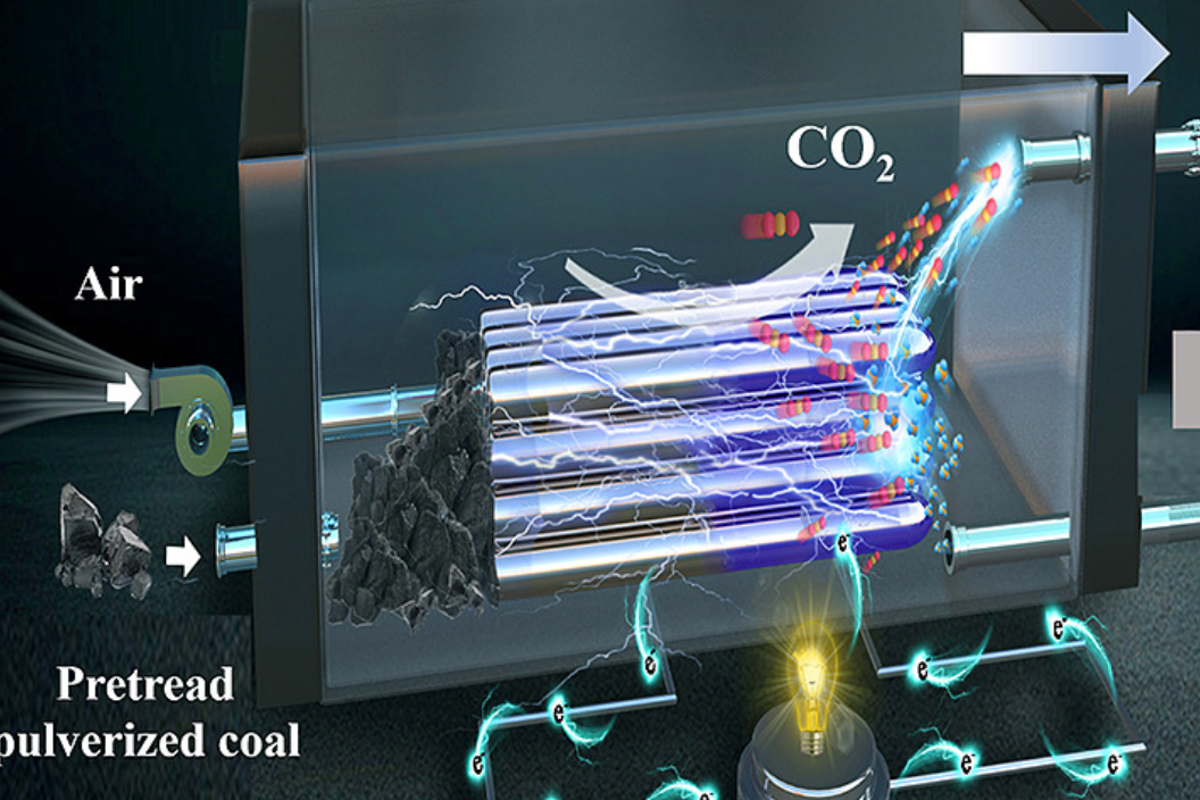
Now, scientists at Shenzhen University have built what they claim to be a zero-carbon-emission coal fuel cell, or ZC-DCFC.
Instead of burning coal to produce steam for running a turbine, the design relies on pulverising coal and drying coal and giving it special pre-treatment before it’s fed into the anode chamber of a fuel cell.
Oxygen is supplied to the cell’s cathode, leading to the coal in the anode undergoing electrochemical oxidation across an oxide membrane.
Components of ZC-DCFC ( Energy Reviews )
Carbon dioxide gas is generated from the reaction, which is captured within the fuel cell system itself and converted into feedstocks for other valuable chemicals like syngas.
The cell can generate energy at an efficiency of up to 40 per cent, scientists say.
“In the ZC-DCFC, by avoiding the efficiency losses associated with combustion and thermal engines, it enables substantially higher theoretical efficiency,” according to the new study published in the journal Energy Reviews.
Previous models of fuel cells that attempted to turn carbon directly into energy suffered from short operational lifetimes and low power density.
The latest design overcomes these challenges by being scalable in the form of stacks and boasting a higher carbon-to-energy conversion efficiency, scientists say.
“This perspective proposes the concept of zero-carbon-emission direct coal fuel cells for power generation as a disruptive technological paradigm for efficient coal utilisation,” the study noted.
“ZC-DCFC is expected to open up a new pathway for near-zero-emission coal utilisation, transforming coal from a traditional fossil fuel into a feasible clean energy source.”
Scientists hope future studies can help identify suitable application scenarios for ZC-DCFCs in the energy sector.
Shallow coal reserves are currently being rapidly depleted worldwide, driving coal extraction beyond depths of 2,000m
In such a scenario, researchers propose ZC-DCFCs for the conversion and high-efficiency utilisation of coal directly from within these deep geological environments for power generation.