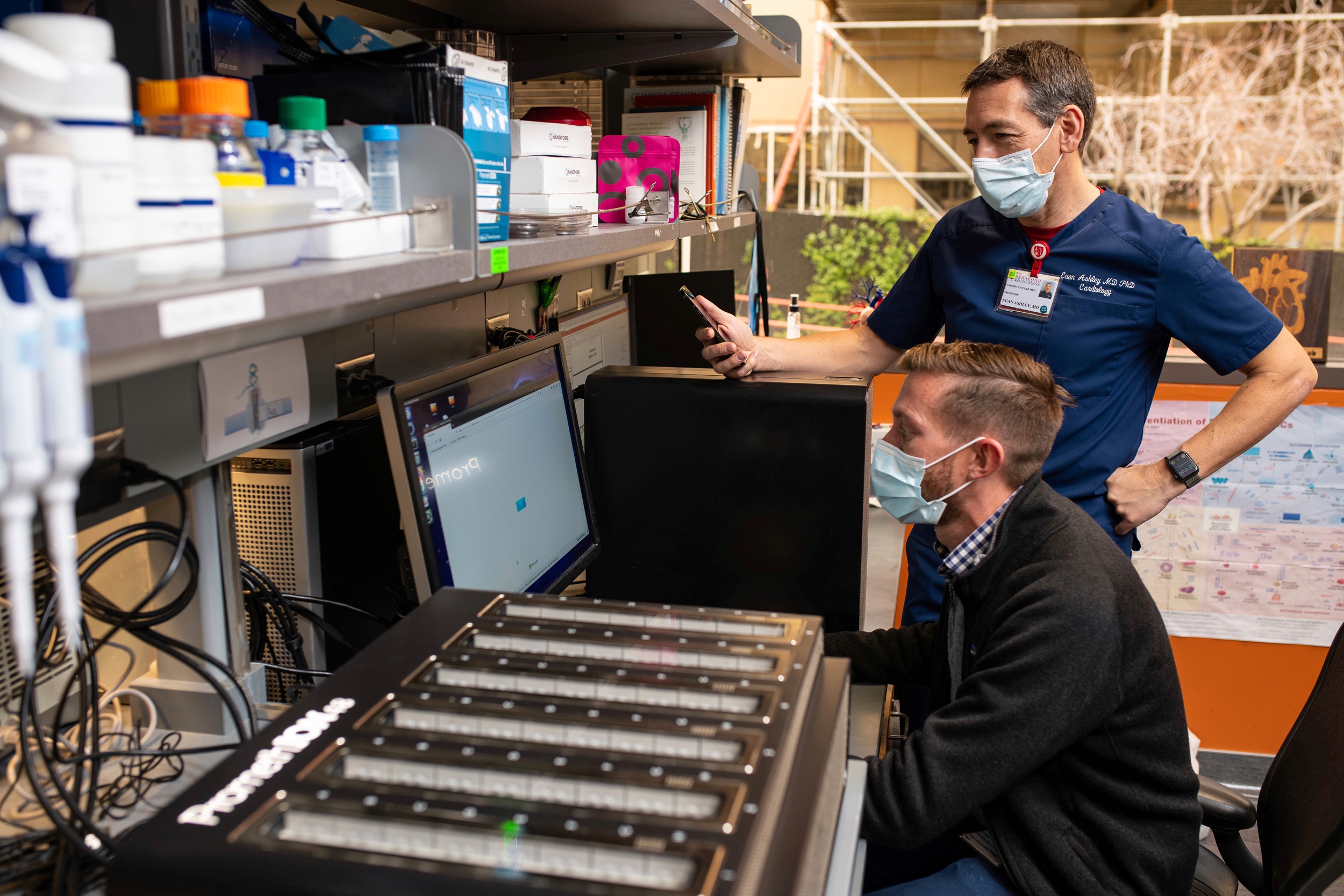
“It was just one of those amazing moments where the right people suddenly came together to achieve something amazing,” Ashley said. “It really felt like we were approaching a new frontier.”
The time it took to sequence and diagnose that case was 7 hours and 18 minutes, which, to Ashley’s knowledge, is about twice as fast as the previous record for a genome sequencing-based diagnosis (14 hours) held by the Rady Children’s Institute. Fourteen hours is still an impressively quick turnaround, Ashley said. Stanford scientists plan to offer a sub-10-hour turnaround to patients in intensive care units at Stanford Hospital and Lucile Packard Children’s Hospital Stanford — and, eventually, to other hospitals.
Speeding up
To achieve super-fast sequencing speeds, the researchers needed new hardware. So Ashley contacted colleagues at Oxford Nanopore Technologies who had built a machine composed of 48 sequencing units known as flow cells. The idea was to sequence just one person’s genome using all flow cells simultaneously. The mega-machine approach was a success — almost too much. Genomic data overwhelmed the lab’s computational systems.
“We weren’t able to process the data fast enough,” Ashley said. “We had to completely rethink and revamp our data pipelines and storage systems.” Graduate student Sneha Goenka found a way to funnel the data straight to a cloud-based storage system where computational power could be amplified enough to sift through the data in real time. Algorithms then independently scanned the incoming genetic code for errors that might cause disease, and, in the final step, the scientists conducted a comparison of the patient’s gene variants against publicly documented variants known to cause disease.
From start to finish, the team sought to hasten every aspect of sequencing a patient’s genome. Researchers literally ran samples by foot to the lab, new machines were rigged to support simultaneous genome sequencing, and computing power was escalated to efficiently crunch massive datasets. Now, the team is optimizing its system to reduce the time even further. “I think we can halve it again,” Ashley said. “If we’re able to do that, we’re talking about being able to get an answer before the end of a hospital ward round. That’s a dramatic jump.”
Long-read sequencing
Perhaps the most important feature of the diagnostic approach’s ability to quickly spot suspicious fragments of DNA is its use of something called long-read sequencing. Traditional genome-sequencing techniques chop the genome into small bits, spell out the exact order of the DNA base pairs in each chunk, then piece the whole thing back together using a standard human genome as a reference. But that approach doesn’t always capture the entirety of our genome, and the information it provides can sometimes omit variations in genes that point to a diagnosis. Long-read sequencing preserves long stretches of DNA composed of tens of thousands of base pairs, providing similar accuracy and more detail for scientists scouring the sequence for errors.
“Mutations that occur over a large chunk of the genome are easier to detect using long-read sequencing. There are variants that would be almost impossible to detect without some kind of long-read approach,” Ashley said. It’s also much faster: “That was one of the big reasons we went for this approach.”
Only recently have companies and researchers honed the accuracy of the long-read approach enough to rely on it for diagnostics. That and a drop from its once-hefty price tag created an opportunity for Ashley’s team. To his knowledge, this study is the first to demonstrate the feasibility of this type of long-read sequencing as a staple of diagnostic medicine.
During the study, Ashley’s team offered the accelerated genome sequencing technique to undiagnosed patients in Stanford hospitals’ intensive care units. They provided established standard of care testing to the study patients along with the experimental rapid gene sequencing, with which they sought answers to two important questions: Are genetics to blame for the patient’s ailment? If so, what specific DNA errors are stirring up trouble?