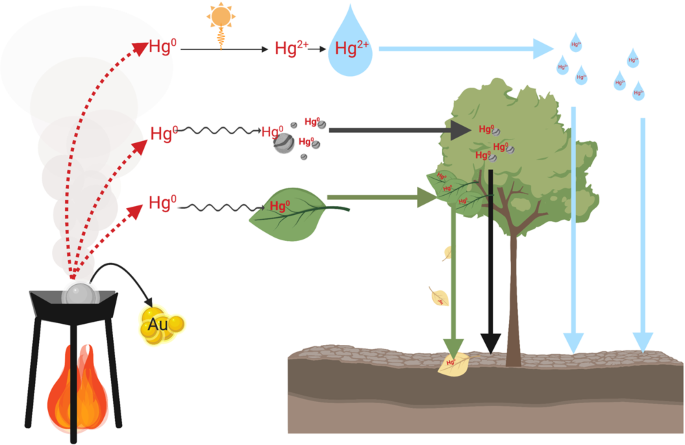
Mercury deposition near artisanal gold mining in the Peruvian Amazon
Our investigation occurred in the southeastern Peruvian Amazon in the department of Madre de Dios, where over 100,000 hectares have been deforested for alluvial ASGM3 adjacent—and sometimes within—protected land and national reserves. ASGM activity along rivers in this Western Amazonian region has increased dramatically over the past decade25 and is expected to continue as gold prices remain high and with increased connectivity to urban centers via the Interoceanic Highway3. We selected two sites without any mining (Boca Manu and Chilive, approximately 100 and 50 km from ASGM, respectively)—hereafter referred to as “remote sites”—and three sites within the mining zone—hereafter referred to as “mining sites” (Fig. 2A). Two of the mining sites are located in secondary growth forests near the towns of Boca Colorado and Laberinto, and one mining site is located in the intact old-growth forest of the Los Amigos Conservation Concession. Note that the release of Hg vapor from the burning of Hg–gold amalgams regularly occurs within this mining zone, at both the Boca Colorado and Laberinto sites, though exact locations and number of locations are unknown since these activities are generally informal and clandestine; we refer to mining and amalgam burning collectively as “ASGM activity”. At each location, we installed deposition samplers both in clearings (deforested areas completely void of woody plants) and beneath the tree canopy (forested areas) in the dry and wet seasons for a total of three seasonal campaigns (each 1–2 months in duration) to collect wet deposition and throughfall, respectively, and deployed passive air samplers in clearings to collect GEM. In the second year, we installed collectors at six additional forested plots at Los Amigos based on the high rates of deposition measured during the first year.
Fig. 2: Concentrations of mercury in depositing materials and surficial soil in Madre de Dios, Peru. A Map of the five sampling sites shown as yellow circles. Two sites (Boca Manu, Chilive) are located in areas remote from artisanal gold mining, and three sites (Los Amigos, Boca Colorado, and Laberinto) are located in mining-impacted areas, with mining towns shown as blue triangles. The insets show a typical forested remote site and deforested mining-impacted site. In all figures, the dashed line represents the demarcation between the two remote sites (on the left) and the three mining-impacted sites (on the right). B Gaseous elemental mercury (GEM) concentrations at each site for the 2018 dry (n = 1 independent sample for each site; square symbol) and wet (n = 2 independent samples; square symbol) seasons. C Concentration of total mercury in precipitation collected in forested (green boxplots) and deforested (brown boxplots) areas during the 2018 dry season. For all boxplots, the line represents the median value, the box shows Q1 and Q3, and the whiskers denote 1.5 times the interquartile range (n = 5 independent samples for each forested site, n = 4 independent samples for each deforested site). D Concentration of total mercury in leaves collected during the 2018 dry season from the canopy of Ficus insipida and Inga feuillei (left axis; dark green square and light green triangle symbols, respectively) and as bulk litter on the ground (right axis; olive green circle symbol). Values are shown as mean and standard deviation (n = 3 independent samples for live leaves for each site, n = 1 independent sample for litter). E Concentration of total mercury in surficial soils (top 0–5 cm) collected during the 2018 dry season (n = 3 independent samples for each site) in forested (green boxplots) and deforested (brown boxplots) areas. Data for other seasons are shown in Figs. S1 and S2. Full size image
Atmospheric Hg concentrations (GEM) followed our predictions, with high values adjacent to ASGM activity—particularly near the towns where Hg–gold amalgams are burned—and low values in areas distant from active mining (Fig. 2B). At remote locations, GEM concentrations were below the global southern hemisphere average background concentration of approximately 1 ng m−326. In contrast, GEM concentrations in all three mining sites were 2−14 times higher than remote sites, with concentrations at the sites near the two mining towns (up to 10.9 ng m−3) comparable to, and sometimes exceeding, concentrations from urban and industrial areas of the United States, China, and South Korea27. This GEM pattern in Madre de Dios is consistent with Hg–gold amalgam burning as the primary source of elevated atmospheric Hg in this remote Amazonian region.
Forest canopy as a driver of mercury deposition
While GEM concentrations in clearings tracked proximity to mining, total Hg concentrations in throughfall were dependent on both proximity to mining and forest canopy structure. This pattern suggests that GEM concentrations alone do not predict where on the landscape elevated Hg will be deposited. We measured the highest concentrations of Hg in throughfall in the intact mature forest within the mining zone (Fig. 2C). The average concentration of total Hg in throughfall at Los Amigos Conservation Concession during the dry season was among the highest reported in the literature (range: 18–61 ng L−1), rivaling levels measured in sites contaminated from cinnabar mining and industrial coal combustion in Guizhou, China when considering differences in precipitation volume28. These values represent, to our knowledge, the largest measured annual throughfall Hg flux, according to calculations using Hg concentrations and precipitation rates from both the dry and wet seasons (71 µg m−2 yr−1; Supplementary Table 1). Throughfall total Hg at the other two mining sites was not elevated compared to the remote sites (range: 8−31 ng L−1; 22−34 µg m−2 yr−1). Other than Hg, only aluminum and manganese were elevated in throughfall at the mining sites, which likely is due to land clearing associated with mining; all other measured major and trace elements did not vary between the mining and remote locations (Supplementary Data File 1), a finding consistent with leaf Hg dynamics29 and ASGM amalgam burning, rather than airborne dust, as the main source of Hg in throughfall.
In addition to serving as sorbents for particulate and gaseous Hg, plant leaves can assimilate GEM directly and incorporate it into tissues30,31. Indeed, litterfall was a major source of Hg deposition at sites in close proximity to ASGM activity. Average concentrations of Hg measured in live canopy leaves at all three mining sites (0.080–0.22 µg g−1) exceeded published values for temperate, boreal, and alpine forests in North America, Europe, and Asia, as well as other Amazonian forests in South America, located in both remote areas and near point sources32,33,34. Concentrations were comparable to foliar Hg concentrations reported from subtropical mixed forests in China and Atlantic forests in Brazil (Fig. 2D)32,33,34. The highest total Hg concentrations in bulk litter and canopy leaves were measured in the secondary growth forests within the mining zone, following patterns in GEM. However, the estimated litterfall Hg flux was highest in the intact old-growth forest in the mining zone at Los Amigos, presumably due to greater litterfall mass. We estimated the flux of Hg via litterfall at the Los Amigos site to be 66 μg Hg m−2 yr−1 by taking the measured Hg in litterfall (averaged between the dry and wet seasons) and multiplying by the previously reported litterfall mass for the Peruvian Amazon35 (Fig. 3A). This input suggests that both proximity to mining and canopy cover are important contributors to Hg loading from ASGM in this region.
Fig. 3: Mercury flux and surficial soil pools (0–5 cm) at the Los Amigos Conservation Concession. Data are shown in A forested and B deforested areas. The deforested area at Los Amigos represents a clearing for the field station, which makes up a small fraction of total land. Fluxes are shown in arrows and expressed as µg m−2 yr−1. Pools are shown in circles for the top 0–5 cm of soil and expressed as μg m−2. Percentages represent the percent of the mercury present as methylmercury in the pool or flux. The average concentration between the dry season (2018 and 2019) and wet season (2018) for total mercury in throughfall, bulk precipitation, and litterfall were used for this upscaled estimate of mercury loading. Methylmercury data are based on the 2018 dry season, the only year that it was measured. For information on pool and flux calculations, see the “Methods”. C Relationship between total mercury concentration in throughfall and leaf area index at the eight plots at Los Amigos Conservation Concession according to an ordinary least square regression. D Relationship between precipitation total mercury concentration and surficial soil mercury total concentration at all five sites in the forested (green circle) and deforested (brown triangle) areas according to an ordinary least square regression (error bars show standard deviation). Full size image
Using long term precipitation and litterfall data, we were able to scale our measurements of throughfall and litterfall Hg content derived from three campaigns to perform a preliminary estimate of total annual atmospheric Hg fluxes (throughfall + litterfall + precipitation) to the Los Amigos Conservation Concession. We found that atmospheric Hg fluxes in forested conservation areas adjacent to ASGM activity are more than 15 times greater than surrounding deforested areas (137 vs. 9 µg Hg m−2 yr–1; Fig. 3 A, B). This preliminary estimate of Hg loading at Los Amigos exceeds previously reported Hg fluxes in forests of North America and Europe near point sources of Hg (e.g., coal combustion) and is on par with values in industrial China21,36. Taken together, approximately 94% of total Hg deposited in conserved forests at Los Amigos occurs via dry deposition (throughfall + litterfall – precipitation Hg), a much higher contribution from dry deposition than most other forested landscapes globally. These results highlight the elevated quantity of Hg from ASGM activity entering forests via dry deposition and the importance of the forest canopy in scavenging ASGM-derived Hg from the atmosphere. We anticipate that observed patterns of highly enriched Hg deposition in forested areas near ASGM activity are not isolated to Peru.
In contrast, deforested areas in the mining zone had lower Hg loading, largely via bulk precipitation with little throughfall and litterfall Hg inputs. Concentrations of total Hg in bulk precipitation within the mining sites were comparable to the values measured at the remote sites (Fig. 2C). Average concentrations of total Hg in dry season bulk precipitation (range: 1.5–9.1 ng L−1) were below values previously reported for the Adirondack Mountains of New York37, and generally below values for remote areas in the Amazon38. Thus, in contrast to patterns of GEM, throughfall, and litterfall concentrations at the mining sites, bulk precipitation inputs of Hg are uniformly lower within adjacent deforested areas (8.6–21.5 µg Hg m−2 yr−1) and do not reflect proximity to mining. Because ASGM requires deforestation2,3, the cleared areas where mining activity is concentrated receive lower Hg inputs from atmospheric deposition than nearby forested areas, though non-atmospheric direct releases from ASGM such as elemental Hg spillage or tailings can be high22.
The variation in Hg flux observed in the Peruvian Amazon was driven by large differences within (forested and deforested) and between sites during the dry season (Fig. 2). In contrast, we saw minimal differences within and between sites and low Hg fluxes during the wet season (Supplementary Fig. 1). This seasonal difference (Fig. 2B) likely results from a higher intensity of both mining and dust generation during the dry season. Increased deforestation and the low volume of precipitation during the dry season likely enhances dust generation, thereby increasing the quantity of atmospheric particles which sorb Hg. This production of Hg and dust in the dry season likely lead to patterns in Hg flux within deforested compared to forested areas at the Los Amigos Conservation Concession.
Since Hg inputs from ASGM in the Peruvian Amazon are largely deposited to terrestrial ecosystems via interaction with the forest canopy, we tested whether higher canopy density (i.e., leaf area index) would lead to higher Hg inputs. Within the intact forest at Los Amigos Conservation Concession, we collected throughfall from seven forested plots with different canopy densities. We found that leaf area index is a strong predictor of total Hg inputs via throughfall, with mean total Hg concentrations in throughfall increasing with leaf area index (Fig. 3C). Many other variables also impact Hg inputs via throughfall, including leaf age34, leaf roughness, stomatal density, wind speed39, turbulence, temperature, and antecedent dry period.
Mercury fate in terrestrial ecosystems
Consistent with the highest rates of Hg deposition, surficial soils (0–5 cm) from the Los Amigos forested site had the highest total Hg concentrations (140 ng g−1 in the 2018 dry season; Fig. 2E) of our study sites. Moreover, Hg concentrations were enriched throughout the measured vertical soil profile (range of 138–155 ng g−1 up to 45 cm in depth; Supplementary Fig. 3). The only site to exhibit higher surficial soil Hg concentrations within the 2018 dry season was a deforested site near a mining town (Boca Colorado). At this site, we hypothesize that the extremely high concentrations may have been due to local contamination of elemental Hg during the amalgamation process, as concentrations were not elevated at depth (>5 cm). It is also likely that the fraction of atmospheric Hg deposition lost by evasion (i.e., release of Hg to the atmosphere) from soil is considerably lower in forested areas due to canopy cover compared to deforested areas40, suggesting that a sizable fraction of Hg deposited to conservation areas is retained within the soil. The soil total Hg pool in the intact forests at Los Amigos Conservation Concession was 9100 μg Hg m−2 within the top five cm and over 80,000 μg Hg m−2 within the top 45 cm.
Since foliage incorporates Hg predominantly from the atmosphere and not from the soil30,31 and then delivers this Hg to the soil via throughfall, the high rates of Hg in deposition are likely driving the observed patterns in soils. We found a strong correlation between average total Hg concentrations in surficial soil and total Hg concentrations in throughfall across all forested sites, and no relationship between Hg in surficial soil and total Hg concentrations in bulk precipitation in deforested areas (Fig. 3D). Similar patterns are also evident for the relationship between surficial soil Hg pool and throughfall total Hg flux in forested, but not deforested areas (surficial soil Hg pool vs. bulk precipitation total Hg flux).
Nearly all research on terrestrial Hg pollution associated with ASGM has been limited to measurements of total Hg, yet it is MeHg concentrations that determine Hg bioavailability and subsequent trophic accumulation and exposure. In terrestrial ecosystems, Hg is methylated by microorganisms under anoxic conditions41,42, and thus it is often assumed that MeHg concentrations are low in upland soils. However, we document for the first time that there are measurable MeHg concentrations within Amazonian soils near ASGM, suggesting that elevated MeHg concentrations extend beyond aquatic ecosystems and into terrestrial environments within these ASGM-impacted areas, including soils that are inundated during the wet season as well as those that remain dry throughout the year. The highest surficial soil concentrations of MeHg during the 2018 dry season occurred at two of the forested sites in the mining zone (Boca Colorado and Los Amigos Conservation Concession; 1.4 ng MeHg g−1, 1.4% Hg as MeHg and 1.1 ng MeHg g−1, 0.79% Hg as MeHg, respectively). As these percentages of Hg present as MeHg are comparable to other terrestrial sites around the globe (Supplementary Figure 4), it appears that the high concentrations of MeHg are due to high total Hg inputs and high storage of total Hg in soil, rather than efficient net conversion of inorganic Hg to MeHg (Supplementary Fig. 5). Our results represent the first measurements of MeHg in soils near ASGM in the Peruvian Amazon. Based on other studies that report higher MeHg production in flooded versus dry landscapes43,44, we expect that MeHg concentrations will be even higher in nearby forested seasonal and permanent wetlands experiencing similar Hg loadings. Though it remains to be determined if MeHg poses a toxicity risk for terrestrial wildlife near gold mining activity, these forests near ASGM activity could be hotspots for Hg bioaccumulation into terrestrial food webs.
Implications for tropical forests and biodiversity
The most important and novel implication of our work is the documentation of elevated quantities of Hg being delivered to forests near ASGM activity. Our data show that this Hg is available to, and moving through, terrestrial food webs. Moreover, very large quantities of Hg are stored in biomass and soils with the potential for release with land use change4 and forest fires45,46. The southeastern Peruvian Amazon is one of the most biodiverse ecosystems on the planet for vertebrate and insect taxa47. The high structural complexity within intact old-growth tropical forests promotes bird biodiversity48 and provides niches for a wide range of forest-dwelling species49. For this reason, over 50% of the Madre de Dios region is designated as either protected land or national reserve50. International pressure to control illegal ASGM activity within the conservation buffer zone of Tambopata National Reserve has grown significantly over the last ten years, resulting in a major enforcement action by the Peruvian government in 2019 (Operación Mercurio). Yet, our results suggest that the very forest complexity that is the basis for Amazonian biodiversity makes this region highly vulnerable to enhanced Hg loading and storage on the landscape from ASGM-related Hg emissions, leading to the highest ever reported measurements of throughfall Hg flux globally and elevated litterfall Hg flux in intact forests near ASGM, according to our preliminary estimates. While our investigation occurred in a protected forest, the pattern of elevated Hg inputs and retention would apply to any old growth primary forest near ASGM activity including buffer zones, making these results relevant to protected and non-protected forests alike. The risk to the landscape of Hg from ASGM is, therefore, a function not only of direct Hg inputs via atmospheric emissions, spills, and tailings, but also of the landscape’s potential to capture, store, and transform Hg into the more bioavailable form of MeHg, suggesting differential impacts for the global Hg pool and terrestrial wildlife depending upon forest cover near mining.
By sequestering atmospheric Hg, intact forests near ASGM may reduce the risk of Hg to nearby aquatic ecosystems and to the global atmospheric Hg pool. If these forests are cleared for the expansion of mining or agricultural activities, legacy Hg could be mobilized from the terrestrial to aquatic ecosystem via forest fires, evasion, and/or runoff45,46,51,52,53. In the Peruvian Amazon, where ~180 tons of Hg are used annually in ASGM54 and approximately a quarter of this Hg is emitted into the atmosphere55, 30 million hectares of intact forested land would be required to capture all this Hg given the rates observed at the Los Amigos Conservation Concession. This is an area about 7.5 times that of the total extent of protected lands and natural reserves in the Madre de Dios region (~4 million ha), a department that has the largest fraction of land in protected status of any other Peruvian department, and much of this intact forested land is not within the depositional radius of Hg from ASGM. Forest sequestration of Hg in intact forests is therefore not sufficient to prevent ASGM-derived Hg from entering the regional and global atmospheric Hg pool, suggesting the importance of reducing releases of Hg from ASGM. The fate of the large amount of Hg that is stored within terrestrial systems is greatly influenced by conservation policies. Future decisions regarding how intact forests are managed, particularly in areas adjacent to ASGM activity, thus have implications for Hg mobilization and bioavailability now and for decades to come.
Even if forests could sequester all the Hg released in tropical forests, this is not a panacea for Hg pollution because terrestrial food webs may also be vulnerable to Hg exposure. We know little about the concentration of Hg in biota within these intact forests, but these first measurements of terrestrial Hg deposition and soil MeHg suggest that high Hg loading and elevated MeHg within soils could increase the risk of exposure to high trophic level consumers inhabiting these forests. Data from previous studies on terrestrial Hg bioaccumulation in temperate forests found that bird blood Hg concentrations were correlated with Hg concentrations in deposition and that songbirds consuming entirely terrestrially-derived food can exhibit elevated Hg concentrations56,57. Elevated Hg exposure in songbirds leads to reduced reproductive performance and success, decreased offspring survival, impaired development, altered behavior, physiological stress, and mortality58,59. If this pattern holds for the Peruvian Amazon, the high Hg flux occurring in intact forests could lead to high Hg concentrations in birds and other biota and potentially to adverse effects. This is of particular concern since this region is a global biodiversity hotspot60. These results highlight the importance of preventing ASGM activity from occurring within national reserves and the buffer zones that surround them. Formalizing ASGM activity15,16 could be a mechanism for ensuring protected lands are not mined.
To assess whether the Hg deposited into these forested areas is entering terrestrial food webs, we measured total Hg concentrations in the tail feathers of several species of resident songbirds from the Los Amigos Conservation Concession (mining-impacted) and Cocha Cashu Biological Station (unimpacted old growth forest), a remote site 140 km beyond our most upstream sampling site at Boca Manu. For all three species for which multiple individuals were sampled at each site, Hg was elevated in the birds from Los Amigos compared with Cocha Cashu (Fig. 4). This pattern was present regardless of feeding habits, as our samples included the understory invertivores Myrmotherula axillaris, ant-following invertivores Phlegopsis nigromaculata, and frugivores Pipra fasciicauda (1.8 [n = 10] vs. 0.9 μg g−1 [n = 2], 4.1 [n = 10] vs. 1.4 μg g−1 [n = 2], and 0.3 [n = 46] vs. 0.1 μg g−1 [n = 2], respectively). Of the ten Phlegopsis nigromaculata individuals sampled at Los Amigos, three exceeded the EC10 (effective concentration at which reproductive success is decreased by 10%), three exceeded the EC20, and one exceeded the EC30 (see EC standards in Evers58), while no individuals of any species at Cocha Cashu exceeded the EC10. These initial findings of average Hg concentrations 2−3 times higher and individual Hg concentrations up to twelve times higher in songbirds from a protected forest adjacent to ASGM activity raise considerable concern about the extent to which Hg pollution from ASGM may be entering terrestrial food webs. These results highlight the importance of preventing ASGM activity from occurring within national parks and the buffer zones that surround them.
Fig. 4: Total mercury concentrations in tail feathers of bird species in the Peruvian Amazon. Data were collected at the Los Amigos Conservation Concession (n = 10 for Myrmotherula axillaris [understory invertivore] and Phlegopsi nigromaculata [ant-following invertivore], n = 46 for Pipra fasciicauda [frugivore]; red triangle symbol) and the remote site of Cocha Cashu Biological Station (n = 2 for each species; green circle symbol). The effective concentrations (EC) at which reproductive success is reduced by 10, 20, and 30% (see Evers58) are shown. Bird photos are modified from Schulenberg65. Full size image
The extent of ASGM in the Peruvian Amazon has increased over 40% in protected areas since 2012 and even more in unprotected areas2,25. The continued use of Hg in ASGM could have devasting impacts on wildlife inhabiting these forests. Even if miners eliminated the use of Hg immediately, this contaminant has a legacy in soils that can extend for centuries, with the potential for elevated losses associated with deforestation and forest fires61,62. Mercury contamination from ASGM thus could have long lasting impacts on biota of intact forests near ASGM, with both the current risks and the potential for future contamination through Hg liberation and remobilization maximized in old growth forests with the highest conservation value. Our finding that terrestrial biota may be at considerable risk from ASGM-derived Hg pollution should provide further incentive for on-going efforts to reduce the release of Hg from ASGM. Those efforts include a variety of approaches that range from the relatively simple Hg-capture system of retorts to the more challenging economic and social investments that would formalize this activity and reduce the financial incentives of conducting ASGM illegally.