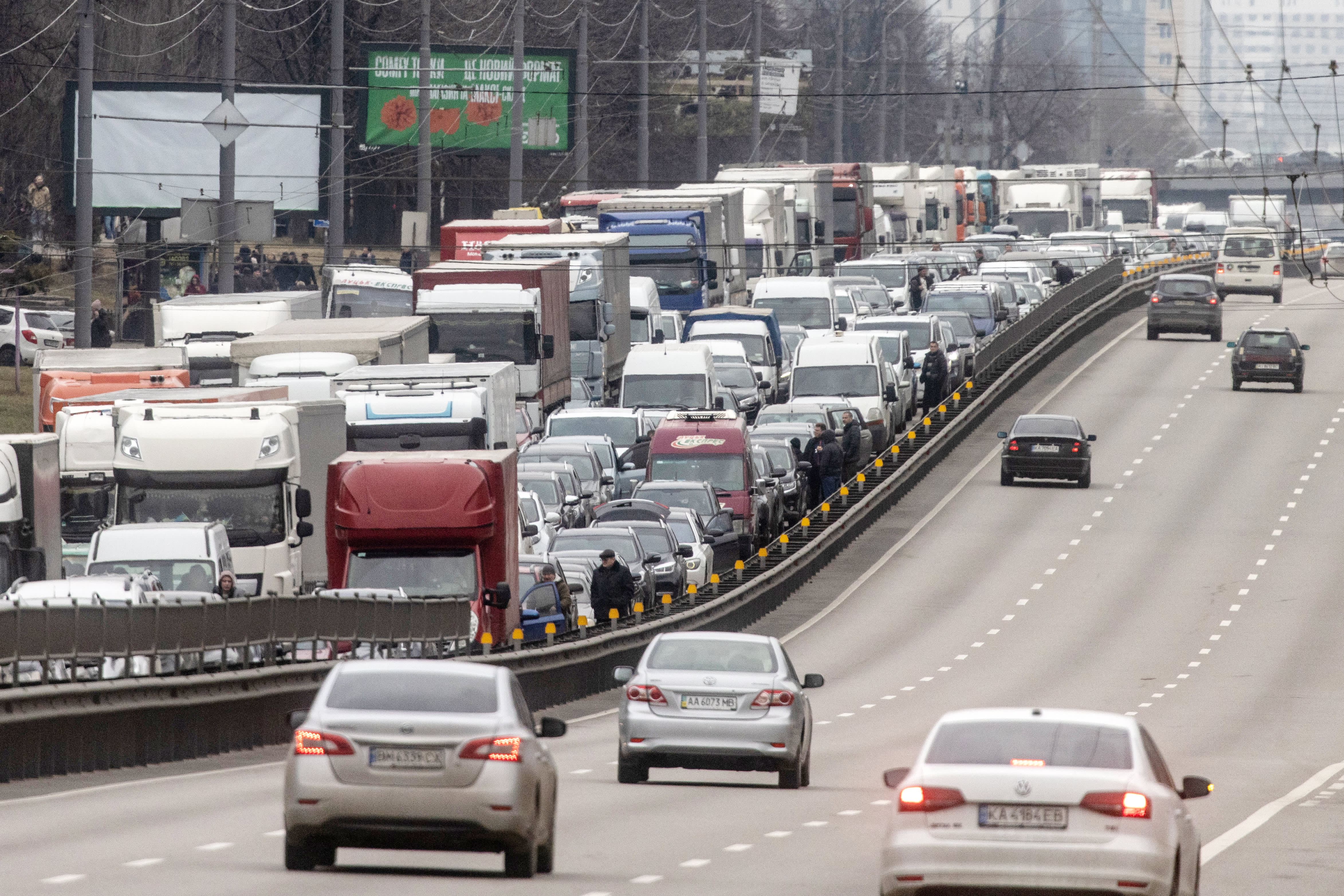
Cars sit at a standstill as people try to leave the city on February 24, 2022 in Kyiv, Ukraine.
New U.S. sanctions and Russia's invasion of the Ukraine could have wide-ranging impacts on the already constrained automotive global supply chain, but only a few automakers have notable exposure in the country.
France-based Renault Group, which has a controlling stake in Russian automaker AvtoVAZ, accounts for 39.5% of the country's vehicle production, followed by South Korea-based Hyundai Group at 27.2%, and German automaker Volkswagen at 12.2%, according to research firm IHS Markit.
Toyota Motor follows at 5.5%, followed by all other automakers in the single digits, according to the data and insights company.
"The biggest global [automakers] aren't making tons of money out of Russia," Tim Urquhart, a European principal automotive analyst at IHS. "But Renault is obviously the biggest company in terms of exposure."
Renault will suspend its production at its assembly plant in Moscow next week due to "forced change in existing logistic routes" that are causing component shortages, Reuters reported Friday.
Regarding the "Detroit Three" automakers, General Motors ceased production operations in 2015. It also ended a joint venture in 2019, but continues to operate a sales office for imported vehicles. Both Ford Motor, which largely exited the country in 2019, and Stellantis, formerly Fiat Chrysler, each operate a factory through joint ventures in the country. Stellantis represents only 1.6% of the country's vehicle production, IHS reports.