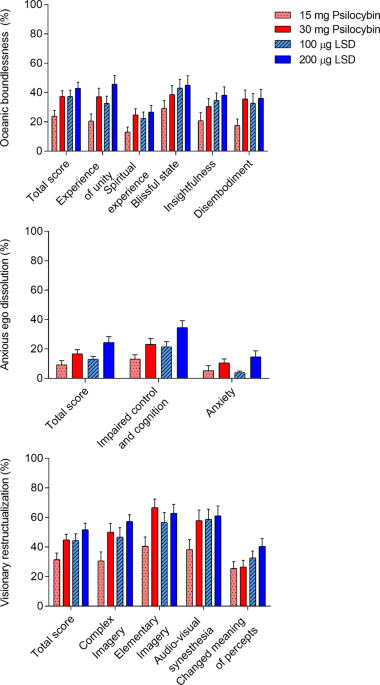
The present study investigated and directly compared acute effects of LSD and psilocybin using well-defined doses in healthy participants. Previous recent studies only investigated either LSD or psilocybin alone. The present study was the first modern study that compared both substances within the same study using a within-subjects design. We used LSD and psilocybin doses that covered the range of therapeutically used doses and were expected to induce comparable subjective effects as previously reported in similar Phase 1 studies of either LSD or psilocybin [11, 21, 33]. The present study was also the first to describe acute effects and particularly the pharmacokinetics of fixed doses of psilocybin, thus complementing our recent study using a fixed dose of 25 mg psilocybin in healthy subjects [38]. In contrast, several previous studies of psilocybin in healthy participants used body weight-adjusted dosing approaches [11, 13,14,15, 39, 40]. Fixed dosing is likely to be used in therapeutic settings [2, 41]. The body weight adjustment of the psilocybin dose did not alter subjective effects and had no advantages [42], and fixed dosing is more practical in large trials in patients. Both LSD and psilocybin were used in pharmaceutical formulations with defined content uniformity and stability. Furthermore, plasma concentrations of both LSD and psilocin were determined as measures of exposure to the substances.
Subjective effects that were induced by both doses of LSD and the high 30 mg dose of psilocybin were largely comparable, whereas 15 mg psilocybin exerted clearly weaker effects. Subjective effects of LSD in the present study were similar to previous studies that investigated either LSD or psilocybin [7, 11, 28]. For LSD, the dose-effect relationship reached a ceiling effect for good drug effects at a dose of 100 µg. Only ego dissolution and negative drug effects further increased at a dose of 200 µg compared with 100 µg, which is consistent with previous studies [7, 43]. Notably, the ceiling effect was less pronounced in the present study compared with our previous study [7]. In contrast, psilocybin showed a clear dose-effect relationship on most outcome measures at the doses used in the present study. Ratings of the high 30 mg psilocybin dose were nominally between the 100 and 200 µg doses of LSD, indicating that 30 mg psilocybin corresponds to 150 µg LSD base, a dose that was not tested herein. This means that the doses of psilocybin that were used in the present study (30 and 15 mg) were lower in terms of strength compared with the two doses of LSD, and ceiling effects were likely not reached for psilocybin compared with LSD. A previous study that investigated body weight-adjusted doses of psilocybin of ~20 mg/70 kg, 30 mg/70 kg, and 40 mg/70 kg found no difference in positive mood scale ratings on the MEQ30 [14], indicating that a ceiling effect for good drug effects for psilocybin, similar to LSD, might be reached at doses above 20 mg. The only subscale on which 200 µg LSD was significantly different from 30 mg psilocybin was “ineffability” on the MEQ30 and MEQ43. Ineffability largely describes the ability to express an experience in words. Because 200 µg LSD was nominally more effective than 30 mg psilocybin and because 100 µg LSD showed a nearly significant lower effect on this scale compared with 200 µg LSD, we suggest that this is a dose effect rather than a substance-specific effect. In addition, no sex differences were found, consistent with previous reports [7, 28, 43].
Both LSD and psilocybin had dose-dependent effect durations, with higher doses producing longer effects. However, the effects of LSD were also clearly and significantly longer than the effects of psilocybin. The differences in the duration of action can be fully explained by differences in the pharmacokinetics of LSD and psilocin. The elimination half-life values of LSD and psilocin were an average of ~4 h and 2.5 h, respectively. These values are consistent with previous studies [7, 13, 19, 37], although a slightly shorter half-life of 2 h has also been described for psilocybin [38, 44]. Body weight had no influence on LSD or psilocin plasma concentrations, as described previously [7, 38, 45]. The faster time of onset for LSD can be explained by the liquid formulation compared with the capsules that were used for psilocybin and cannot be attributed to the substance.
LSD and psilocybin both produced significant autonomic stimulant effects as observed previously [7, 11, 40, 43]. The cardiostimulant responses were present at both doses, with a trend toward greater responses at the higher doses. Interestingly, psilocybin produced stronger elevations of arterial blood pressure, whereas LSD produced stronger elevations of heart rate. When combining elevations of heart rate and blood pressure into the rate-pressure product, the high dose of psilocybin (30 mg) and both doses of LSD (100 and 200 µg) exerted overall similar cardiovascular stimulation, whereas the 15 mg dose of psilocybin exerted overall weaker effects. Psilocybin increased body temperature more than LSD. Psilocybin also produced greater impairments in pupil contraction compared with LSD. This lower pupillary contraction in response to a light stimulus has also been observed with MDMA compared with LSD [28] and may represent a similarity of psilocybin and MDMA. This similarity may be explained by a common action of psilocybin and MDMA on the serotonin transporter [10]. Overall, however, these autonomic effects were moderate and transient and thus not a safety concern. We also assessed acute and subacute adverse effects and spontaneously reported adverse events between test days. LSD and psilocybin produced comparable acute adverse effects, but the high doses (30 mg psilocybin and 200 µg LSD) produced more subacute adverse effects, indicating that higher doses are associated with longer-lasting and more unpleasant effects. The number and type of systematically assessed and spontaneous reported adverse effects are comparable to those reported in a larger pooled analysis of the safety of LSD in healthy subjects [43].
The true content of the LSD formulation in the present study was 11–14% lower than in previous studies by our group that used the same dose and formulation [7, 19, 28]. This lower LSD content and larger study group size might partly explain the trend toward greater effect differences between the 100 and 200 µg LSD doses compared with a previous dose-finding study in 16 subjects [7]. The two doses of psilocybin (15 and 30 mg) that were selected for this study were lower in terms of acute effect strength compared with the 100 and 200 µg doses of LSD. We also recently evaluated the acute effects of 25 mg psilocybin. Altogether, these results suggest that 20 mg psilocybin is equivalent to 100 µg LSD, and 30 mg psilocybin is equivalent to 150 µg LSD, a consistency that was also noted elsewhere [46]. Thus, the dose equivalence of LSD to psilocybin is ~1:200. This result may be helpful for dose finding in future studies and facilitate interpretations of future clinical results that are obtained with either substance.
The present study was well blinded. The only condition that was identified by the subjects with high certainty was placebo. Furthermore, the high dose of LSD (200 µg) was almost never mistaken for the low dose of psilocybin (15 mg). Generally, both the low and high doses were more likely to be confused with each other rather than the high dose being exclusively mistaken for the low dose. Interestingly, this was still the case at the end of the study, despite the clear differences in effect durations between LSD and psilocybin that could be expected to unmask the blinding between substances. These findings further support the view that alterations of states of consciousness that are induced by LSD and psilocybin are more likely dose-dependent rather than substance-dependent and that the differences in their pharmacological profiles [10] do not relevantly influence subjectively experienced effects. Studies in rats indicated a later, more negative, temporal phase with involvement of D 2 and D 4 receptors for LSD, but not for psilocybin [47, 48]. The finding of no difference in the quality of subjective effects of LSD and psilocybin also confirms that both classic psychedelics produce their effects via shared agonistic effects on 5-HT 2A receptors. The subjective effects of both substances can robustly be blocked by 5-HT 2A receptor antagonist administration in humans [7,8,9].
In the present study, neither LSD nor psilocybin altered plasma BDNF concentrations compared with placebo. Previous studies reported that 200 µg LSD but not 100 µg LSD increased BDNF levels [7, 28]. In addition, LSD and psilocybin both increased PRL and cortisol levels, which are markers of serotonergic activity [49]. Furthermore, the present study was the first to document increases in circulating oxytocin after psilocybin administration as previously shown for LSD [21, 22] and MDMA [28, 50].
The present study has strengths. Two well-characterized doses of LSD and psilocybin were used within-subjects and compared with placebo under double-blind conditions in a laboratory setting. We included equal numbers of male and female participants and used internationally established psychometric outcome measures. Plasma LSD and psilocin concentrations were determined up to 24 h for all conditions. Notwithstanding these strengths, the present study also has limitations. The study used a highly controlled setting and included only healthy subjects. Thus, subjects in different environments and patients with psychiatric disorders may respond differently to either LSD or psilocybin.