Federal and state spending on acute care for nonelderly patients will reach $583 billion in 2023 if the public health emergency ends in Q2, Urban Institute estimates show.
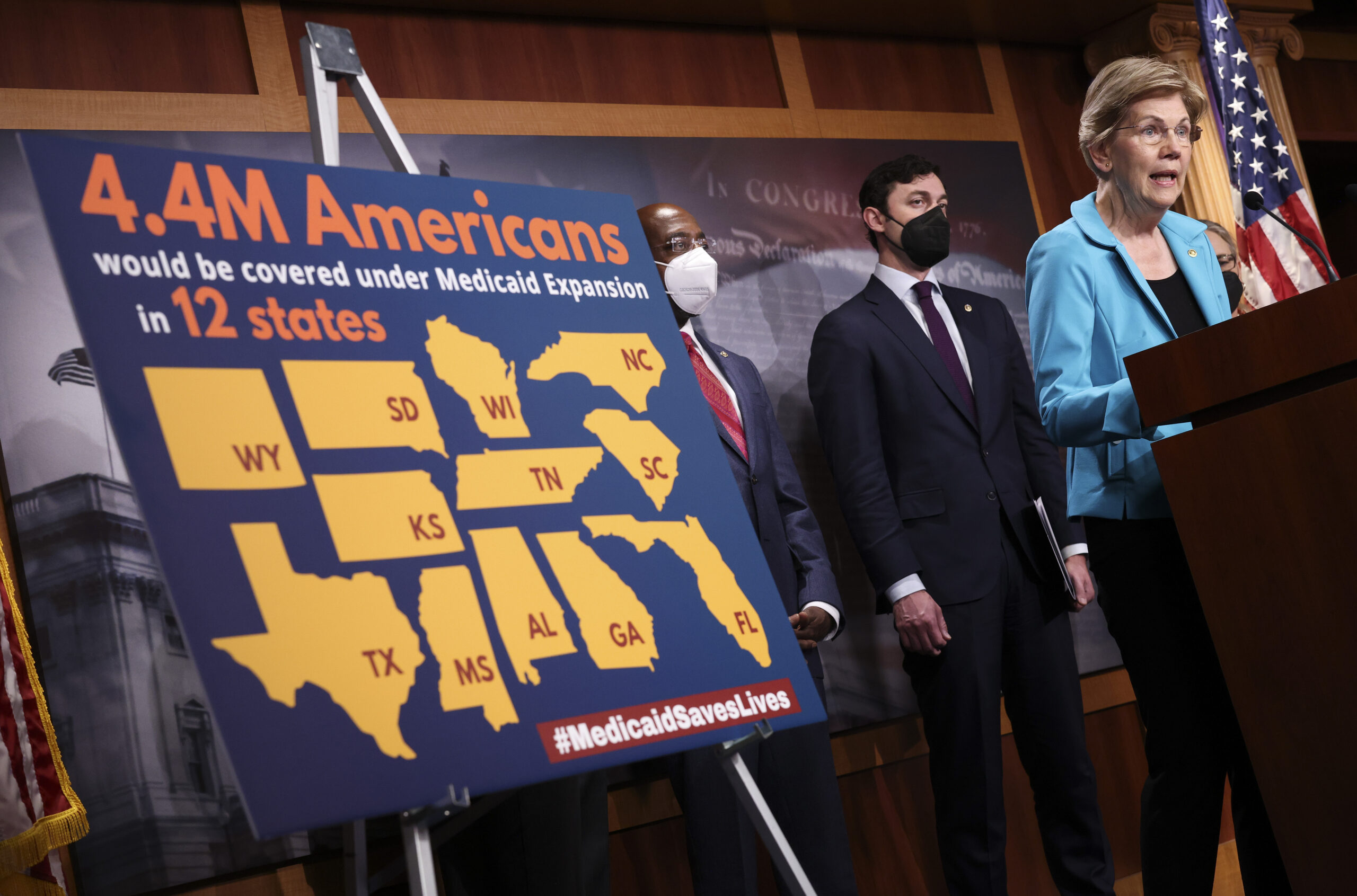
Sen. Elizabeth Warren (D-Mass.) speaks on Medicaid expansion and the reconciliation package during a press conference with fellow lawmakers at the U.S. Capitol on Sept. 23, 2021, in Washington, D.C. (Kevin Dietsch/Getty Images)
Nearly 16 million people could lose their Medicaid coverage after the national public health emergency ends, new estimates show, and while health care groups are asking for months of notice before that happens, the burden that the end of the emergency period will cause them will only grow the longer it wears on. Throughout the COVID-19 pandemic, the federal government has given extra funding to state Medicaid programs — as long as they agree not to cut people from Medicaid during the public health emergency, even if beneficiaries lose eligibility in that period. From February 2020 to September 2021, enrollment in Medicaid and the Children’s Health Insurance Program has surged by 19.1 percent, reaching 84.8 million. That means that as states eye the winding down of the emergency and the loss of extra federal funding, which could be triggered as soon as July, they’re facing a massive backlog of work to determine who’s still eligible for Medicaid coverage. The new estimates from the Urban Institute indicate that the coverage losses will be greater the longer the health emergency goes on: 12.9 million if it expires at the end of March, 14.4 million in June and 15.8 million in September. Medicaid spending is also dependent on when the emergency ends. If it expires in the second quarter, for example, federal and state spending on acute care for nonelderly patients will reach $583 billion in 2023.
Meanwhile, groups working with payers, including the Centers for Medicare and Medicaid Services, are looking to ensure that the process doesn’t lead to a massive surge in the number of uninsured. But they are facing a tangled web of bureaucratic hurdles and other challenges. “A quarter of America has to go through the redetermination process,” said Craig Kennedy, president and chief executive of the Medicaid Health Plans of America, which represents the Medicaid managed care industry. “That takes all hands on deck.” Options for beneficiaries dropped by Medicaid will vary by state The next steps for people who lose Medicaid, and how easy it will be for them to get other coverage, will depend on where they live. Many are likely eligible for subsidized coverage on Obamacare plans, and CMS is encouraging flexibility for managed care companies with both marketplace and Medicaid plans to do outreach to people being kicked off Medicaid and help move them onto the exchange. “If a state runs their own marketplace, it’s the same interface for Medicaid and the marketplaces,” said Matthew Buettgens, a senior fellow in the Health Policy Center at the Urban Institute and author of the new report. “If you’re losing Medicaid eligibility, they should be able to very quickly determine that you’re eligible for tax credits and keep you from losing coverage.” He said that process could be slower in the 33 states that don’t run their own exchanges, though. Jennifer Babcock, senior vice president for Medicaid policy at the Association for Community Affiliated Plans, said one of the biggest challenges is also one of the seemingly simplest: ensuring state agencies in charge of the redetermination process have the right contact information for people on Medicaid. That’s because of “the disruptive nature of the pandemic — around unemployment, around living arrangements and that sort of thing,” Babcock said, adding that states should be looking to pharmacists and other community-based services to find the most up-to-date information. Kennedy, for one, said that in states with Medicaid managed care, “everyone interacting with Medicaid populations should be considered a partner” in the process, including providers and nonmedical services like transportation.
Oklahoma Saw Biggest Jump in Medicaid Enrollment During Pandemic Change in Medicaid and CHIP enrollment, February 2020 to September 2021 Data: Kaiser Family Foundation report: “Analysis of Recent National Trends in Medicaid and CHIP Enrollment”