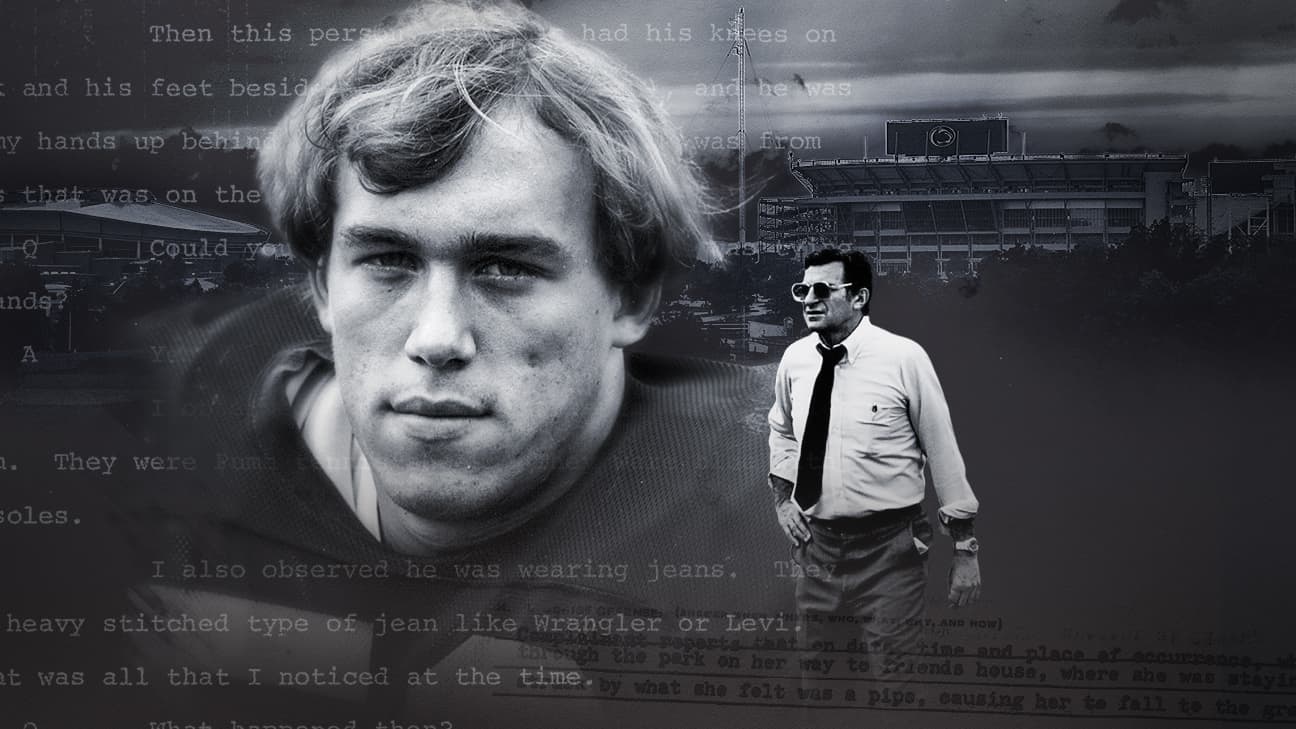
Editor's note: This story contains explicit language and graphic descriptions of sexual violence and a murder investigation. Karen was alone in her apartment when the phone rang. She didn't like being alone. It had been weeks since she had been attacked there, but the apartment still felt to her like a crime scene, a place that had been turned over and rummaged through. She had called the police on the night of the attack, when she finally convinced herself that she might be safe. She had gone to the local hospital and submitted to an examination. She had opened the Yellow Pages and called a resource new to the town where she had gone to school and now lived, something called a rape crisis center. But the police seemed to want more from her, even after she had told them everything she could remember. The hospital had run out of rape kits, and the nurse who examined her was rude, she thought, "mocking." The rape crisis center had no therapists to recommend, only women around her age who offered more sympathy than expertise. Karen felt as though she were being pushed aside and forgotten. The attack she had endured was inescapably real but, in its aftermath, she faced a sense of unreality so powerful that she kept in her pocket the scant newspaper clipping about her assault to remind herself that it really happened. The apartment provided no refuge. When she discovered that photos she kept of herself were missing, she knew they had been taken but couldn't be sure by whom. Nothing had gone untouched. When the phone rang, the call came through a line that a few weeks before had been cut by the blade of a knife. She had heard from the police that there were others who had been attacked recently. She had heard some of the other women had received phone calls after their assault, possibly from the assailant. But when she picked up, she did not hear the voice she feared. This was someone familiar but not someone she knew. It was a man everyone knew. And when she realized who it was, she wondered immediately how he knew her name: "Karen, this is Joe Paterno," the man said. "Are you OK?"
ACT 1: CRIME Todd Hodne joined the Penn State football team in 1977 as a prized recruit from Long Island, New York. He would become perhaps the most dangerous person to ever play college football. USED WITH PERMISSION FROM THE EBERLY FAMILY SPECIAL COLLECTIONS LIBRARY, PENN STATE UNIVERSITY LIBRARIES
Forty-three years ago, Penn State University played for its first national championship in a football season that began against Temple on Sept. 1, 1978, and ended against second-ranked Alabama, on Jan. 1, 1979. It was the season in which Penn State football became Penn State Football, a season that saw head coach Joe Paterno become an American icon. It was also a season that saw a serial sexual predator attack multiple Penn State students. If you are any kind of sports fan, you probably know the first story, all the way through its shocking denouement 10 years ago—the story of the football coach whose black shoes and white socks were seen as his moral underpinnings until they weren't ... until his career ended when the sexual abuse committed by an assistant coach named Jerry Sandusky came to light. You almost certainly don't know the second. It is not just a story that hasn't been told; it's a story that doesn't exist, even in obscure corners of the internet. It's the story of a Penn State football player who, as his team ascended to the pinnacle of the sport, was ransacking the lives of women in the dark. His name was Todd Hodne, and he was perhaps the most dangerous predator ever to play college football. "I have been a prosecutor for nearly 30 years," wrote John B. Collins, who prosecuted one of Hodne's crimes, in a letter to a parole board. "I have prosecuted serial killers and capital cases. Todd Hodne, to this day, remains among the three most dangerous, physically imposing and ruthless excuses for a human being I have ever faced in court." Hodne arrived in State College in 1977 as a prized recruit from New York's Long Island, and in 1978, he was the Penn State Rapist. There were other rapes and rapists; Penn State, in the mid- and late seventies, was enduring an epidemic of sexual assault that female students of the day still talk about. But even against that backdrop, Hodne's rapes and attacks stand out because he was a football player who, according to one family member, "had no control over his dark impulses." He was big and strong, entitled and enabled. He was driven and determined and a little desperate. He was also cruel, the most predatory of predators, a hunter who liked to linger. He attacked with a knife to the throat, and when he attacked women, he made sure they couldn't see him, but he also liked to suggest they knew him. "Do you recognize my voice?" he'd asked Karen. In October 1978, Hodne was finally caught on the strength of three fingerprints and a traced phone call. Five months later—two months after Penn State and Paterno lost the national championship game to Alabama and Bear Bryant—Hodne was found guilty of criminal sexual assault after one of his victims testified against him. But that was not the end of Hodne's string of attacks. It was, tragically, just the beginning of a series of crimes of such escalating violence that they have become generational, wreaking havoc on the lives of his victims and their descendants. More from ESPN’s investigative team The Hero of Goodall Park: Inside a true-crime drama 50 years in the making
Inside a true-crime drama 50 years in the making ESPN Investigates Podcast: The Running Man
The Running Man College football: Death at the U: Who killed Bryan Pata? Todd Hodne died of cancer on April 29, 2020, six days after his 61st birthday, comatose but still under guard in the prison ward of a hospital in New York state. The story you are reading started with three questions about Hodne and his criminal career: What did he do, why wasn't he stopped and why doesn't anyone know about him? We have examined hundreds of pages of surviving, often heavily redacted, documents and have done hundreds of interviews with Hodne's friends, girlfriends, family members, teammates and coaches, as well as those who investigated and prosecuted his crimes. We have contended with the obstacles of indifference and obstruction but also of time itself; after 43 years, people grow old, people forget and people die. But of course, they also remember, and the most consequential witness is offered by the women who survived the ravages not just of time but of Hodne himself—who survived their hours in the dark with a 240-pound Division I football player with a knife in his hand and no particular interest in their survival. Of the 12 women he is known to have attacked, four are dead. We spoke to six of the other eight and to the husband of a seventh. One did not respond. We asked them about the violent attacks they endured in 1978 and 1979—and 43 years later, they remembered those crimes in unflinching detail. They shared the stories they'd had to bear in private. And out of that, out of the sheer scope of lives changed and ruined, emerged a portrait of a time and a place, a portrait of a football program and its coach, and a portrait of a terrifying predator who called himself "the All-American kid."
They were a bunch of kids, 14 years old, but also strangers to one another. They were at freshman football camp, on a new team for a new school, St. Dominic in Oyster Bay, Long Island. They were just yakking before mealtime, in their bunks. You know boys like these: someone had to prove himself, someone had to dominate. So one of them, John Poggioli, started messing with the kid playing linebacker, the kid with the long face and the long hair combed to the side and the serious real estate at the jawline. Nobody even remembers what was said. But anyone who was there remembers what happened next. One second, Poggioli is talking, teasing the kid. Next second, the kid takes out a knife and throws it at him. He misses, but not by much—the knife sticks in the wall, vibrating like a tuning fork, a few inches from Poggioli's head. The linebacker, Hodne is his name, gets up and without a word pulls the knife from the wall. He slides it back in its leather sheath and heads for chow. The rest follow, wondering if they should tell one of the coaches what they just saw. They never do. Hodne could hit. Even before he put on all that muscle, even when he was all shoulders and long legs and arms, he could ring bells, he could make the guy on the other side of the line quit or at least reconsider being a hero. "It was just different, getting hit by Todd," Poggioli says. It's human instinct to slow down when you make a tackle—to pull up, just a little bit, right before contact. Hodne didn't have that instinct. He accelerated through the tackle. He accelerated through the ball carrier and liked to luxuriate in the aftermath, standing over the guy he laid out. There were rumors he stuck rolls of quarters in his arm pads. His ferocity was what brought him to St. Dominic. It was a small school, with around 150 kids in each class, and not a traditional power. But the football coach, Tom Capozzoli, had been at St. Dom's for about a dozen years, and now he had a star player—his son Tony, who had won the national Punt, Pass & Kick championship two years in a row. The athletic department decided to bring in players who would help the Capozzolis win a championship before Tom retired. Hodne was one of them, along with a teammate from the Levittown Red Devils travel team, Dave Smith. Hodne wasn't even Catholic. He was just rangy and violent, an intimidator. He was even intimidating at the freshman dance in the fall of 1973. It was held at the Knights of Columbus Hall; the football players hung around a big round table, showing off for each other. Hodne wound up doing something they talk about even now. He pulled a girl at the dance under the table while his teammates stayed in their chairs—an act that made his reputation in some quarters, and in some quarters undid hers. "To be very honest with you, we all pointed the finger at her," says Marge Galtieri, a St. Dominic cheerleader and one of Hodne's classmates. "We judged her. But maybe we judged her wrong, looking at the events of the following years." Hodne was from Wantagh, a comfortably middle-class town between the little boxes of Levittown and the fulfillment of Robert Moses' vision in the boardwalk of Jones Beach. He had a hard-working father, a charming and stylish mother, and siblings with whom he was close. He became an All-Long Island linebacker whose very name rattled opponents. But even in ninth grade, Todd Hodne was a polarizing figure at St. Dominic, because even in ninth grade, Todd Hodne was talking about breaking the law. He brought his knife to school and, according to Poggioli, "definitely" kept the quarters in his fists when he, as a freshman, battered a senior who challenged him. He also bragged about stealing car stereos and doing burglaries. His teammates listened, and they had to decide whether to believe him and what to do if they did. Dave Smith was the son of a Nassau County police officer, and when they were all sophomores, he told his father that Hodne was breaking into people's houses. Smith's father contacted Hodne's local precinct, which investigated. The result, says retired officer Don Smith, was that Hodne, at 15, was "custodialized" by the juvenile justice department of Nassau County and compelled to return the stereo equipment he had stolen. The intervention made enduring enemies of Hodne and Smith, the two inside linebackers for the St. Dominic Bayhawks. But it neither deterred Hodne nor threatened his status on the team. Many of Hodne's teammates remember Tom Capozzoli repeatedly taking up for him with school administrators. One remembers a coach being fired after he tried to warn Hodne's parents about their son. Ralph Willard, who was the athletic director at the time and went on to coach basketball with Rick Pitino at Louisville, says, "I don't remember there being any problems with Todd, to be honest. I just remember how he hit." St. Dominic won the state Catholic High School Football League championship in 1975, in Tom Capozzoli's final season as head coach. His son Tony, a senior, was named first-team Parade All-American, and he committed to Penn State as a quarterback and a kicker. Todd Hodne, Dave Smith and John Poggioli had one more season together, and though Hodne and Smith once had a fistfight on the school stairs, Hodne and Poggioli were thought to be best friends. In truth, Poggioli said he remained in the friendship because he didn't know how to get out. He was drawn to Todd Hodne and he was afraid of Todd Hodne in equal measure, and Hodne made him pay every time Poggioli tried to emerge from under his sway. When Poggioli was a junior, he told Hodne that he might try out for the school play; Hodne responded by sneering, "You're no actor," and dumping a pail of water on his head. When Poggioli had a crush on a girl named Janet, he wouldn't dare ask her out because Hodne, though not her boyfriend, had claimed her. "In my four years at St. Dominic, nobody asked me out because they were so afraid of Todd," Janet Shalley remembers now. "I could only date boys from other schools. And back then, I had it going on." Hodne followed Tony Capozzoli to Penn State. The coach who recruited both of them remembers Hodne as a good kid: "If he wasn't a good kid, we wouldn't have brought him to Penn State." But even with Hodne in Pennsylvania, Poggioli remained under his influence. After Hodne completed his freshman year as a Nittany Lion, he invited Poggioli and a friend from Wantagh to spend a weekend with him in State College. School had ended. But Hodne was living with some other athletes in a house off campus. He had made plans with his friends from home to drive to Philly for a Rolling Stones concert. They were going to have a cookout in the backyard, and so they went to the supermarket. "We went to get supplies for the barbecue and got a bunch of steaks," remembers his Wantagh friend. "He goes, 'I know this trick: You just turn the steaks over in the cart and walk on out.' So we robbed all these big steaks and had a feast."
As Todd Hodne wreaked havoc in State College in 1978, Penn State football coach Joe Paterno and his team ascended to legendary status. RICH CLARKSON/NCAA PHOTOS/GETTY IMAGES
The next morning, June 18, 1978, there was something else Hodne wanted. They went to a store on College Avenue, the main drag for Penn State students. It was called the Record Ranch, and Hodne, sometimes in the company of other athletes, had been stealing LPs from there since he'd come to school, hiding them under his coat. The store was closed on a Sunday morning, but Hodne wanted to go in. Poggioli thought it was a bad idea, he says now; the problem was telling his friend. "I didn't stop Todd because I couldn't stop Todd. If you tried to stop Todd, he would hurt you. You couldn't say no to him, and he could convince you to do things you wouldn't normally do." According to a police report, they kicked in a window of the Record Ranch and were in the process of stealing $30 in quarters and another $800 in merchandise—a Yamaha stereo amplifier; a Rolling Stones mirror; some T-shirts and Harley Davidson belt buckles; and record albums by Donald Fagen, David Gilmour, Little Feat and Rick Wakeman, among others—when two employees from an adjacent store saw a door open and peeked inside. They saw Hodne's Wantagh friend dangling from the broken window and called the police. He was arrested along with Poggioli, who had stayed outside. But Hodne easily shrugged off the police and ran right through them. "Todd got away because Todd at that point was a criminal," Poggioli says. "He knew how to get away." The next day, Hodne showed up at the police station, saying he heard two of his friends were in some trouble and wanted to visit them in jail. According to a police report, he first said his name was "Tom Harris." Then he changed his mind and "stated that his name was Todd Hodne ... that he was a Penn State football player and that he did not want his name out." He was leaving the station when an officer told him he matched the description of the man who fled the Record Ranch burglary. The officer asked for permission to take a photograph of him, and Hodne agreed. Hodne drove back to Wantagh and, in his absence, was identified in a photographic lineup. When he returned to State College, he was arrested, and on June 21, he, along with his friend from the neighborhood, were charged and later convicted with felonies. "He ruined my life," says Poggioli, who wound up pleading to a misdemeanor. "But he ruined so many lives. I feel lucky to have gotten out when I did. I feel lucky compared to the others." It was not a violent crime. But it was a felony, and Joe Paterno was a coach who called players into his office even when he heard they were not participating in classroom discussions. He was a disciplinarian, and there would have to be discipline. On Aug. 19, 1978, two months after the burglary, Penn State held a scrimmage, and afterward, Paterno told gathered reporters that Todd Hodne had been suspended for the season. But he did not like to give up on his players, and he did not give up on Hodne. In his announcement, Paterno said that Hodne will be able to return to the team "if he has a good academic year and if he proves to us that [the robbery] was a mistake." He also sought to provide Hodne a role model for his sophomore season, and to that end, one of his seniors, Fred Ragucci, was summoned into the football office. Ragucci went to a Catholic high school on Staten Island, and now he played defensive end for Paterno. When Ragucci was told he would have a new roommate in Hamilton Hall, he didn't blink, even though he was two years older than Hodne and was not part of his crowd. Ragucci could figure out easily enough why he wound up in this unlikely pairing: "I was a pretty good student. I was pretty straight, never in any trouble. Nobody specifically mentioned this to me, but I think they were trying to put people in with people who might be a good influence." They did not spend a lot of time together at 279 Hamilton. Why would they? In 1978, there was nothing in most college dorm rooms outside a stereo and perhaps a hot plate. But later, Ragucci will always remember one thing about his new roommate: his knife. It was Hodne's prized possession, a gift his grandmother gave him after she returned from a trip to her ancestral Norway, the blade forged from fine Scandinavian steel. But what Ragucci remembers is how much time Hodne spent with it, his fascination with it. "He was always playing with it when he was in the room," Ragucci says now. "It had a leather sheath, and he would take the sheath on and off, on and off. All the time, even when you were having a conversation."
Betsy Sailor was a senior at Penn State in the fall of 1978. COURTESY BETSY SAILOR On Sept. 13, 1978, a Wednesday, Betsy Sailor's phone rang all day. Two days before, she had placed a classified ad in the Penn State student newspaper, the Daily Collegian. She was living in the basement apartment of a brick home not far from one of Penn State's golf courses, the White Course. Her intended roommate had not returned to school for the fall term, and she was looking for someone to share expenses. In her ad she wrote: "Female roommate needed to share quiet apt. near golf course. Rent $87.50 plus phone. Non-smokers only. Call Betsy." It was the kind of thing people did back then, and Betsy's ad ran along with eight others. She was 21 years old, a senior at what she proudly called "my state university" and one of the few women majoring in business administration. She had curly hair and smiled with resolute cheer. Though still a student, she led a settled life, with a fiancé seven years older than she was who lived a couple of hours away in Johnstown, Pennsylvania. She believed that "going to Penn State football games was the most exciting thing you could do" and that Joe Paterno was "a demigod." She lived with two Siamese kittens. She had never heard of anything bad happening in State College. She thought it was a safe place to be—"good times all the time." Betsy liked taking the calls. She liked talking to the callers—interviewing them, really, so that she could make the right choice. She might have been, as one friend remembers, more mature than other students, "like an older person coming back to school," but she was open to new things, eager for fresh perspectives. A previous roommate, Lisa Yelverton, says of her time with Betsy: "We just clicked. I was from Philadelphia, and I was inner city. And she was country. I was Black, and she was white, and I guess we were so intrigued and wanted to learn about each other's cultures more than anything." As Betsy answered the phone, she hoped she could find someone like Lisa again. Two men called, but one annoyed her, asking if she was absolutely sure she didn't want a male roommate. The other was calling for his girlfriend. She had registered late, he said, and she needed a place to live. He asked about her apartment and its location and if he could come by and take a look at it. She told him that she was going out for a while and wouldn't be home. Then she spoke to a caller who connected with her over common interests and made her decision. She studied for a while, relishing her time alone, and then, near 10 p.m. went upstairs to tell her landlord she was going to the store for some cat food. She was not gone long, and when she returned, her landlord, a motherly woman with whom Betsy was close, told her that the kittens had gotten frisky in her absence. She had heard them knock something down in the apartment. When Betsy went downstairs, she turned on the light in her bedroom. The only thing she found amiss was a telephone book open on the floor, and she wondered to herself how her landlord had been able to hear such a small disturbance. She had already left a message on the answering machine of the woman she selected as her roommate, and she was nothing if not polite, so she also began making plans to call back all the others who had expressed interest in the room, including the boyfriend of the late arrival who now had no place to live. But making a choice had given her a strong sense of freedom and relief, and she celebrated by "doing those silly things you do when you're living alone"—singing to herself and "dancing with the refrigerator door." After a while, she remembered that she had to study for a test and went into her bedroom to find her books. She hit the light switch, but the room remained dark, and in the moment of surprise between expectation and reality, it felt suddenly and consumingly black. "The next thing you know," Betsy says, "I had a hand around my mouth and a knife at my neck, and a voice said, 'I'll kill you if you say a word.'" She did not say a word. She did not scream. She began making choices right away, and the first was that "there was nothing he could do, nothing he could steal, that was worth my life." The second was that she would go into "information-gathering mode," and try to remember the details of everything that happened, though her assailant did his best to prevent her from doing so. He had been hiding in her room for as long as she had been home and had used that time to make preparations. He used one of her scarves to blindfold her and the belt from the robe she kept in her closet to bind her hands behind her back. Then he picked her up and planted her face down on her bed, and from his lack of strain or even apparent effort, she understood that his outsize strength made him particularly dangerous. When he went to her bathroom and began rummaging around the medicine cabinet, she told herself, "Good, he's leaving prints."But when he asked for her razor, she told herself, "No way I'm giving this guy my razor," and decided to gamble. She kept her razor in the bathtub. But she knew that men don't view shaving in terms of the bath; they view it in terms of the mirror. She told him that her razor was where he would have kept it, the medicine cabinet, and when he gave up trying to find it—when he returned empty-handed—she was grateful that men know so little about women.
MARY F. CALVERT FOR ESPN “I thought, if he touches anything in there, I’ve got him for fingerprints.” BETSY SAILOR, on considering her basement-apartment surroundings while Todd Hodne attacked her.
Though she decided not to fight him, her mind never stopped resisting. Even when he flipped her over and sat on her chest, with his knees straddling her shoulders, she kept trying to see around the margins of her blindfold and then the pillowcase he had put over her head, kept trying to glean information she could use later to identify him or use now to stay alive. She saw his thumb and knew he was white. She saw the soles of his sneakers and the stitching of his jeans and knew what he was wearing. And yet she was still telling herself that he was there to rob her. "You can take my jewelry," she said. "I'll tell you where it is." "I'm not going to do that," he said. "What are you going to do?" she asked. "I'm going to rape you," he replied. His voice shattered her. It was the voice from the phone, the voice of the boyfriend who had called about the apartment, but it was so matter-of-fact, so untroubled and decisive, as if her fate were no longer her own. When she heard it, she felt herself split in two, so that she also heard herself, her own voice saying, "Oh no." “You could just tell he was big. And he said, ‘If you say a word, I will kill you.’” Betsy Sailor What happened next was described in excruciating and graphic detail in the police report for what became case 678-09229: "Actor returned and he took off all his clothes and sat on her chest and put his penis to her mouth and told her to suck it, she said she couldn't do that, he became angry so she opened her mouth and he put it in. He then moved to her crotch and began licking. He said 'say you like it,' she said, 'no, because I don't.' Actor then began to rape complainant and she said, 'Please don't cum inside because I'm not using birth control and don't want to become pregnate [sic] over something like this.' He said OK but complainant does not know if he did or not. Actor then put his clothes on and went out of the room. "... she heard him open the back door (outside exit) and then he came back in. Actor told her to open her legs. She refused saying, 'What are you going to do? Don't put anything inside me.'" Actor then began moving around the room opening dresser drawers. She asked him what he was doing and he said, 'Waiting for a ride.'"
When the phone rang in Ann Sailor's house, she didn't automatically think the call was from one of her children. Although she had three in college, long-distance calls were punitively expensive in September 1978 and therefore rare. Betsy called every few weeks. She wrote Ann letters, telling her mother about her studies in business administration. The Sailors were a family of schoolteachers, and Betsy would have made a great one, calm and kind, cheerful and strong, given to striking up long conversations with strangers she encountered on campus. "I'm OK," Betsy began. As Ann remembers now, "When your child says, 'I'm OK,' you know something has happened. But she just calmly told me, step by step, what had happened." The one thing Betsy didn't say, wouldn't say, was that she had been raped. "I wouldn't use that word," Betsy says. "I wanted to spare her that. I said, 'Mom, I've been sexually assaulted.' As if that would make it better." Rape. It was not something most people talked about back then, even if—especially if—it had happened to them. It often went unreported, because of the shame associated with the word and the shaming the legal system routinely inflicted on those who survived it. Rape was an ordeal that promised more ordeals to come, chief among them silence. Things like that didn't happen back then in State College, people still say. But they did. It was just rare that someone came out and said so.
MARY F. CALVERT FOR ESPN “I didn’t want to use the words, ‘rape,’ because I thought that’s just too big of a word.” BETSY SAILOR, on phoning her mother after being raped by Todd Hodne.
Ann Sailor knew her daughter was "one heck of a woman," so stoic she insisted that her parents not drive the three hours from northwest Pennsylvania to State College—that she could handle this ordeal on her own. But she was still so very young, and Ann says she would often wonder: "When she puts her head down on her pillow at night, is she having bad dreams?" Betsy was prepared to say to anyone but her mother that she had been raped in State College. She was prepared to go to court and press charges against whoever had done this to her. She was not afraid, and she was not resigned to silence. And yet, just as there is a cost to keeping silence, there is cost to breaking it. Decades after Betsy called Ann to tell her what had happened on the night of Sept. 13, they both remain reluctant to speak the word that names what Hodne did to her. The daughter is now 64. The mother is 84. They are close; they know most of what there is to know about each other. But they both remember that phone call, and the weight of the word, and how breaking the silence broke them. They can say it now; they can say that Betsy was raped. But they still grieve each time they do. And both of them, far away from one another, in separate phone calls, still weep.
Hodne's roommate freshman year (who asked that his name not be used) was from upstate New York, and so at first he thought that Hodne was different from him because Hodne came from Long Island and hung around with "the Long Island clique"—older, edgier guys like Tom Donovan and Tony Capozzoli and a basketball player named Frank Brickowski. Then he began to sense that Hodne was also different from everyone else. On the field, Hodne was the same, one of a scrum of players more distinguished by toughness than by talent. Off the field too, he was just another guy who liked to drink, smoke weed, go to parties and bring women back to the room. The difference, the roommate realized soon enough, was a matter of degree. The realization came when someone told Hodne, "No." At Hamilton Hall, they lived between the two "jock house" fraternities, Phi Delta Theta and Phi Gamma Delta, otherwise known as "Fiji House." One night early in freshman year, Hodne and his roommate headed for a party at Fiji House, only to be told at the door that freshmen weren't invited. They left, but on their way back to Hamilton, Hodne saw an opportunity. "At Fiji House, they kept the kegs of beer in the back, near the stairwell," the roommate remembers. "And Todd goes, 'We're going to take one.' And he picks up a keg and carries it to our dorm room. And then he goes downstairs and puts up a sign that says there's a party in our room. We have 25 people in there, and he's charging at the door for beer that he stole from Fiji House. And I'm like, 'I'm not going to make it through my freshman year.' After two weeks, I thought, 'Oh, I'm in the s---.'' I considered going to Joe [Paterno] and asking him for a room change. But Joe's going to ask me why. And what do I tell him? So I just decided to suck it up. But I spent my entire freshman year praying I wouldn't be arrested." It wasn't just that when Hodne drank, he "could drink a bottle of Jack Daniels in a half hour." It wasn't just that when he went to the Record Ranch, he couldn't leave without a few LPs under his coat. And it wasn't even that when they both went to Hodne's home in Wantagh, he once stopped on the way back to State College and picked up a pound of weed for the purpose of selling it. No, it was that "Todd just didn't have the same moral compass that other people did." Hodne was extreme in everything, in particular the activity that so many football players took as a privilege of being on the roster. "He had some wild sexual appetites," the freshman roommate says. "We had bunk beds, and I'm on the bottom, he's on the top. And he'd be up there going at it for hours at a time. It just wasn't normal. I mean, I knew something was definitely different in that aspect." Most of the players who remember Hodne minimize the significance of their memories of him, either discounting the time they spent with him or the time he spent on the team. But the freshman roommate still thinks about him. "Living with someone like that is certainly something you never forget," he says. "What it's taught me is that you can't really know people and what they're capable of. That's what I struggle with. How is somebody capable of [the crimes that Hodne committed]? I mean, to me, it's not even a matter of morals or morality. It's what deep inside humans are capable of doing. And that's what freaks me out."
There were a lot of bars in State College. Beer—sometimes sold to tables by the case—was so extraordinarily cheap that the players followed weekly specials that let them drink nearly for free. They drank at The Saloon, they drank at the Rathskeller, they drank at the Corner Room. After Tuesday practices, a bunch of them used to go to the Train Station, a downtown restaurant and bar with a caboose out front. They ordered hoagies and beer and went back to an off-campus house to watch The Three Stooges. That's how Hodne got his nickname: "Shemp." It was not a flattering moniker. Shemp was the fourth Stooge. Hodne had endured the meat grinder anonymity of freshman football and then had been suspended. Kip Vernaglia, one of the players who hung out with him, remembers Hodne as a "happy-go-lucky knucklehead kind of guy." Years later, when we told him of the full extent of Hodne's crimes, Vernaglia said, "Are you serious? ... he was Shemp!"
Adrienne Reissman was a student at Penn State and a waitress at the Train Station. She kept her car parked close by, in the alley behind the restaurant. One night after work in the fall of 1978, she was walking out to the alley in the dark. She remembers what she was wearing because she has asked herself so many times what she looked like that night, what he might have seen. "What woman doesn't ask what she looked like?" she asks now. "Was I a target? Was I trashy?" She was wearing "black slacks and a tan sweater with suede patches at the elbows." She was 24 years old. She was 5 feet tall. She was an artist and a self-described hippie. She didn't know the football players who came into the Train Station because she didn't particularly care about them: "I was not boom-boom rah-rah." She was opening the door of her car when she felt someone behind her and heard him say, "Give me your wrists." He bound her wrists and then blindfolded her with athletic tape and pushed her inside. She was sprawled across the front seats of her car, and he had his knee in the door. She had heard of students being raped at the golf course, and she was sure that's what he wanted to do—drive her to the golf course and rape her there. But her car was small, a Mazda RX-3, and he was big. He couldn't fit into the front with her already inside, and this gave her a few moments. She tried to discourage him by telling him she was on her period, even though she wasn't. She managed to free her hands. She couldn't see, but she knew where the latch was on the passenger side door. She reached for it and scurried across the front seats as he fumbled behind her. She opened the door and began screaming. He ran. When the cops came, she saw a pair of scissors lying by the driver's side door. "I've asked myself a million times, if I had known he'd had a pair of scissors, what would I have done? What would I have done? Would I have acquiesced? Would I have fought? He had a weapon. Oh, God." “I was wearing a black pair of slacks and a tan sweater that had suede on the elbows, because what woman doesn’t question, ‘What did I look like? Was I a target? Did I look trashy?’ I guess it doesn’t matter what you look like.” Adrienne Reissman She had been attacked from behind and never saw the perpetrator's face. But when news came out about Hodne being arrested for the attack on Betsy, she read the details of his build and felt certain it was him. He had blindfolded her and bound her hands and had tried overwhelming her with his size and strength. He hadn't worn gloves, and she was sure he had left fingerprints on her car and on the scissors she saw on the street. She wanted to press charges. Police came to the scene of her attack, but they seemed "disappointed that I didn't see his face," she says, and didn't contact her after the initial investigation. We requested reports of her case but were told by State College Police that they no longer existed. "It took a long, long time to feel safe again," Adrienne says. She was an arts education major. She was taking a weaving course, and when she returned to classes the next week, she found that's all she could do, all day long: weave. "The monotony of putting that shuttle back and forth in the loom, it was cathartic for me," she says. She remembers surviving the semester by "never going alone, ever, anywhere" from that point forward. She also was taking a course from Penn State's bowling coach, the esteemed Don Ferrell, who was the university's first Black head coach and a close friend of Joe Paterno. She had not shared the story of what had happened to her beyond telling the police, close friends and her weaving teacher. Ferrell has no memory of her. But in Adrienne's recollection, "When I went back to the class, the coach came over and he looked at me and he said, 'You don't have to come here one more time. You're done. You're passed. Now go try and take care of yourself.'"
Like Betsy Sailor, Susan (who asked to be identified only by her first name) had placed an ad in the paper looking for a roommate. She told one caller that she'd talk to him later, that she was going over to her friend's house to watch "Dallas." When she returned, she noticed some potted plants that had been on the windowsill were on the floor. She tried to turn on the bedroom light. It didn't go on. He was hiding in the closet. "When he confronted me, he threw one of my shirts, one of my favorite shirts, over my head, put me in a bathtub and shaved my pubic area. And then had his way. Put it that way," she says. "Oh, actually he had a knife to my neck. It was one of my kitchen knives. If I would've known it was that one, I would have said, 'Go ahead and slit my throat,'' kind of thing, because it was very dull." Susan, who sounds brash and fearless telling the story now, wanted to move on: "Suck it up, put your big girl panties on and just deal with it." But he kept calling, to gloat, to threaten a return. The calls pissed her off. She told her father. Her father worked for the phone company. He had the calls traced. They took the records to the police department. The calls were coming from 279 Hamilton Hall. The State College Police had Hodne's fingerprints on file ever since the Record Ranch burglary, along with his photograph. Investigators also found his fingerprints at Betsy Sailor's apartment—on a tube of Clinique eye cream in the medicine cabinet; on the prized Norwegian knife he left behind; and on the lightbulb he loosened ever so slightly in its socket. But the fingerprint system was years from being computerized at State College. There were no instantaneous matches. Centre County District Attorney David Grine needed a name, and the phone trace gave him one, he says. Todd Hodne, in the greedy predation of his phone calls to Susan, had revealed himself.
Betsy Sailor's criminal case against Todd Hodne reached the Centre County Courthouse by October 1978. MARY F. CALVERT FOR ESPN
State College PD sent the prints to the FBI. On Oct. 13, 1978, an officer at headquarters wrote the following: "On this date at 1335 hours, this officer returned [FBI] Agent [Larry] Harper's phone call to Washington D.C. Agent Harper told me that he had lifted one latent print from a knife blade, one from a light bulb, and one from a tube of cleansing cream. Harper told me that all three prints belonged to one Todd Steven Hodne." Until this point, Hodne had remained a Penn State student despite his suspension from the football team on Aug. 19, had remained on scholarship and lived at 279 Hamilton Hall with Fred Ragucci. It took a few hours for the police to produce a warrant for his arrest. At the end of Oct. 13, the lead investigator on the case, Duane Musser, wrote a report summarizing the efforts that he and his partner, Garry Kunes, had made to find Hodne: "At 1920 hours Off. Kunes contacted Joe Paterno in an attempt to determine the location of Hodne since Hodne rooms with Fred Ragucci, a PSU football player. Paterno indicated that he would attempt to determine this by contacting Ragucci. Paterno asked to be recontacted on Sunday 10/15/78 at 1830 hours for further information." There is no record of a second call to Paterno on that Sunday. Hodne remained free for the weekend, a bye week for the Nittany Lions. He turned himself into Penn State University Police on Monday, Oct. 16, 1978, at 6:45 a.m. He was driven in a police cruiser to headquarters in downtown State College, where Musser began questioning him. Musser had just turned 30, and it was his first case as an investigator. He asked Hodne about his whereabouts on a series of dates between early September and the middle of October. Some of the dates corresponded to reported State College attacks with a similar modus operandi. Hodne had answers and alibis. Hodne said that on Sept. 1, he was in Philadelphia with Frank Brickowski, watching Penn State play Temple in its opening game of the season. He said that on Sept. 13, the night Betsy Sailor was raped, he was at a Phi Delt party with his girlfriend. On other days and at other times, he said he was hanging out with Tony Capozzoli in his room at Hamilton Hall. These were lies. In the days before turning himself in, Hodne had tried to convince Brickowski to vouch for him regarding one of the nights Musser was interested in. "Todd tried to tell me, 'That's bulls---, because you and I know we were both at the library that night,'" remembers Brickowski, who went on to play 13 years in the NBA and whose father had taught Hodne driver's ed in high school. "And I looked at him. I go, 'What?' He says, 'We were at the library that night. Study hall.' And I'm like, 'Todd, we never stayed in study hall.' We would go to study hall, sign in the front and slip out the back and have someone sign our names. And he goes, 'No, no, on this night, we did.' And I go, 'No, we f---ing didn't. And that was the break between him and I."
Fred Ragucci, a Penn State defensive end, was asked to room with Todd Hodne in 1978. USED WITH PERMISSION FROM THE EBERLY FAMILY SPECIAL COLLECTIONS LIBRARY, PENN STATE UNIVERSITY LIBRARIES Three days after Hodne gave himself up to Duane Musser at State College Police headquarters, Musser went to 279 Hamilton Hall on the campus of Penn State to talk to Hodne's roommate, Fred Ragucci. "I didn't want to do it, to be honest," Ragucci says. "I'm with a roommate I didn't pick, and he's having this kind of problem—why am I involved? 'No,' Joe said. 'You have to do this. You have to talk to them.'" After the interview, Musser wrote a brief report, dated Oct. 19, 1978. "[Ragucci] was asked if he knew or ever heard of Todd Hodne speak of any of the following victims," the report reads. Musser then names five women, including Elizabeth Sailor. "He was asked if he could recall at what times on the following dates that Hodne left or returned to his room," the report reads. Musser then names four dates in September and October. Ragucci did not recognize the women's names nor recall the dates. "The knife used in this incident was shown to Ragucci," the report reads. "He stated that Hodne had a knife similar in appearance." There are no surviving transcripts from the criminal trial of Betsy Sailor's case in Centre County. The half-page report of Musser's interview with Ragucci is the only surviving document in the state of Pennsylvania archives that demonstrates the scope of the Hodne investigation between his arrest for the rape of Betsy Sailor and the trial. We obtained a copy of Musser's report from the Centre County district attorney's office last fall. The names of Ragucci and of the women other than Betsy Sailor had been redacted, but the document raised the possibility that the Hodne investigation in State College included multiple sexual assaults in addition to the rape of Betsy Sailor. There were now other women to find. Several months later, in May, 2021, we obtained an unredacted copy of Musser's report. It came from John B. Collins, who as chief prosecutor in New York's Suffolk County had received documents from Pennsylvania while investigating Todd Hodne for later crimes in Long Island. It was part of three large files Collins kept about Hodne's crimes. It gave us the names of the other women—Karen (who asked to be identified only by her first name), Susan and Adrienne Reissman (as well as of another former Penn State student who did not respond to our calls)—and access to their stories and voices. Collins' files also yielded a report written by Musser two days after Betsy Sailor was raped. That report identifies "a similarity between this case [Sailor's] and 678-08239 [Karen's case], invol. Deviate Sexual Intercourse," and indicates Musser "reinterviewed [Karen] and showed her the [artist composite] sketch. She said he looks familiar, but the nose didn't seem quite right." Also in those files is a report in which Musser questioned Hodne, and later his parents, on the day he was arrested in State College. They had come to State College to post bail. "Mr. Hodne was shown the knife used and he indicated that he had never seen it," the report stated. "He stated that his son was at home on August 20th, 1978," the day after Karen was attacked. In all, the Collins files showed that in addition to naming five victims, Musser and the State College Police questioned Hodne, his parents, his girlfriend and two of his teammates—Capozzoli and Ragucci—about his activities on nine dates between the middle of August and the middle of October 1978. As in the Betsy Sailor case, Susan, Karen and Adrienne Reissman had reported being sexually assaulted by a very large, very strong man who bound their hands and threatened them with a deadly sharp object. Further records from their investigations have since been lost or purged.
On Oct. 25, 1978, Todd Hodne was arraigned at a preliminary hearing for the rape of Betsy Sailor. Later that afternoon, the phone rang at the State College police station. Duane Musser wrote at the time: "At approx. 1700 hrs. this date someone called this Bureau from the Centre County Jail to inform us that Todd Hodne had posted bail and was released. "His photo and the above information were placed on the Daily Bulletin for patrol alert. I also contacted [Susan] (678-10416) and informed her of Hodne's release." Susan (678-10416) was the daughter of the phone company employee who had traced Hodne's phone calls. Musser was calling to warn her.
ACT 2: PUNISHMENT Joe Paterno won 24 bowl games, including two national championships, while at the helm of Penn State football. SPORTING NEWS/GETTY IMAGES
On the night of Aug. 18, 1978, Karen—one of the five State College women—came home to an empty apartment. She lived with her roommate, Jean, in an apartment building on Beaver Avenue and Jean had gone away for the weekend, something she never did. Karen won't go into detail about what happened that night when her attacker found a way in and found her alone. It's too traumatic. An article in the Daily Collegian describes the attack like this: "State College Police are still investigating an incident in which a woman was forced to commit a deviate sexual act at knifepoint Aug. 19. Police had said a man entered the woman's East Beaver Avenue apartment through a window between 3:30 a.m. and 4 a.m. and then forced her to commit the act." The Aug. 19 crime is the first of a series of sexual assaults for which Todd Hodne would be investigated. And Aug. 19 is also the afternoon Joe Paterno announced Hodne's suspension from the Penn State football team. In Karen's mind, the horror of the attack would always coincide with fond memories of her last summer in State College. Jean was dating Penn State defensive end Clyde Corbin, and Karen often accompanied them when they went to downtown bars like The Saloon for pitchers of beer. Karen had a lot of friends and a job she liked at the Centre Daily Times, but that summer was the first time she socialized with football players. It was part of what made the summer special. It also was part of what left her with a lifetime of questions: How did her attacker know she was home alone? How did a football player know she was home alone? Why did her attacker ask if she recognized his voice? Had she met him before? Did he have an accomplice? There was an investigation of the attack. "The police came over," she says. "They were in my apartment for a long time." Karen remembers her attacker going through everything, and now the cops were doing the same. Jean remembers seeing smudges of black all throughout their apartment where police had tried to lift fingerprints. Jean also remembers that when Hodne was arrested, Clyde had reminded her that the three of them had run into him at The Saloon a few weeks before the attack. Karen remembers police finding a footprint outside her window. But 43 years later, what Karen remembers most is the sense she had that the police were investigating her as much as they were investigating what happened to her: "And basically what came out of it was that they told me they didn't have enough information to go to court. And that's what I heard from everyone involved in this: not enough evidence. They had evidence."
In addition to being a father figure to many of his players, Joe and his wife, Sue Paterno, raised five children, including two daughters, Mary and Diane. BETTMANN ARCHIVE When we first called Karen in the summer of 2021, she asked why anyone would be interested in the story of what happened to her. "Is this going to be some kind of exposé about Penn State?" she asked skeptically. The next day, she called back, asking how we had gotten her name. We told her about the police report Duane Musser had written after his interview with Hodne's roommate Fred Ragucci, noting the names of other possible victims. "Yes," Karen said. "I would have been one of those people." For decades, Karen had felt like what happened to her "didn't matter to anyone," she says. But to be asked about Hodne now—to receive a phone call about Hodne now—changed things. "It was just something that was ignored, and there was nothing much I could do about it," she says. "That [someone] wanted to do a story about it, and felt that it was significant, made me realize, 'Well, maybe this is more important.'" She had told so few people over the years. And when she did, she often regretted it. Indeed, it was as if her experience of long ago had determined the course of the decades to follow—as she once felt investigators pushed her aside, she later heard those closest to her urging her to push aside her traumatic memories. She told her parents, and they suggested she must not have been careful enough. She told her brothers and the man she married, and they asked her to move on—to not think about it. And she tried; how she tried, even through her nightmares and unending insomnia. "It was buried," she says. "And it would come out at the most horrible times." When she called back, she started to tell us what happened to her in the summer of 1978—an experience that "has affected me to a great extent my entire life." She remembered a woman named Betsy as "the only one who could actually pin [Hodne] down" at the time. And she told us something else: "I know Joe Paterno was involved, and I'm trying to remember all the details." There were other memories. The attacker used a knife; she didn't want to talk about it. He stole money from her purse. Later, the police asked about his hands. We circled back to Paterno. What did she mean she knew he was involved? "He knew who I was. He knew the police were interviewing me. The trial itself I was discouraged from going to, and not necessarily by the police. And I'm trying to remember how all that went as well." How did Paterno know her? Did he reach out? Did he call her? "I think he might have. I think he might have,'" she said. "And I'm trying to remember all those details, and I hesitate to blurt things out because I'm not totally certain about how that all went. Yeah. I think he did. I think he did. And from then on, he knew me. He would say hello to me on campus if he would see me." She went on. "I'm trying so hard to remember. It was a rather shallow conversation. It wasn't anything. But the impression I got was he knew it was that guy [Hodne] but he wanted to probe and see if I knew that it was him. I think that was kind of the gist of it. Which at the time I was really—I don't remember what I said. I don't remember too much about what I revealed or didn't reveal. I don't think I revealed much of anything." Why did she think he was asking her questions? "Oh, to protect his player," Karen said.
Our conversations with Karen have continued since the day she called back. She says it has been an awakening for her, and she has kept us informed as she has remembered more and more details. Library archives contain none of Paterno's phone logs from those years. There is barely any information available in the police report about Karen at all. And she remembers Paterno's call the way she remembers everything else about the days and months after Aug. 19, 1978—fitfully, fretfully. But the basic narrative has not changed. When Todd Hodne was arrested for his assault on Betsy Sailor, the police had reason to believe that he had also attacked Karen, so closely aligned was the modus operandi. In the fall of 1978, as far as she knew, no one other than Jean, Clyde, Karen's boyfriend and State College Police investigators knew Karen was one of the named victims in an ongoing string of sexual assaults. But then she learned she might hear from Joe Paterno. "I seem to recall that somebody told me that he was concerned about it and that he might reach out to me," she says. Paterno, in those days, was famous for doing the right thing. When he called Karen after Todd Hodne had been arrested for the attack on Betsy Sailor, Karen hoped he was doing the right thing for her, especially after he asked, "Are you OK?" But the call went differently than she expected. To Karen, Paterno's call "was kind of an admission that his football player did it, and he was expecting me to move forward." Karen wanted to move forward but didn't want to forget. She was, in fact, hoping to prosecute. "He was trying to ascertain if I was going to go to [the Betsy Sailor hearing] and if the police had discovered anything concrete. My recollection is that he came out and asked me if I was going to testify—if I was planning to go to court." When Paterno called, she had hoped that he was calling out of concern for her. Instead, Karen felt he was calling out of concern for his program. "He was kind of scaring me I think a little bit," she says.
Paterno was in charge of discipline on the Penn State football team. "Sometimes they felt that because they were football players, they'd be getting special treatment," Lee Upcraft, university assistant vice president for student affairs at the time, says of players who got in trouble. "But they were more worried about Joe Paterno than they were of me, let's put it that way. Joe could just do anything he wanted and nobody was going to question him." Paterno kept his own counsel and maintained his own doghouse, which had a number of rooms. The main room was for players who drank, who fought, who put their fists through windows, who had done "something stupid" and embarrassed him. These he punished at practice by making them run the steps of Beaver Stadium or wear the dreaded white jersey of "the foreign team." "If you messed up, you'd find it in your locker," says Tony Capozzoli. The second room was for players who were flunking out. These he sent to academic advisers and, if they proved themselves immune to intervention, dropped from the team. The final room was for those who either never left the first two or had made the newspapers by breaking the law. These he suspended unilaterally. He was not in the habit of consulting with his coaches during his deliberations; he only informed them of their result. "He would say, 'All we have to do is pretend he sprained his ankle yesterday and go on,'" remembers Booker Brooks, one of his longtime assistant coaches. But the players, the press and everybody else in the sphere of Penn State football would know that beyond incurring Paterno's displeasure, the player had been deemed unworthy. He had been excommunicated. He had been, in a phrase repeated again and again in any discussion of Paterno's decisive discipline, "sent home." Todd Hodne did not fit within Paterno's system of crime and punishment. Paterno liked to make an example of players who had gotten into trouble, lecturing the team even as the players did their penance. But he had nothing instructive to say about the predatory behavior of Hodne. "There was something fundamentally wrong with Todd," Ragucci says. "And that was not something that could be corrected by making an example of him." On Oct. 21, 1978, a little more than two months after Karen had been attacked, the Nittany Lions beat Syracuse 45-15 for their seventh straight win of the season. A week later, they beat West Virginia 49-21 and were ranked second in the national polls. In between those two games, on Oct. 25, several players attended Hodne's preliminary hearing at the Centre County Courthouse. Offensive tackle Irv Pankey, who would later become an offensive captain of the team, remembers they were late for practice that Wednesday. Assistant coaches were displeased, but Pankey says Paterno had approved their attendance at the hearing: "It doesn't matter what the assistant coaches think when Joe Paterno tells you it's OK." Paterno liked Hodne, some of his teammates say, and made a habit of calling him out with the grumpy affection he reserved for wayward charges: "Hodne, get a haircut."
Irv Pankey was an offensive tackle for Penn State who became an offensive captain of the team and went on to play 13 years in the NFL. USED WITH PERMISSION FROM THE EBERLY FAMILY SPECIAL COLLECTIONS LIBRARY, PENN STATE UNIVERSITY LIBRARIES
Hodne was still one of them, a teammate. "He was still our boy," as Pankey says. Hodne had worked with them, sweated with them, drank and partied with them. He might have been "Shemp" to some, but to defensive back Micky Urquhart he was "a free spirit," and to Bill Dugan, a sophomore lineman and resident of Hamilton Hall, he was "one of the leaders of our class." They were shocked by the reports of his arrest. They wanted to give him a show of support, and so they came in force, the undefeated Nittany Lions still recognizable in their suit jackets. Betsy Sailor remembers Centre County District Attorney David Grine telling her that Hodne's teammates were coming to court if not to intimidate her then at least to make it more difficult for her to identify a football player seated among his kind. And that is exactly what Betsy saw when she looked at the courtroom in Bellefonte, Pennsylvania, on Oct. 25, 1978. "There were a bunch of big, burly guys in the courtroom," she remembers. "It was front-loaded with football players." But Betsy was neither intimidated nor confused. She spoke of the rape as she always had, forthrightly and with nearly forensic precision. She was not easily embarrassed, and she did not shy away from describing anatomical details if they helped her case. And in her recounting of the crime, she described the blue suede Puma sneakers her blindfolded eyes had struggled to see as she was pinned to the bed—the sneakers Hodne was wearing in court. Preliminary Hearing Transcript In a portion of Betsy Sailor's interview with the Centre County district attorney at a preliminary hearing following Todd Hodne's arrest, she described the shoes Hodne was wearing when he attacked her. Source: Centre County Court of Common Pleas A lot of Hodne's teammates didn't think he did it. They didn't think he did it because they didn't think he needed to do it—because he already had two girlfriends, one from home and one from the Penn State swim team; because he seemed to have his pick of any girl he wanted. "Frankly, we thought it was bulls---," Kip Vernaglia says. "We thought that a girl just got pissed off or whatever. Because it just didn't make any sense. I mean, it wasn't like Todd was some dreamy-looking handsome dude. But back then, that didn't matter. You're not destitute on a desert island. In those days, if you played football for Penn State, the last thing you needed was a date." The blue suede "Clydes" were what started to change minds, because they were part of what made Hodne so "Long Island," as much a fixture of his public life as his knife was of his private one. When Betsy mentioned them in her testimony, they glanced at each other as she spoke—in the words of one of them, "'Like, holy s---.'" It was not easy for her. Betsy was but one person, still very young, daring to bring criminal charges against a Penn State football player. She had never known the power of Penn State football until she felt it firsthand—until she understood that by accusing one of its players, she had taken it on. "I felt like I had thrown dirt at the queen," she says. "I felt bad. I felt bad that one of the things that I admired about this institution, the football team, had produced this individual. They weren't at fault, but I just felt bad. I was just ... I guess I was kind of shocked that part of the university that I admired would do that." Betsy remained one person, because although Karen, Susan and Adrienne Reissman all wanted to bring charges against Hodne, none were deemed to have enough evidence to do so. Betsy never met them, and they never met her. And although by this time there was evidence of Hodne attacking multiple women, the preliminary hearing marked an ambiguous milestone: it was both the beginning of Betsy Sailor obtaining justice for her rape and the end of ongoing investigations of her rapist in Pennsylvania. There are no reports indicating that police investigated either Karen's case or Susan's beyond Oct. 25, 1978, the day of the hearing and the day Duane Musser called Susan to tell her Hodne was free on bail. Fred Ragucci knew that Hodne was being investigated for other crimes because he had been asked about them. So did Tony Capozzoli, who had also been asked about them. So did Joe Paterno, who knew to reach out to Karen in the time leading up to the preliminary hearing of the attack on Betsy Sailor. "It was a bit of a different time," Ragucci says. "Police were authoritative and, presumably, they were doing the right thing. There was no question in my mind they were doing the right thing. There was no question in my mind that Joe was doing the right thing. He talked, you listened, and to be honest with you, it would never have dawned on me to go to the newspaper. And for the people that I talked to—my parents, my girlfriend, my friends—it never came up. We just assumed that the school, the administration, the football folks and the police were all doing the right thing. I tell them what I know. And then they do what they're supposed to."
Ragucci remembers returning one day to 279 Hamilton Hall and finding all traces of his roommate gone. But Hodne stayed in State College. Out on bail, he was crashing with friends or living in his car, a yellow Ford Torino with New York plates. One night at the end of November 1978, an officer from the Penn State University Police approached his car to deliver him written notice from student affairs that he had been "summarily suspended." Hodne tucked the letter under the windshield visor; then he read it, crumpled it into a ball and threw it on the street, a report from the University Hearing Board says. A week later, the director of student conduct told him that a disciplinary hearing had been scheduled for Dec. 7. Betsy Sailor showed up for the hearing. Hodne did not. In the company of Duane Musser, she told the story of her rape to what she calls "a room full of men," led by the director of Conduct Standards for the Office of Student Affairs, Don Suit. The University Hearing Board listened and ruled Hodne guilty as charged. He was dismissed from Penn State, and State College Police noted he w