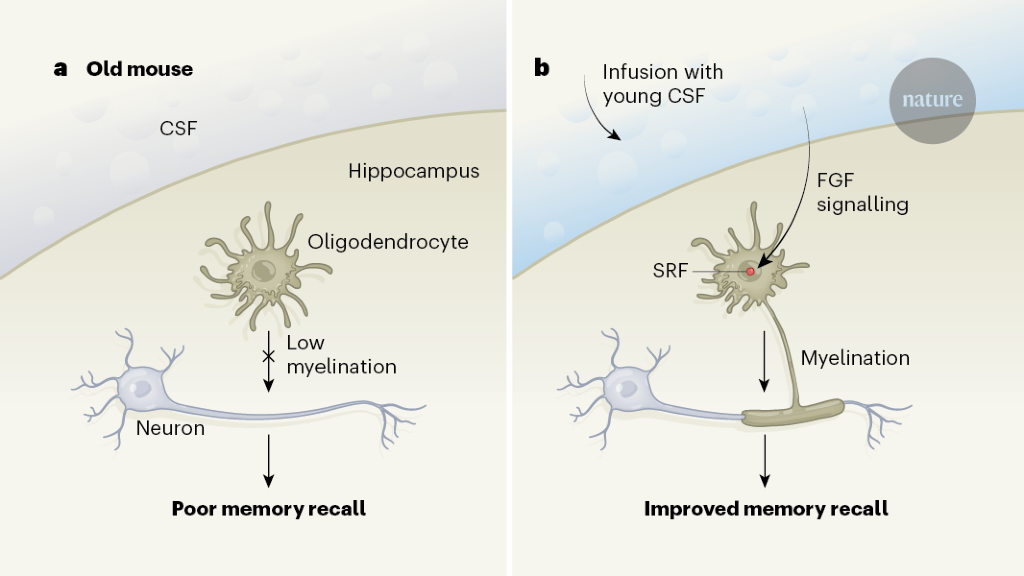
Age-related cognitive decline affects up to one-quarter of adults over the age of sixty1. A healthy diet and regular exercise can help to prevent this decline, but as yet there are no treatments to reverse it2. Progress in understanding how the brain changes during development and ageing has sparked tantalizing ideas for harnessing youthful factors to slow age-associated cognitive changes — or even to rejuvenate the ageing brain. Writing in Nature, Iram et al.3 bolster this line of thinking by tapping into the cerebrospinal fluid (CSF), which bathes the brain tissue and contains several protein growth factors necessary for normal brain development.
doi: https://doi.org/10.1038/d41586-022-00860-7
References Röhr, S. et al. Alzheimer’s Res. Ther. 12, 167 (2020). Anderson, N. D. CNS Spectrums 24, 78–87 (2019). Iram, T. et al. Nature https://doi.org/10.1038/s41586-022-04722-0 (2022). Pan, S., Mayoral, S. R., Choi, H. S., Chan, J. R. & Kheirbek, M. A. Nature Neurosci. 23, 487–499 (2020). Steadman, P. E. et al. Neuron 105, 150–164 (2020). Villeda, S. A. et al. Nature 477, 90–94 (2011). Islam, M. R. et al. Nature Metab. 3, 1058–1070 (2021). Lehtinen, M. K. et al. Neuron 69, 893–905 (2011). Fame, R. M. & Lehtinen, M. K. Dev. Cell 52, 261–275 (2020). Silva-Vargas, V., Maldonado-Soto, A. R., Mizrak, D., Codega, P. & Doetsch, F. Cell Stem Cell 19, 643–652 (2016). Download references
Competing Interests The authors declare no competing interests.
Related Articles
Subjects