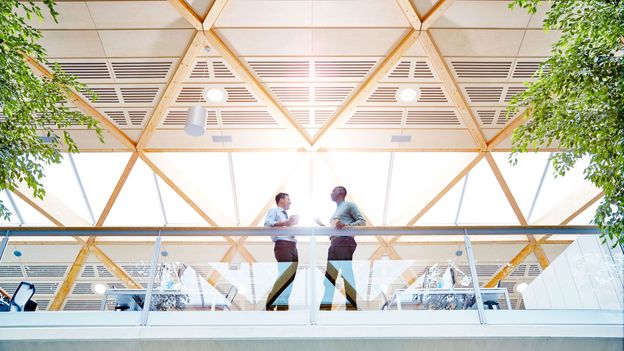
The employees of LendingTree, an online loan marketplace headquartered in Charlotte, North Carolina, US, are still working from desks and couches, on patios and in libraries. But rather than doing so remotely, they’re in a corporate office that’s been re-designed to include environments that mimic working from home. LendingTree calls the concept “resi-mercial”.
“It’s a blend of a residential and commercial feel,” says Jill Olmstead, LendingTree’s chief human resources and administration officer. “The idea is that it’s comfortable, and you want to be here as much as you want to be at home.”
When the world transitioned to remote work near the start of the pandemic, employees’ ability to adapt became rapidly apparent. A massive number of people, suddenly forced to work from home, were able to do their jobs as well – or, in some cases, even better – than they could in the office. One survey of close to a million US workers at Fortune 500 companies showed productivity remained stable or increased after employees began working remotely.
In short, workers have proved remote work is both possible and profitable. Some large, mainly tech-centered companies, including Facebook, Upwork and Slack, are transitioning to permanent remote work.
Many others, though, are encouraging a return to the office, either part- or full-time.
But now that we’ve seen how we can do our jobs efficiently from home, and found methods that keep us connected to colleagues, what is the office really for – and is it possible to make employees want to be there? It’s a looming question companies are trying to answer.
What the office offers
In terms of performance, says Ethan Bernstein, an associate professor of business administration at Harvard Business School, an office isn’t necessary for productivity. But just because we don’t need to be in the office to effectively perform work tasks doesn’t mean it’s useless. There are several functions a physical office space can serve, he says, even if people are still getting a lot of their work done from home.
“If you think of the office as an add-on, then you ask not what can offices do that remote work can’t,” Bernstein says, “but, how can we use the office to make what we’re doing remotely even more effective? If remote work becomes the default, maybe the office is there for the sake of cementing relationships, introducing people and deliberate relationship-building.”