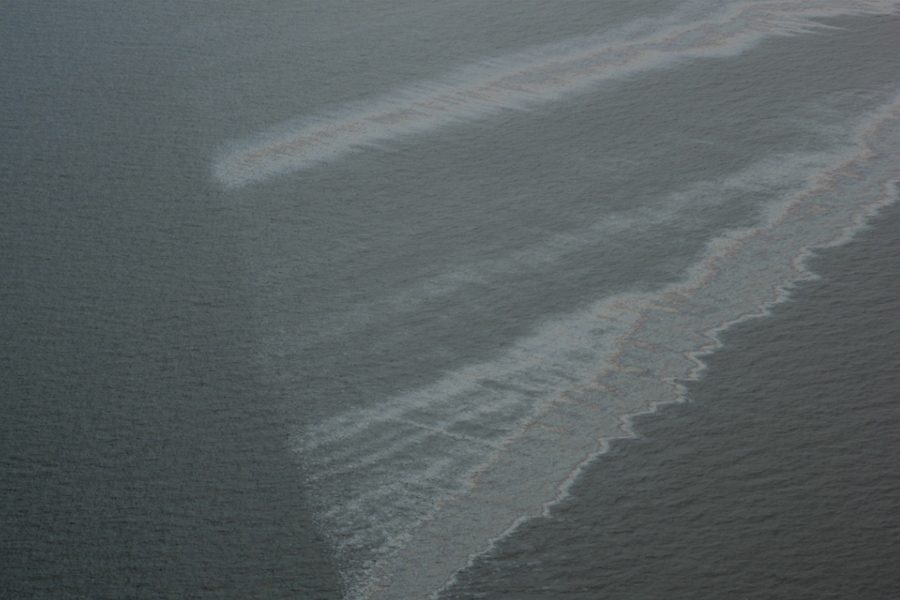
A team of U.S. and Chinese scientists mapping oil pollution across the Earth’s oceans has found that more than 90% of chronic oil slicks come from human sources, a much higher proportion than previously estimated.
Their research, published in Science, is a major update from previous investigations into marine oil pollution, which estimated that about half came from human sources and half from natural sources.
“What’s compelling about these results is just how frequently we detected these floating oil slicks — from small releases, from ships, from pipelines, from natural sources such as seeps in the ocean floor and then also from areas where industry or populations are producing runoff that contains floating oil,” said Ian MacDonald, a professor in the Department of Earth, Ocean and Atmospheric Science at Florida State University and a paper co-author.
Oil slicks are microscopically thin layers of oil on the surface of the ocean. Massive oil spills can cause them, but they’re also widely and continuously produced by human activities and natural sources.
These short-lived patches of oil are continuously being moved around by wind and currents, while waves are breaking them apart, making investigations challenging. To find and analyze them, the research team used artificial intelligence to examine more than 560,000 satellite radar images collected between 2014 and 2019. That allowed them to determine the location, extent and probable sources of chronic oil pollution.
Even a miniscule amount of oil can have a big impact on plankton that make up the base of the ocean food system. Other marine animals, such as whales and sea turtles, are harmed when they contact oil as they come up to breathe.