Our future and the realization that we will grow older are not always on the forefront of our minds. There is ample research showing that many people excessively discount the future and make decisions that run counter to their long-term self-interests1. One group for which the inclination towards short-term gratification is particularly pronounced is criminal offenders. Compared with their normative peers, offenders are more likely to be substance abusers, to overspend and save too little, and more often engage in reckless activities, such as speeding, driving under influence, and unprotected sex2,3,4,5. Similar to delinquency, these behaviors are characterized by immediate benefits and more delayed costs. Offenders, in other words, tend to be short-sighted decision makers across a series of correlated self-defeating domains. Although this group stands to benefit from interventions aiming to improve their ability to make informed cost–benefit tradeoffs, it has been found to be comparatively resistant to efforts to achieve this6,7.
The goal of this study was to stimulate future-oriented decision making in young adult offenders by drawing from theoretical perspectives that examine intertemporal decision making through the lens of present versus future selves8,9,10. Future-self models frame intertemporal choice in terms of a conflict between the needs and wants of the self at different points in time, where immediate rewards accrue to the present self and longer-term costs come at the expense of a temporally remote future self11,12. Psychological absence of the future self at the time of decision implies a reduced likelihood that future costs are adequately factored into the choice process, resulting in short-sighted decision making. Conversely, having vivid image of their future self may steer people away from decisions that negatively impact it, in the awareness that one day they will be that self. Rendering the future self more vivid will motivate them to act in ways that will benefit, or at least not harm, themselves in the future13.
Previous studies have related the ease and detail with which people are able to imagine and describe their self in the future, referred to as vividness of the future self, to improved intertemporal decision making10,11. Hershfield and colleagues14, for example, showed that individuals who interacted with a realistic version of their future self in virtual reality (VR) exhibited an increased tendency to accept delayed monetary rewards over immediate ones compared to individuals who interacted with a version of their present self. In another study using VR, university students were exposed to an age-progressed avatar representing themselves when looking into a virtual mirror15. Following this experience, students exposed to their future self were less likely to cheat compared to those in a control group who had seen their present self reflected in the virtual mirror. In addition, Van Gelder and colleagues12 found that daily interaction with a future version of the self via a social media platform led to reduced self-reported delinquent behavior among high-school students. Importantly, this reduction was mediated by corresponding changes in vividness of the future self.
In the present study, convicted offenders interacted with and virtually embodied realistic and dynamic age-progressed renderings of their future self in VR. Virtual embodiment refers to the substitution of an individual’s physical body by a virtual one, with the objective of generating the cognitive illusion that the virtual body is, at least temporarily, one’s own16,17,18. Previous research has investigated the effects of virtual embodiment on behavioral and cognitive processes19,20,21,22,23. For example, a recent study investigated the impact of virtual embodiment among male perpetrators of domestic violence24. Results show that after embodying an avatar representing a female victim of domestic violence, the ability to recognize fearful female faces was improved among these offenders. In another study, participants enrolled in a ‘self-counseling’ task by alternating, i.e., ‘body swapping’, between a virtual representation of themselves and an avatar resembling Sigmund Freud23,25. Results of this study indicated that this self-counseling task improved participants’ mood and influenced their thinking.
The current study employs a body swapping paradigm involving virtual representations of participants’ present self and future self. Convicted offenders alternated between virtually embodying their present self and their 10-year-older, ‘future’ self over multiple rounds. First, participants embodied their present self and were presented with several statements related to positive (e.g., regular exercise) and negative (e.g., drug use) behaviors. Participants were asked to indicate whether these statements applied to them or not. Subsequently, they embodied the avatar representing their future self to reflect on whether the selected behaviors were beneficial or harmful for their future self by sorting these into different stacks. After returning to embodying the present self, participants received a ‘future-self score’, based on the number of positive and negative behaviors in each stack. The exercise ended with the participant embodying the future self and providing free-format advice, which was played back to the present self.
The graphic and immersive nature of VR technology lends itself particularly well to increasing vividness of the future self. For this reason, and in line with previous research focusing on delinquent and unethical behavior12,15, the concept of vividness of the future self is central in this study. In addition, and extending previous work, we also include other theorized components of the psychological connection between the present self and the future self, i.e., connection to the future self, similarity to the future self, and future-self valence, and assess the extent to which each of these components is also affected by the VR task11,26.
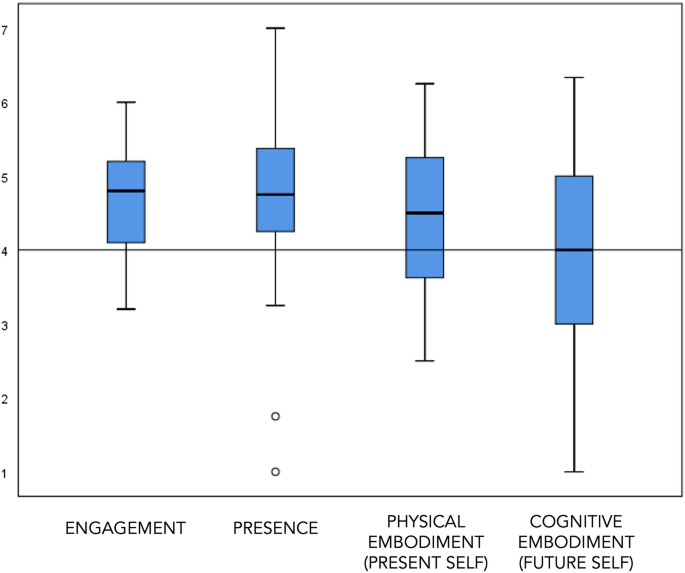
Participants reported their self-defeating behavior prior to and one week after the experimental session. Vividness of the future self and the other components were measured just before, immediately following, and one week after the experimental session. In line with previous research, we hypothesized that the VR exercise would increase vividness of the future self (H1) and have a dampening effect on self-defeating behavior (H2)12,15. Furthermore, and also in line with earlier work, we hypothesized that decreases in self-defeating behavior would be associated with increases in vividness (H3). Aside from testing the hypotheses, we also conducted a series of exploratory analyses. First, we explored to what extent vividness was associated with self-defeating behavior over and above the other future-self concepts, i.e., connectedness, similarity, and valence. In addition, it has been argued that experiencing body ownership of a virtual avatar increases feelings of ‘presence’, the subjective sense of being in the virtual environment, which in turn increases the likelihood that the user responds realistically to virtual events27. Hence, we explored the relation between participants’ subjective VR experience (e.g., body ownership, presence, engagement, feelings of cognitive embodiment) and changes in vividness. Lastly, we explored whether the interaction with a vivid version of the future self affected participants’ perception of their perceived future prospects. Null hypothesis testing was conducted with p < 0.05 as cut-off for significant effects. We report findings where p < 0.10 as non-significant trends.