Experimenting near absolute zero
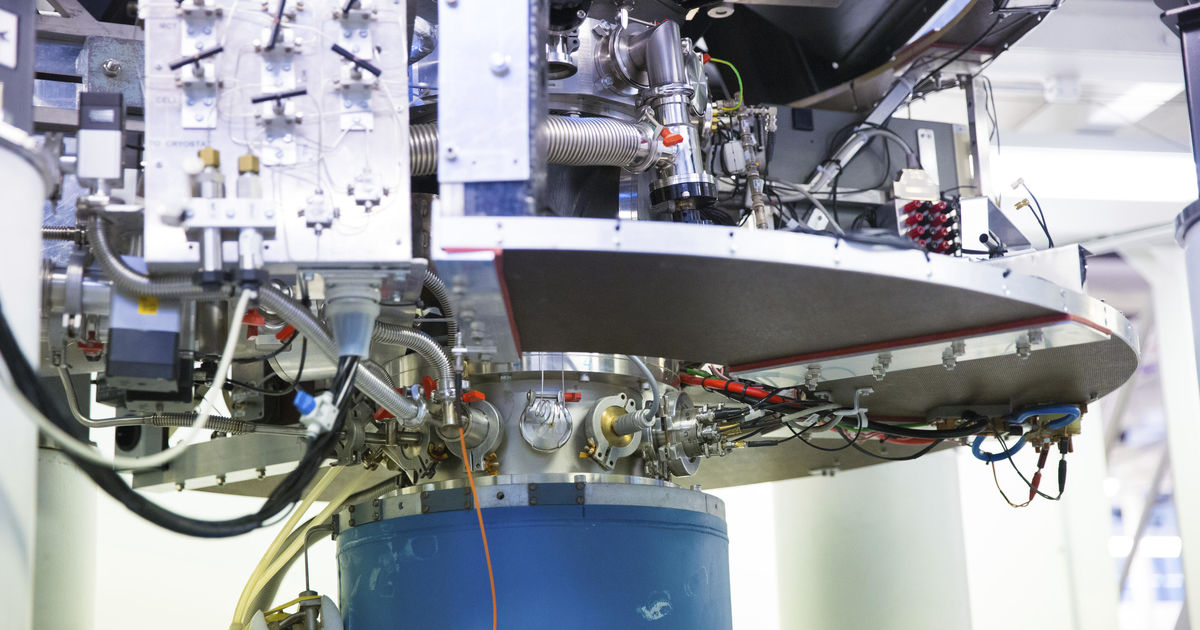
The researchers brought a helium-3 superfluid down to one ten-thousandth of a degree from absolute zero, which means that the temperature was exactly -273,15 °C. After that, they created two time-crystals inside the liquid. The crystals can survive up to a few minutes, which is a remarkably long time for a quantum phenomenon. The researchers were able to observe the attributes and interaction of the two crystals because of their long life.
During the experiment, the time-crystals formed a two-level quantum system, which is a combination of two independent quantum states that can occupy both states at the same time.
Researcher Jere Mäkinen of Aalto says that the state of time-crystals can be described through oscillation, i.e. with sine waves that have an amplitude related to the number of particles and a frequency describing the energy state of the time crystal.
‘The time-crystals we created are different from each other in the sense that one changes its frequency in time, whereas the other doesn’t. During the experiment we were able to make their frequencies intersect. When their frequencies are about the same, they interact and a part of each’s amplitude moves over to the other crystal. In our second experiment the crystal that remained regular was ‘empty’ at the beginning, i.e., its amplitude was zero. When the frequency of the other crystal crossed with the empty one, a part of the amplitude moved to it precisely in the way that the theory describing two-level quantum systems predicted,’ Mäkinen explains.
A great example of a two-level quantum system is the qubit, a quantum computer equivalent to the bit in traditional computing. Where a bit can only have a zero or a one as its value, a qubit can have both at the same time. This is what helps partially explain the exponentially greater calculation power quantum computers have in comparison to traditional computers.
Based on the fact that the time-crystals formed a two-level quantum system in the experiment, they could potentially be used in devices such as the memory components of quantum computers. Because time crystals can survive in room temperature, they might pave the way for room-temperature quantum devices. Mäkinen says that the study of time-crystals is such a new field that any and all practical applications are purely speculative.
“In addition to quantum computers, time-crystals could be useful in things like the extremely precise measuring of time.”
The Low Temperature Lab is part of the OtaNano research infrastructure that's available for scientists, research groups and companies at Otaniemi.
More information:
Jere Mäkinen
Post-doctoral researcher
Aalto University
[email protected]
tel. 044 3675 125
Samuli Autti
Reseacher
Lancaster University
[email protected]
tel. +44 7375926775
If you want to know more about the work of Nobel laureate Frank Wilczek who first theorized time-crystals in 2012, watch his talk at Aalto University in InstituteQ's colloquium on May 27, 2022 below.