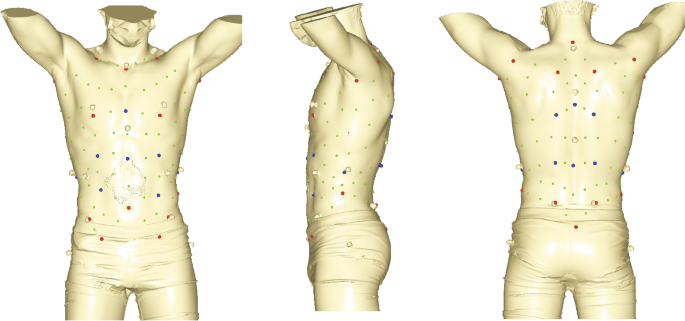
Modern humans are characterized by a relatively flat and narrow ribcage and pelvis when compared to fossil representatives of the genus Homo that are characterised by more stocky, wider and antero-posteriorly deeper torso configurations2,3,4,5,6,15,62,63. While more and more evidence seems to document this morphological trend, possible functional implications of reduced widths and depths of the trunk remain poorly understood. Because the trunk comprises elements of the respiratory and locomotor systems, the interaction of trunk shape with respiratory and locomotor performance is of specific interest.
In the present study, we address possible relations between torso shape and locomotor function in an experimental setting relating 3D external trunk surface shape with running velocity at different levels of intensity. The results showed no relationship between trunk shape and running performance at lower levels of exercise (V1, V2) below the anaerobic (respiratory) threshold, and just above it, indicating no relations between external torso shape and endurance running speeds between 7 and 10 km/h. However, at higher intensities and velocities above the anaerobic (respiratory) threshold (V3; average 14.4 km/h) a statistical relation between torso shape and running speed emerged. According to our results, subjects with a flatter and slightly narrower thorax, lower thoracic kyphosis, more pronounced lumbar lordosis, and slightly narrower pelvis can achieve such higher velocities such as indicated by the higher variances of 3D trunk shape shown at V3 and maximum velocity. It has been suggested that an endurance running velocity of about (5 ms−1 = 18 km/h) can be sustained by many amateurs without special training18, which is considerably faster than in our sample. At moderate intensity (V2), presumably within the aerobic metabolic domain, the average speed was about 10 km/h (Table 2). This may be related to the slight inclination of the treadmill (1%) during the incremental experiment (and the thereby simulated air resistance), but it could also reflect the fact that not all the volunteers were specialized endurance runners. Likewise, the average speed of 14 km/h at V3, which is likely already beyond the anaerobic threshold, is still lower than the published one and, again, could be related to the factors mentioned before. However, at and beyond this velocity, 3D torso shape was statistically related to running capacity.
The most visible features related to higher running capacities were a low degree of thoracic kyphosis, with a flatter, slightly narrower central thorax and a greater degree of lumbar spine curvature with a relatively slightly narrower pelvis. Covariation in depths was more clearly recognisable than in widths (Fig. 2). While the thoracic part suggests interpretation within a respiratory biomechanical perspective, the lumbo-pelvic part of the torso also requires consideration within functions of the locomotor system, although both are clearly related with each other. For example, the role of the posterior lumbar muscles is essential, as they act keeping an upright posture of the lower trunk during running and giving stability to the diaphragm and psoas major lumbar insertions. So, trunk extensors have the ability to reduce the kyphosis angle64,65. Links between breathing biomechanics and lumbar stability have been found in Kang et al.66 who showed that spinal posture was improved by specific breathing exercises in a clinical context.
The combination of a reduced thoracic kyphosis and a flat ribcage, with anteriorly declined ribs, in which the anterior rib ends are more caudally located than the posterior rib ends, could point to the importance of ventilatory biomechanics in higher intensity running. Bellemare et al.44,45 suggested that declined ribs can be elevated more during inspiration than horizontally aligned ones accentuating potentially the costal contribution to thorax movement during lung ventilation. Also, anteriorly declined ribs may have better biomechanical leverage during forced expiration, which crucially increases the tidal volume during heavy exercise breathing35. Because the declination of the ribs is morphologically related to a flatter rib cage configuration, the hypothesis that a flat thorax is positively related to running performance finds support. Physiologically, a less curved thoracic spine increases further the vertical space potentially available for lung expansion through enhancing of rib mobility. For example, negative consequences for lung ventilation due to kyphotic thoracic spine deformations, which compress thoracic space and affect rib biomechanics, have been reported46,67.
The implication of lumbar lordosis for locomotor biomechanics consists of its effect on the forwards orientation of the anterior superior iliac spine, which is an advantageous position for efficient leg return31. However, while these authors have not found a significant relation between lumbar lordosis angle and hip flexion capacity, our results in Fig. 2 clearly show that more pronounced lumbar curvature, to which also the lower thoracic kyphosis contributes, produces forwards tilt of the pelvis.
Warrener et al.32 have found a significant reduction of length and an increment of frequency of strides associated with higher trunk flexion posture during running. This finding is supported by Castillo and Liebermann34, who pointed out that higher lumbar lordosis (trunk extension) is linked with longer stride length in runners, a key factor in speed running as we have observed in our sample. Additionally, upright posture have been associated with better economy and running performance in the context mechanically interactions between trunk kinetics, reaction forces and spatiotemporal patterns of strides29.
Therefore, the empirical evidence reported in the present study seems to indicate that trunk evolution as a whole may have brought about the appearance of some features that are more clearly related to long distance running, along with others that are more related to power locomotion with higher workloads. However, these features lead to a mosaic notion, which reflects a complex picture of potential adaptations to running economy.
In Neandertals, some adaptations to power locomotion were proposed on anatomical, genetic, and ecological grounds19,20. Our results suggest that the relatively straight thoracic column along with their high level of trunk muscularity, possibly reflected by wide, deep thorax shape and associated high body mass estimates, would fit with the power locomotion hypothesis2,68,69. On the other hand, their supposed hypo-lordosis would argue against such interpretation as the relatively uncurved reconstruction of the thoracic and lumbar spine in the Kebara 2 Neandertal13,69 would indicate reduced pelvic tilt and thus a reduced capacity of leg return, hip flexion and sprinting capacity. Yet, the most recent reconstruction of the La Chapelle aux Saints Neandertal suggests vertebral curvatures similar to modern humans14 and this indicates that a better fossil documentation of lumbar spine anatomy in Neandertals is needed. Importantly, a recent study accounting for a wide range of population variability in modern humans, identified consistently and significantly more pronounced lordotic wedging in Neandertal L5 of Kebara 2, Shanidar 3, and La Chapelle aux Saints41 together with a more hypo-lordotic wedging in upper lumbar vertebra. Accordingly, this could suggest a completely different position of the lumbar spine within the trunk, with yet unclear biomechanical implications. Therefore, further fossil reconstructions of Neandertal torso skeletons together with experimental testing are necessary.
In African H. erectus, as reconstructed on the remains of KNM-WT 15,000, the straight thoracic3 and curved lumbar spine morphology70 would be more in line with effective power-locomotion. This, together with greater torso width and depth would be also compatible with higher muscularity and body mass3,15,63,71,72. However, clearly, the elongated limbs favour an interpretation of long-distance locomotion and, possibly, running17,21. Altogether, the present evidence and reviews suggest that our interpretations relate to a great extent on the reliability of the fossil body reconstructions.
However, it is important to bear in mind the limitations of our experimental evidence in the evolutionary context of endurance running. Obviously, the fossil record does not contain information about soft tissue anatomy, while the present data was exclusively collected on the external surface of the torso and so the relations between skeletal and soft tissue anatomy are unknown. Yet, bony features are considered. The curvature of the spine is assessed by the tips of the spinous processes which are variable in terms of sagittal orientations and thus do not directly inform about the curvature as assessable on the basis of the vertebral bodies. Also, the ribcage anatomy is only indirectly reflected by the skin surface landmarks and closer to skeletal thorax shape only at the central and lower parts of the rib cage. These data can thus only give a general idea about thorax shape. The pelvic landmarks are clearer in this respect as the iliac spines can be identified without problems. However, the reduced landmark set, which excluded shape information related to the latissimus dorsi and major pectoralis muscles may be less influenced by muscularity, and the fact that the results of the full and the reduced data are similar suggests little soft tissue effects on the results.
Further limitations are related to the proper running experiment. Endurance running in the evolutionary context appeared in the context of specific climatic conditions that were not considered in the present experiment. Also, actual endurance running is defined as running at intermediate velocities and aerobic conditions for longer time than considered in our experiment, where we only tested for potential relations between velocity and aerobic running conditions during the early stages of the incremental exercise. In this perspective, our data are only informative about shape-function relation during higher intensity running. Future studies should relate torso shape to running performance data on velocity and distance during longer trails and in hot weather conditions. Such analysis will provide further insight into the important relationships between torso shape, body shape and locomotor performance relevant for human evolution.