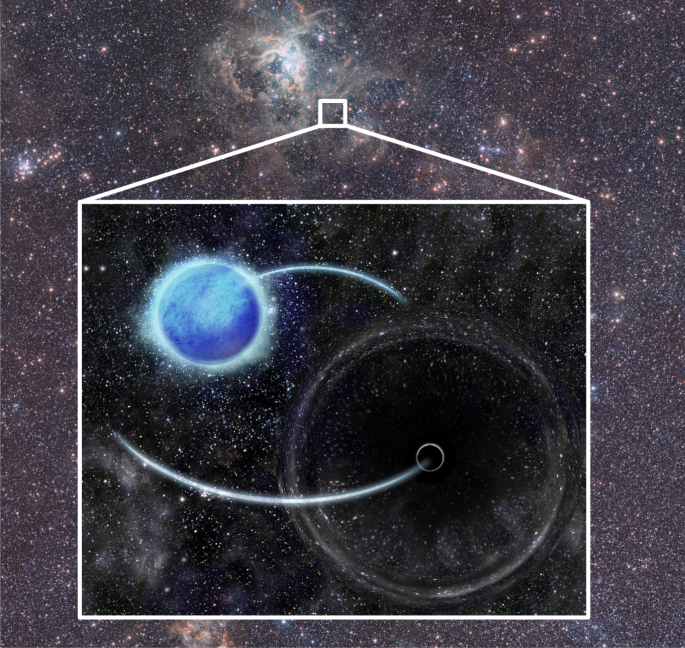
This research has received funding from the European Research Council (ERC) under the European Union’s Horizon 2020 research and innovation programme (T.S. and H.S., grant agreement 772225: MULTIPLES). T.S. acknowledges support from the European Union’s Horizon 2020 programme under Marie Skłodowska-Curie grant agreement 101024605. This work is based on observations collected at the ESO under programme IDs 182.D-0222, 090.D-0323 and 092.D-0136. L.M. thanks the ESA and the Belgian Federal Science Policy Office (BELSPO) for their support in the framework of the PRODEX programme. P. Marchant acknowledges support from FWO junior postdoctoral fellowship 12ZY520N. We thank J. Hillier for making the CMFGEN code available. C.H. acknowledges support from the KU Leuven Research Council (grant C16/17/007: MAESTRO). P.A.C. acknowledges support from UK Science and Technology Facilities Council research grant ST/V000853/1. V.H.-B. acknowledges the support of the Natural Sciences and Engineering Research Council of Canada (NSERC) through grant RGPIN-2020-05990. M. Gieles acknowledges support from the Ministry of Science and Innovation through a Europa Excelencia grant (EUR2020-112157). The PoWR code, as well as the associated post-processing and visualization tool WRplot, has been developed under the guidance of W.-R. Hamann with substantial contributions from L. Koesterke, G. Gräfener, A. Sander, T.S. and other co-workers and students. This work has received funding from the ERC under the European Union’s Horizon 2020 research and innovation programme (grant agreement 945806). It is also supported by the Deutsche Forschungsgemeinschaft (DFG, German Research Foundation) under Germany’s Excellence Strategy EXC 2181/1-390900948 (the Heidelberg STRUCTURES Excellence Cluster). S.T. acknowledges support from the Netherlands Research Council NWO (grants VENI 639.041.645, VIDI 203.061). A.H. and D.J.L. acknowledge support by the Spanish MCI through grant PGC-2018-0913741-B-C22 and the Severo Ochoa Programme through CEX2019-000920-S. J.M.A. acknowledges support from the Spanish Government Ministerio de Ciencia, Innovación y Universidades through grant PGC2018-095-049-B-C22. We thank I. Mayo and S. Pinilla for their work on the visualization of VFTS 243. We acknowledge the Cambridge Astronomical Survey Unit and ESO for the background image in Fig. 1. This research has made use of the SIMBAD database, operated at CDS, Strasbourg, France.
An X-ray-quiet black hole born with a negligible kick in a massive binary within the Large Magellanic Cloud