[ICE RUMBLES]
[The camera flies over a glacier and the water beneath it on a rocky landscape. A small red inflatable boat carries people through floating icebergs.]
[MUSIC]
[SCUBA DIVER 1: Good. Let’s do it.]
[Two scuba divers sit on the edge of the inflatable boat in dry suits meant for cold water.]
[SCUBA DIVER 2: Ready?
SCUBA DIVER 1: One, two, three.]
[The scuba divers flip into the water from the boat with a [SPLASH]. Under water, they descend slowly through turquoise water.]
JOHN SPARKS (Curator, Division of Vertebrate Zoology): So it’s the end of our roughly two-week trip in Greenland,
[SPARKS appears on screen with the rocky icy landscape behind him, wearing sunglasses and a beanie and speaking to camera.]
SPARKS: and I’m sitting, because I can barely stand. This has, without a doubt, been the toughest trip,
[The inflatable Zodiac boat navigates through iceberg-filled water.]
SPARKS: –expedition I’ve ever been on.
[Scuba divers swim past walls of ice.]
SPARKS: The dives are brutal. They’re exceedingly cold… It’s crazy, in a way.
[Title appears: Exploring Greenland’s Icy Waters. Constantine S. Niarchos Expedition 2019.]
[SPARKS stands on a small iceberg looking out at glaciers.]
SPARKS: My name is John Sparks and I’m a curator of ichthyology at the American Museum of Natural History in New York City.
[SPARKS is standing on a small ice floe next to DAVID GRUBER.]
DAVID GRUBER (Research Associate, Division of Vertebrate Zoology): My name is David Gruber. I am a marine biologist here at the American Museum of Natural History–
[GRUBER sits on the edge of a boat as the Greenland landscape flies by.]
GRUBER: –and a professor of biology at Baruch College, City University of New York.
[The scientists sit on the boat as it navigates through icy water with a glacier in the background.]
SPARKS: And we were on an expedition to look at the prevalence of biofluorescence in the Arctic.
[A fish with glowing green stripes on its head swims slowly below a glowing green coral. Text appears: Solomon Islands.]
GRUBER: Biofluorescence is the process of animals absorbing blue ocean light
[Scuba divers point bright blue lights at corals. The video fades to the same video showing the corals glowing green.]
GRUBER: –and transforming that light into other colors.
[GRUBER scuba dives in the tropics, surrounded by coral.]
SPARKS: We had been looking at fluorescence in the tropics,
[Fish swim in and out of a coral reef.]
SPARKS: where you get pretty much year-round even amounts of daylight and dark, so we wanted to see if fluorescence was as prevalent, or as common,
[Timelapse of the sun over snowy mountain peaks.]
SPARKS: –in areas where there are very different amounts of daylight. At certain times of the year in polar regions,
[SPARKS appears on screen in the Museum’s collections space, speaking to camera. Text appears: “John Sparks, curator, Division of Vertebrate Zoology.”]
SPARKS: you get sunlight 24 hours a day and other parts of the year, it’s dark all the time.
[GRUBER appears on screen in the Museum’s collections space, speaking to camera. Text appears: “David Gruber, research associate, Division of Vertebrate Zoology.”]
GRUBER: Yeah, it was a little bit like a detective story. We were sitting
[GRUBER and SPARKS are sitting next to each other in the collections space, while GRUBER talks to camera.]
GRUBER: –over a coffee here in New York where like, “I wonder, how does that effect animals underwater when there’s 24-hour light,
[The sunlight refracts in the cold waters of Greenland.]
GRUBER: some parts of the year,
[A scuba diver swims in pitch black water at night, lit only by a blue light in front.]
GRUBER: and zero light other parts of the year. And we were surprised that no one had looked.
[GRUBER and SPARKS scuba dive in full drysuits among kelp forests.]
SPARKS: We targeted Greenland because there were groups there,
[A scorpion fish pokes its head out of some kelp.]
SPARKS: like the scorpion fishes, that we found elsewhere that fluoresce.
[SPARKS captures a scorpion fish with a net.]
SPARKS: So we could directly compare it to tropical or temperate regions.
[An illustrated map of the East coast of North America appears, with a star showing New York City. A plane takes off from New York City and lands in Reykjavik, Iceland.]
SPARKS: For this trip we had to fly to Iceland first,
[Another plane icon takes off from Iceland and lands next to Kulusuk, Greenland.]
SPARKS: and then we took a small plane to Kulusuk on the east coast of Greenland
[The world map zooms in to just a tiny coastal part of Greenland containing Kulusuk.]
SPARKS: and they have just a tiny airport there.
[A dashed line with a boat leaves from Kulusuk and ends to the West of Kulusuk at Tasiilaq. Under the map, we see faint aerial footage of Tasiilaq.]
SPARKS: And from there, we took about a two-hour boat ride to Tasiilaq, and that was our first diving site.
GRUBER: We did a lot of interesting day dives around there,
[A dashed line with a boat leaves from Tasiilaq and goes north and west up the coast to a place labelled “Ice Camp.”]
GRUBER: but when we went another few hours out to this really remote ice camp
[The map fades away to reveal aerial footage of the ice camp with just a handful of small colorful huts.]
GRUBER: where we had a cove that we could just dive any time we want.
[SPARKS wades into the water from the shore in full diving gear, carrying his fins and a collection bag. In a different scene, he stands on the zodiac boat, looking at the shore.]
SPARKS: As soon as we got to Greenland, we realized, “Boy, we might be in over our heads.”
[GRUBER puts on a dry diving suit on a dock.]
SPARKS: “This is really cold. Whose idea was this?”
[SPARKS and GRUBER appear on screen in the Museum collections, speaking to camera.]
GRUBER: Yeah, it was one thing sitting in a nice, cozy little café in New York and just kind of pondering these topics
[SPLASH]
[GRUBER diving in Greenland over seaweed and kelp, holding his hands stiffly in front of him.]
GRUBER: and then, once we’re in the water in 30 minutes my hands were just freezing.
[SPARKS scuba dives and picks something off a rock to put in his collection net.]
SPARKS: As soon as you get under your face gets numb. And you’ve got very limited time to do your work because of the cold.
[SPARKS appears on screen speaking to camera.]
SPARKS: I mean, it just burns.
[GRUBER turns in the water while diving among kelp, and holding a large underwater camera.]
GRUBER: I actually got frostbite in my fingers, but I want to stay longer because, it’s like, we went through so much effort to get out here.
[The small huts of the ice camp as viewed from the water’s edge. SPARKS and GRUBER appear on screen in the ice camp, giving a tour to the camera.]
SPARKS: This is our ice camp.
[Aerial footage of the ice camp with icebergs in the water behind.]
SPARKS: We’ve got our huts here that we sleep in.
[SPARKS and GRUBER take photos of something in a tank.]
SPARKS: We’ve got a makeshift lab we’ve set up in a storage room.
[CAMERA FLASHES.]
[A photo of a green fluorescent shrimp.]
[SPARKS: That’s good.
GRUBER: Really nice.]
[Another aerial view of the ice camp. Water trickles down a small stream.]
GRUBER: Yeah, we’ve got fresh water coming here from the glacier.
[GRUBER and SPARKS continue their tour of the ice camp.]
SPARKS: And it’s delicious. These are our dry suits that made diving possible here.
[SPARKS dives into a kelp forest below the water. Scenes from below the water: an undulating jellyfish, kelp fronds waving slowly, a school of tiny shrimp.]
SPARKS: There was so much kelp! Kelp with the enormous fronds and there’d be little fish swimming, or shrimp, lots of shrimp swimming amongst the kelp.
[A school of shrimp swimming with a scuba diver swimming behind them.]
SPARKS: It was very beautiful underwater.
[A hermit crab pokes its head out of its shell. Lots of anemones sitting underneath kelp fronds. A tube worm retracts its fronds into a hole. Kelp fronds ripple in the water.]
GRUBER: On land, there’s almost nothing living, like nothing dares to grow more than a foot off the ground up there,
[A ghostly white nudibranch on a kelp frond. GRUBER films with an underwater camera among the kelp.]
GRUBER: but all the life is really in the ocean. We did dives in several different habitats.
[GRUBER appears on screen in front of the rocky Greenland landscape, speaking to camera.]
GRUBER: We looked in fjords,
[SPARKS and GRUBER dive among kelp.]
GRUBER: we looked in the kelp forest, and in several of the dives
[The small boat navigates between icebergs. SPARKS and GRUBER dive next to a wall of ice.]
GRUBER: we actually looked for specimens in the ice, among the icebergs.
SPARKS: What’s really interesting about these icebergs is that they are a refuge for lots of little creatures.
[SPARKS tries to catch a small fish swimming above the ice shelf of an iceberg.]
SPARKS: Crustaceans live right among the icebergs. There’s even fish that kind of dart in among the crevices of the iceberg.
[SPARKS and GRUBER dive on top of an iceberg. The camera comes out of the water to show the tip of the iceberg looming above.]
SPARKS: So they’re like floating habitats for lots of these arctic creatures.
[Camera flies over towering icebers.]
GRUBER: We would have to position ourselves on the part of the icebergs
[GRUBER appears on screen in front of the rocky Greenland landscape, speaking to camera.]
GRUBER: –that didn’t have a chance of ice falling on top of us.
[SPARKS and GRUBER dive in drysuits on top of an ice shelf from an iceberg.]
SPARKS: We got a warming when we got back to the boat on one dive that we were too close. And—but, you can’t—underwater you can’t tell. It was like,
[Scientists pass giant icebergs in a red Zodiac inflatable boat.]
SPARKS: “That was kind of dangerous. You were pretty close there.”
[SPARKS reappears on screen, speaking to camera from the Museum’s ichthyology collections space.]
SPARKS: We both didn’t know what to expect. I mean, in general, we both thought there would be less fluorescence there just because–
[Blue dive lights cut through the black water at night, illuminating corals and kelp.]
SPARKS: –for a large portion of the year, there’s not enough ambient light to stimulate
[A flash, and then we see what the kelp looks like with a fluorescent filter: bright fluorescent red, surrounded by green water.]
SPARKS: fluorescence in these organisms, so it would be of no use.
[SPARKS reappears on screen, speaking to camera from the Museum’s ichthyology collections space.]
SPARKS: But then when we got up there, I thought, “Eh, we’d find it just as much as anywhere else,” But we didn’t.
[We see what the underwater world looks like with a fluorescent filter. Kelp is red while the water is neon green.]
SPARKS: Groups that we found all fluorescence members elsewhere,
[Fluorescent green corals with a fluorescent red scorpion fish. Text on screen: “Solomon Islands, Scorpaenopsis papuensis.]
SPARKS: like scorpion fishes–
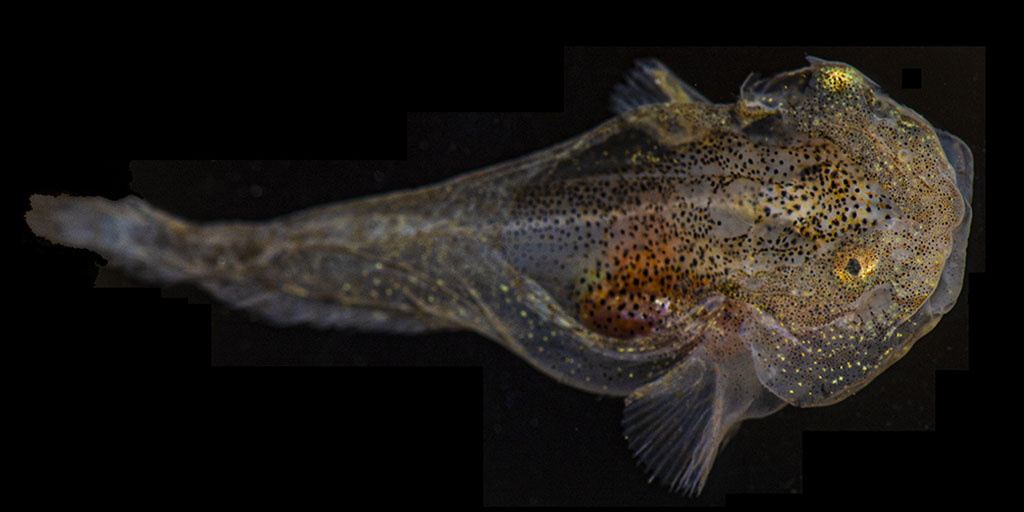
[A new scorpionfish appears, from footage in Greenland. It appears a dull grey on top of bright red kelp – it does not fluoresce red like the other scorpionfish. Text appears: “Greenland. Myoxocephalus sp.]
SPARKS: –not a single member up there was fluorescent, which really was kind of startling.
[Footage from the Solomon islands show fluorescent bright green corals and anemones.]
GRUBER: In the tropics, almost all hard corals are fluorescent. Many of the anemones are fluorescent and when we get to Greenland,
[Scuba divers swim at night with a blue light – nothing is illuminated below them.]
GRUBER: there’s almost zero and that’s interesting.
[GRUBER and SPARKS in the dark of their laboratory with a blue light pointing at a fish tank, as they prepare to photograph it for fluorescence.]
[SPARKS: Lights off.
CAMERA FLASH]
[A fluorescent green fish swims through the frame.]
[GRUBER: Oh. Look at that, John. Ok let’s take one more with the white light.
CAMERA FLASH]
[Still photographs of fluorescent green animals, including snails and shrimp.]
SPARKS: There are cases of things that are fluorescent. They’re very beautiful, but they’re few and far between.
[ICE RUMBLING]
[Camera flies over a landscape of gigantic icebergs.]
GRUBER: You know, Greenland is really discussed a lot in the news, it being a kind of Ground Zero of climate change or of change.
[GRUBER reappears on screen, speaking to camera from the Museum’s ichthyology collections space.]
GRUBER: Really, the fluorescence became one part of the research, but I think the broader thing will be–
[A fish swims among fluorescent kelp. Two fish swim in the icy blue waters of Greenland.]
GRUBER: –as the waters begin to warm, are there new fish coming in that didn’t used to be there.
[Anemones reach tentacles out into the water of Greenland.]
GRUBER: We don’t even really understand fully yet what exactly it is we’re losing.
[SPARKS dives among kelp with a collection net, looking for fish.]
SPARKS: It’s just such a cold, unexplored environment. We felt like a lot of these places, we were the first people ever to dive underwater. And that’s kind of cool in a way.
[A large school of shrimp drifts over the kelp beds.]
SPARKS: You know, just look at these habitats that very few people have seen.
[SPARKS and GRUBER scuba dive on top of the ice shelf of an iceberg, as seen from the air, while the inflatable red zodiac floats nearby.
GRUBER: What I love about this is that it was really pure, pure exploration. It was just John and I and a small boat in some of the most far-flung, difficult-to-get-to places. It was—you know—I’ve been diving for several decades and it felt like it was just totally new.
[Credits roll]
The Constantine S. Niarchos Expedition featured here was generously supported by the Stavros Niarchos Foundation.
Producer
Lee Stevens
Executive Producers
Erin Chapman
Eugenia Levenson
Camera
Peter Kragh
Additional Camera
AMNH / L. Stevens
AMNH / K. Corben, D. Gruber, V. Pieribone, J. Sparks
Editor
Sarah Galloway
Animation / Motion Graphics
Lee Stevens
Images / Archives
David Gruber
John Sparks
Pond5 / Erectus
Music
“Stopping Time” Richard Dutnall (PRS) and Ben Howells (PRS) /
Warner/Chappell Production Music
“A Soft Heartbeat” Richard Dutnall (PRS) and Ben Howells (PRS) /
Warner/Chappell Production Music
“Subtle Story” Richard Dutnall (PRS) and Ben Howells (PRS) /
Warner/Chappell Production Music
“Electronic Organic” Richard Dutnall (PRS) and Ben Howells (PRS) /
Warner/Chappell Production Music
Sound Effects
Freesound / HDVideoGuy, Inplano, jeo, kyles, soundmanfilms, Suz_Soundcreations, tomtenney
©American Museum of Natural History