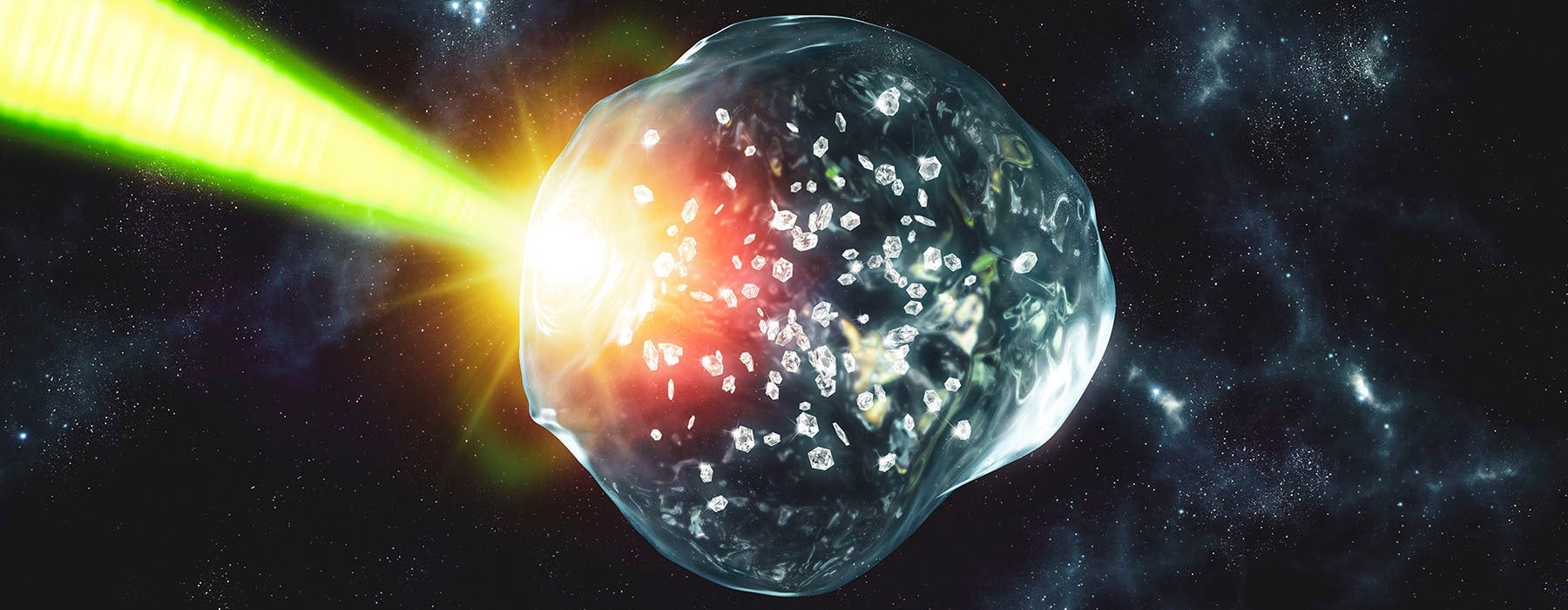
Using a method called X-ray diffraction, they watched as the atoms of the material rearranged into small diamond regions. They simultaneously used another method called small-angle scattering, which had not been used in the first paper, to measure how fast and large those regions grew. Using this additional method, they were able to determine that these diamond regions grew up to a few nanometers wide. They found that, with the presence of oxygen in the material, the nanodiamonds were able to grow at lower pressures and temperatures than previously observed.
“The effect of the oxygen was to accelerate the splitting of the carbon and hydrogen and thus encourage the formation of nanodiamonds,” Kraus said. “It meant the carbon atoms could combine more easily and form diamonds.”
Iced-out planets
The researchers predict that diamonds on Neptune and Uranus would become much larger than the nanodiamonds produced in these experiments – maybe millions of carats in weight. Over thousands of years, the diamonds might slowly sink through the planets’ ice layers and assemble into a thick layer of bling around the solid planetary core.
The team also found evidence that, in combination with the diamonds, superionic water might also form. This recently discovered phase of water, often described as “hot, black ice,” exists at extremely high temperatures and pressures. In these extreme conditions, water molecules break apart and oxygen atoms form a crystal lattice in which the hydrogen nuclei float around freely. Because these free-floating nuclei are electrically charged, superionic water can conduct electric current and could explain the unusual magnetic fields on Uranus and Neptune.
The findings could also impact our understanding of planets in distant galaxies, since scientists now believe ice giants are the most common form of planet outside our solar system.
“We know that Earth’s core is predominantly made of iron, but many experiments are still investigating how the presence of lighter elements can change the conditions of melting and phase transitions,” said SLAC scientist and collaborator Silvia Pandolfi. “Our experiment demonstrates how these elements can change the conditions in which diamonds are forming on ice giants. If we want to accurately model planets, then we need to get as close as we can to the actual composition of the planetary interior.”
Diamonds in the rough
The research also indicates a potential path forward for producing nanodiamonds by laser-driven shock compression of cheap PET plastics. While already included in abrasives and polishing agents, in the future, these tiny gems could potentially be used for quantum sensors, medical contrast agents and reaction accelerators for renewable energy.
“The way nanodiamonds are currently made is by taking a bunch of carbon or diamond and blowing it up with explosives,” said SLAC scientist and collaborator Benjamin Ofori-Okai. “This creates nanodiamonds of various sizes and shapes and is hard to control. What we're seeing in this experiment is a different reactivity of the same species under high temperature and pressure. In some cases, the diamonds seem to be forming faster than others, which suggests that the presence of these other chemicals can speed up this process. Laser production could offer a cleaner and more easily controlled method to produce nanodiamonds. If we can design ways to change some things about the reactivity, we can change how quickly they form and therefore how big they get.”
Next, the researchers are planning similar experiments using liquid samples containing ethanol, water and ammonia – what Uranus and Neptune are mostly made of – which will bring them even closer to understanding exactly how diamond rain forms on other planets.
“The fact that we can recreate these extreme conditions to see how these processes play out on very fast, very small scales is exciting,” said SLAC scientist and collaborator Nicholas Hartley. “Adding oxygen brings us closer than ever to seeing the full picture of these planetary processes, but there’s still more work to be done. It’s a step on the road towards getting the most realistic mixture and seeing how these materials truly behave on other planets.”
The research was supported by DOE’s Office of Science and the National Nuclear Security Administration. LCLS is a DOE Office of Science user facility.
Parts of this article have been adapted from a press release written by the Helmholtz-Zentrum Dresden-Rossendorf.
Citation: Zhiyu He et al., Science Advances, 2 September 2022 (10.1126/sciadv.abo0617)
Press Office Contact: Manuel Gnida, mgnida@slac.stanford.edu
SLAC is a vibrant multiprogram laboratory that explores how the universe works at the biggest, smallest and fastest scales and invents powerful tools used by scientists around the globe. With research spanning particle physics, astrophysics and cosmology, materials, chemistry, bio- and energy sciences and scientific computing, we help solve real-world problems and advance the interests of the nation.
SLAC is operated by Stanford University for the U.S. Department of Energy’s Office of Science. The Office of Science is the single largest supporter of basic research in the physical sciences in the United States and is working to address some of the most pressing challenges of our time.