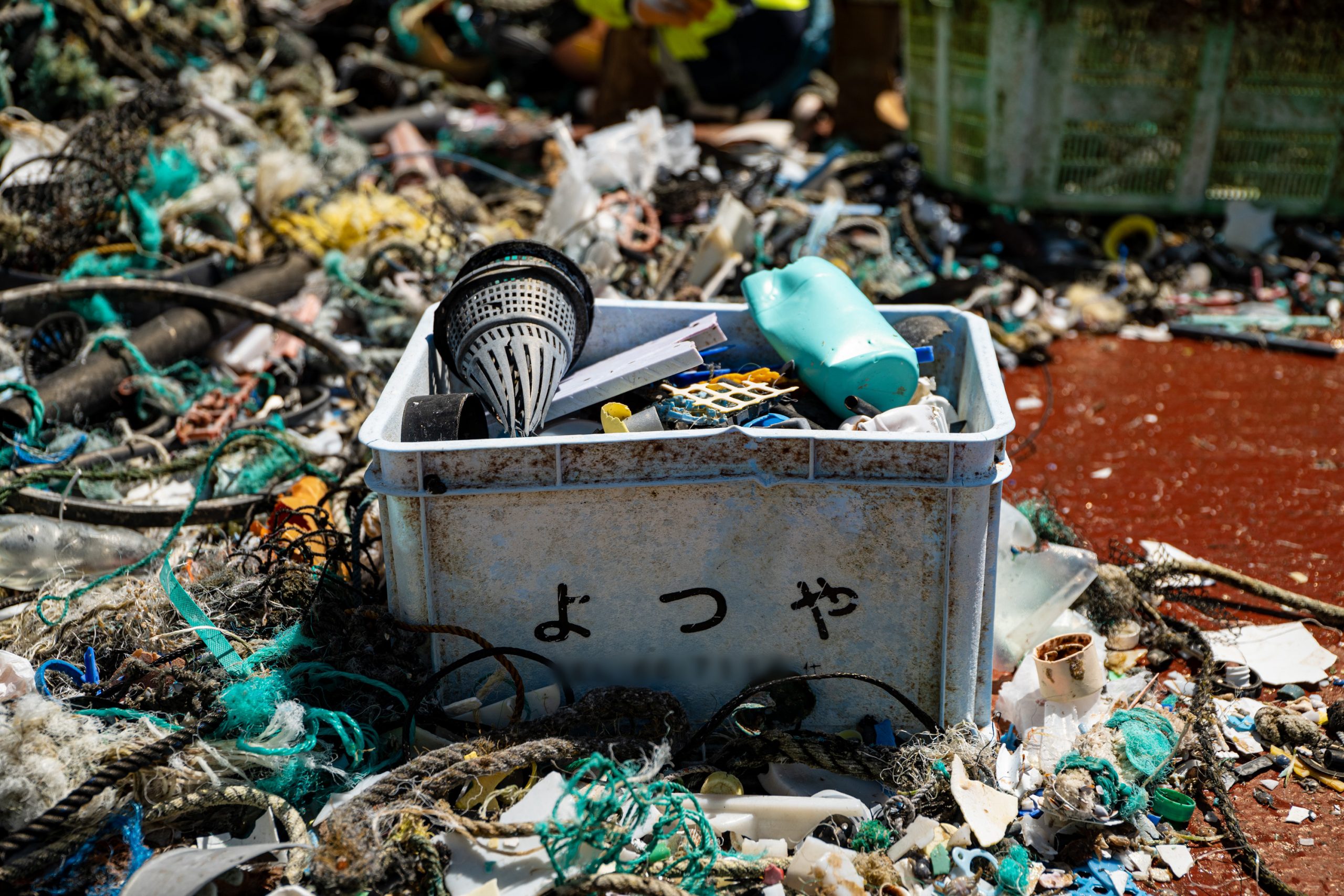
Our scientists were intrigued by the apparent mismatch between the well-reported dominance of land-based emissions of plastic into the ocean on one hand, and the large quantity of fishing-related plastics in the GPGP on the other. If most floating plastic in the global ocean comes from rivers (i.e., from land, not from offshore fishing), why is the GPGP largely full of plastics from this other source – namely, from fishing activities?
Our research proceeded to identify the pathways which lead plastic to accumulate in the GPGP. To do this, they conducted a series of global numerical model simulations to test various scenarios, analyzing plastic emissions both from land and from fishing activities at sea. In simple terms, the models release virtual plastic particles into the ocean (either from rivers or from fishing vessels) and simulate the dispersal of these virtual particles across the ocean surface using available data on sea currents and wind.
These plastic dispersal models are useful tools to study the transport of floating marine debris. The models record the country of origin (for particles simulated entering the ocean from rivers) or the flag of the fishing vessel (for particles simulated entering the ocean from fishing vessels at sea). This allows us to trace the country of origin of each virtual plastic particle accumulating in the GPGP; a huge step forward in our understanding of precisely what plastics make up the GPGP, and where they come from.
DOMINANT CONTRIBUTORS TO THE GPGP
The correlations between the modelled origins of plastic and the origins observed in the field were generally higher with the fishing source scenario than with any land-based scenario. Virtual model particles accumulating in the GPGP were predominantly identified as originating from Japan, China, the Korean peninsula and the USA, consistent with the findings from the compositional analyses. This provides strong evidence that a large proportion of floating hard plastics (i.e., not only the fishing nets themselves) in the GPGP derive from fishing activities at sea, and were not emitted directly from land.
The fishing source scenario also gave insights into the dominant fishing techniques that contribute to plastic in the GPGP. Trawler activity made up 48% of fishing activities that contributed to model particles found in the GPGP, while fixed gear and drifting longlines totaled 18% and 14% respectively. For 16% of modeled fishing activities contributing to model particle emissions, the technique was unidentified and may have been representative of any one of these three gear categories.
As such, trawlers, fixed gear, and drifting longlines accounted for more than 95% of identified fishing activities that may account for emissions of floating plastic debris into the GPGP. Trawling and fixed gear activities contributing to the GPGP generally occurred near the Asian and North American continental shelves, while drifting longlines activities were distributed throughout the oceanic zone of the whole North Pacific Ocean.