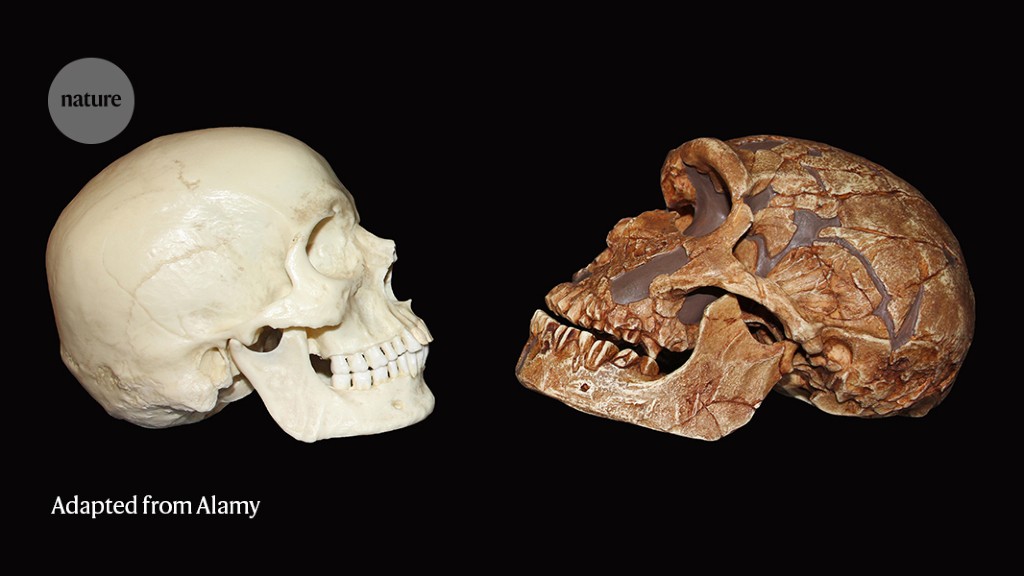
Human and Neanderthal brains were roughly the same size.Credit: Adapted from Alamy
More than 500,000 years ago, the ancestors of Neanderthals and modern humans were migrating around the world when a fateful genetic mutation caused some of their brains to suddenly improve. This mutation, researchers report in Science1,2, dramatically increased the number of brain cells in the hominins that preceded modern humans, probably giving them a cognitive advantage over their Neanderthal cousins.
“This is a surprisingly important gene,” says Arnold Kriegstein, a neurologist at the University of California, San Francisco. However, he expects that it will turn out to be one of many genetic tweaks that gave humans an evolutionary advantage over other hominins. “I think it sheds a whole new light on human evolution.”
When researchers first fully sequenced a Neanderthal genome in 20143, they identified 96 amino acids — the building blocks that make up proteins — that differ between Neanderthals and modern humans in addition to a number of other genetic tweaks. Scientists have been studying this list to learn which of these helped modern humans to outcompete Neanderthals and other hominins.
Cognitive advantage
To neuroscientists Anneline Pinson and Wieland Huttner at the Max Planck Institute of Molecular Cell Biology and Genetics in Dresden, Germany, one gene stood out. The gene, TKTL1, encodes a protein that is made when a fetus’s brain is first developing. A single genetic mutation in the human version of TKTL1 changed one amino acid, resulting in a protein that is different from those found in hominin ancestors, Neanderthals and non-human primates.
The team suspected that this protein could be driving neural progenitor cells — which develop into neurons — to proliferate as the brain develops, specifically in an area called the neocortex, which is involved in cognitive function. That, they reasoned, could be a contributor to modern humans’ cognitive advantage over human ancestors.
To test this, Pinson and her team inserted either the human or ancestral version of TKTL1 into the brains of mouse and ferret embryos. The animals with the human gene developed significantly more neural progenitor cells. When the researchers engineered neocortex cells from a human fetus to produce the ancestral version, they found that the fetal tissue produced fewer progenitor cells and fewer neurons than it normally would. The same was true when they inserted the ancestral version of TKTL1 into brain organoids — mini-brain-like structures grown from human stem cells.
Brain size
Fossil records suggest that human and Neanderthal brains were roughly the same size, meaning that the neocortices of modern humans are either denser or take up a larger portion of the brain. Huttner and Pinson say that they were surprised that such a small genetic change could affect neocortex development so drastically. “It was a coincidental mutation that had enormous consequences,” Huttner says.
Neuroscientist Alysson Muotri at the University of California, San Diego, is more sceptical. He points out that different cell lines behave differently when made into organoids and would like to see the ancestral version of TKTL1 tested in more human cells. Furthermore, he says, the original Neanderthal genome was compared with that of a modern European — human populations in other parts of the world might share some genetic variants with Neanderthals.
Pinson says that the Neanderthal version of TKTL1 is very rare among modern humans, adding that it’s unknown whether it causes any disease or cognitive differences. The only way to prove that it has a role in cognitive function, Huttner says, would be to genetically engineer mice or ferrets that always have the human form of the gene and test their behaviour compared with animals that have the ancestral version. Pinson says she is now planning to look further into the mechanisms through which TKTKL1 drives the birth of brain cells.