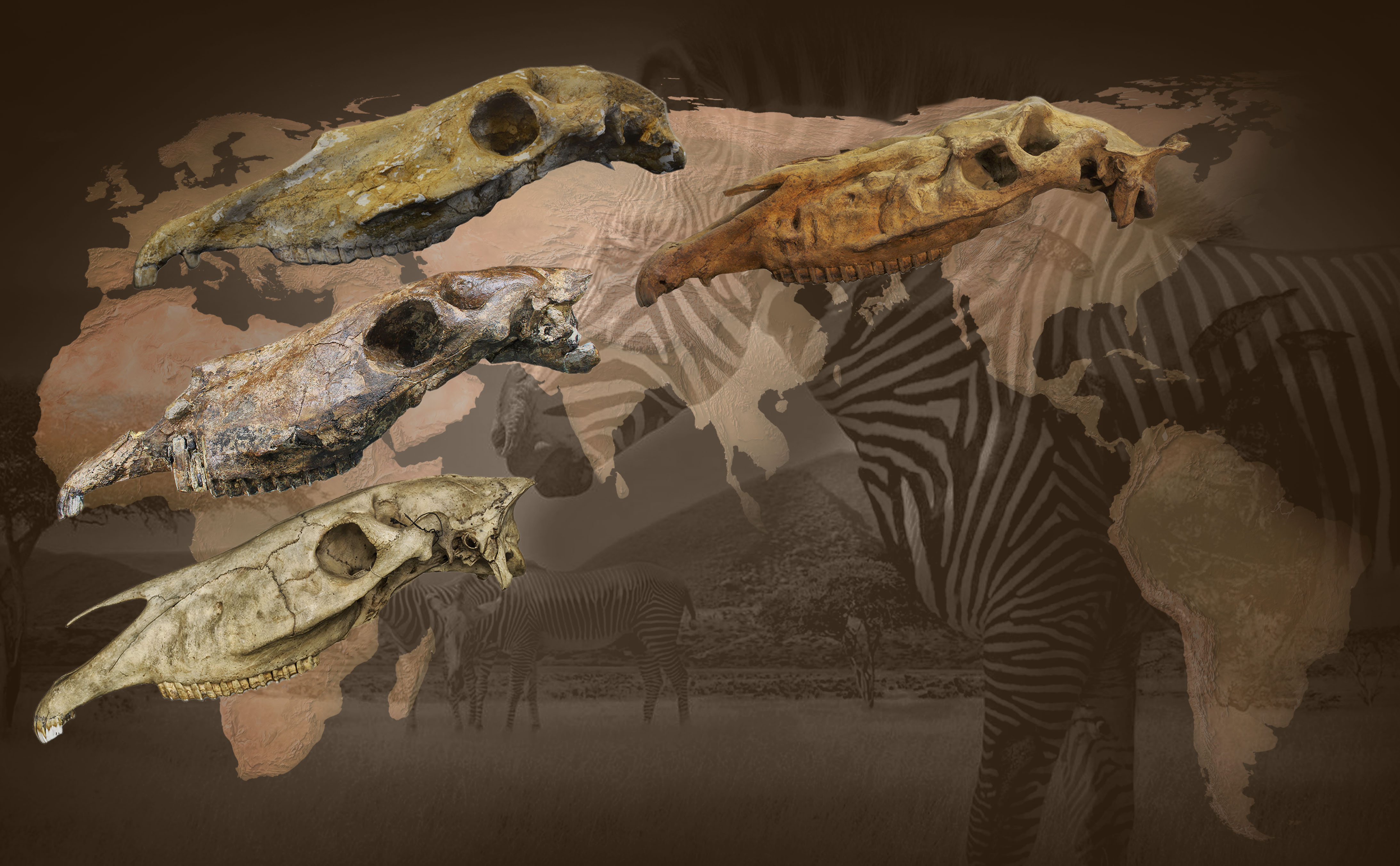
Ancestors of modern horses arose during the Pliocene in North America, then spread to Eurasia and Africa. This figure, originally published in Cirilli et al. 2021, shows the dispersal of an ancestral horse through Eurasia and Africa, eventually giving rise to modern zebras. Image credit: Reprinted from https://www.nature.com/articles/s41598-021-89440-9 (open access).
When it comes to evolution, horses are complicated. Living members of the family Equidae all belong to one genus, Equus. That genus includes donkeys, zebras, Przewalski's horses, and all the many breeds of domestic horses, Equus caballus, such as the mustangs of the American West and Andalusians of Spain. About 107 extinct horses preceded these modern species in the last 5.3 million years, but how they all fit into an evolutionary tree remains the subject of debate.
A recent study in the journal Biology offers the most comprehensive taxonomy to date, by comparing phylogenetic, morphological, and ecological data. Before the large-scale phylogenies considered in this study, prior journal articles “weren’t big-picture solutions to the evolution of horses,” says coauthor and paleontologist Ferhat Kaya at the University of Oulu, Finland. The study also offers the first paleoclimatic maps of the environments that horses evolved in over millennia, which could help explain the patterns of their evolution. Among the highlights: expanding dryland habitats in North America spurred horse diversification.
To carry out their investigation, the 19 co-authors compared the two most recent phylogenies of horse evolution, explains co-lead author and evolutionary biologist Omar Cirilli, a postdoc at Howard University in Washington, DC. Previously, in 2021, Cirilli published one possible horse phylogeny based on measurements of fossil skeletons. In this latest paper, he compares that work with a competing 2019 phylogeny that was based on skeletal and morphological evidence and posits different evolutionary relationships between the many horse species. Rather than arguing for one set of findings over the other, however, Cirilli and collaborators instead lay out the common ground shared by both phylogenies in this latest work.
Both studies agree that the oldest ancestor of modern horses arose during the Pliocene in what is now Idaho, about four million years ago. The studies also agree that from origins in North America, some early Equus species spread to Eurasia and Africa where their descendants gave rise to modern zebras and wild donkeys. Other early Equus species remained in North America and probably became the ancestral lineages of domesticated horses, Equus caballus—the animals running racetracks, jumping equestrian, and herding cattle today. (Although various present-day domestic breeds hail from different nations, the species itself has roots in North America.)
The newest part of the paper is its paleoclimatic analysis, which could help explain how ancestral horses arose in North America and then expanded out to Eurasia and Africa, Cirilli says. For this part of the study, the authors assessed select teeth of fossil horse skulls from around the world. The thicknesses of the teeth, as well as wear on their surfaces, indicated whether each species ate a diet more based on leaves, suggesting they lived in forests, or more based on tough grass in open fields. The authors used this information to map what kinds of environments 114 horse species, including older three-toed horses and the more recent genus Equus, occupied from seven million years ago to the present. They found that diversification events in the timeline of horse evolution tend to coincide with the expansion of open-country dry habitats around the world.
Although researchers knew that the ancestors of today’s horses came from North America, these maps offer detailed paleoeclimatic evidence to explain why horses evolved there rather than in Eurasia. “These maps are a really big deal,” Cirilli says. They show that four million years ago, North America was much drier than Eurasia. The aridity would have meant relatively more open grassland habitats, favoring the evolution of long-legged runners.
Paleontologist Bruce MacFadden at the University of Florida in Gainesville calls the article “a very comprehensive and detailed analysis,” with a new data design and wide geographic coverage around the world. Macfadden, who was not involved in the study, says that the analysis helps advance the field, and suggests that future studies might include stable isotope analysis to clarify and confirm what plants fossil horses ate on different continents. Confirming diets could offer further clues about how changing environments drove horse evolution.
Senior author Raymond Bernor, an evolutionary biologist at Howard and Cirilli’s supervisor, says his research group is now writing an NSF grant to continue their work, focusing on the origins of the genus Equus and making high quality three-dimensional visualizations of the skulls, teeth, and bones of extinct horses for an exhibit at the Virginia Museum of Natural History in Martinsville. “Hopefully,” he says, “we can bring the story to the public.”
Other recent papers recommended by Journal Club panelists:
Rapid evolution of a novel protective symbiont into keystone taxon in Caenorhabditis elegans microbiota